
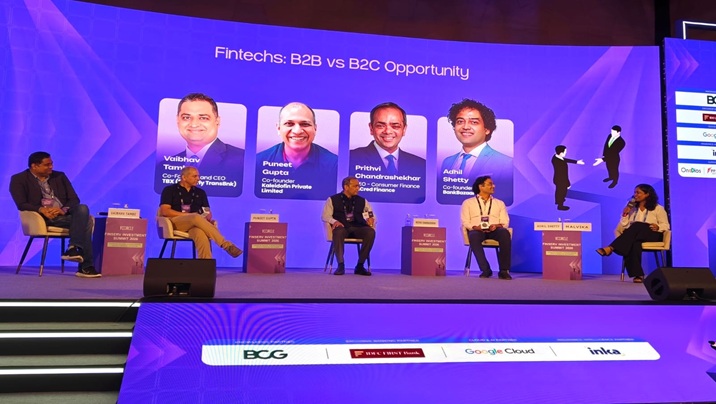
New Delhi, Sept. 21 -- Building a business-to-consumer (B2C) company in the financial services sector offers a much larger value-creation opportunity but requires significantly more capital and carries higher risks than a business-to-business (B2B) company, industry executives said during a panel discussion at the VCCircle Finserv Investment Summit 2026 in Mumbai on Friday.
While B2B fintech models can offer more predictable economics through sticky enterprise relationships, panellists said the larger value-creation opportunity lies with businesses that can build a strong consumer brand and own the customer relationship.
"There will be a lot more value in B2C. That's a minority view, but the way I see it is that the giants in every ecosystem will be B2C brands," said Prithvi Chandrasekhar, chief executive of consumer finance at InCred Finance.
"The problem with going after B2C is it's very expensive, both in terms of burning money on the way to getting there, and in terms of mortality risk (even after burning that much money), and that's scary when we're starting up a company," he added.
The panel on 'Fintechs: B2B vs B2C Opportunity', also included Vaibhav Tambe, co-founder and CEO, TBX (formerly known as TransBnk); Puneet Gupta, co-founder, Kaleidofin; and Adhil Shetty, co-founder and CEO, BankBazaar.
"What we've realized is it's one thing to have a consumer, but you need to know a lot about the consumer to be able to engage her (things such as financial history and their credit background), because as a D2C platform, unless the consumer is on your platform every quarter, you're not going to be able to cross-sell," said Shetty.
The panellist also agreed that there is value to be created both in providing the product that the consumer buys and in providing the infrastructure that supports it. Institutions that have scaled up over the last decade have tried to create value across the entire value chain.
"The next best thing, if you are not able to get into a B2C investment, is basically to get into something which is specialized - by creating an IP - which is not an undifferentiated product that exists out there," said Gupta.
The panellists said defensibility in the B2B business, which may look "safe" in theory, requires patient IP-building, not just distribution contracts. While B2C is capital-intensive, B2B needs time to build trust, and neither is easy money.
"Selling in B2B is going to be difficult because there is going to be resistance from incumbents. A large amount of effort should go from understanding what the customer needs, and empathy is what typically has to be a core of B2B," said Tambe, adding that the lack of "touch-and-feel" makes it less intuitive for investors to back such products.
The panel agreed that if a founder pursues a B2C opportunity, it is important to have large investors and sufficient capital to fuel the burn. Whether it is B2B or B2C, founders should align investor expectations with the model's time horizon and burn profile to avoid systemic risk.
Published by HT Digital Content Services with permission from VC Circle.