
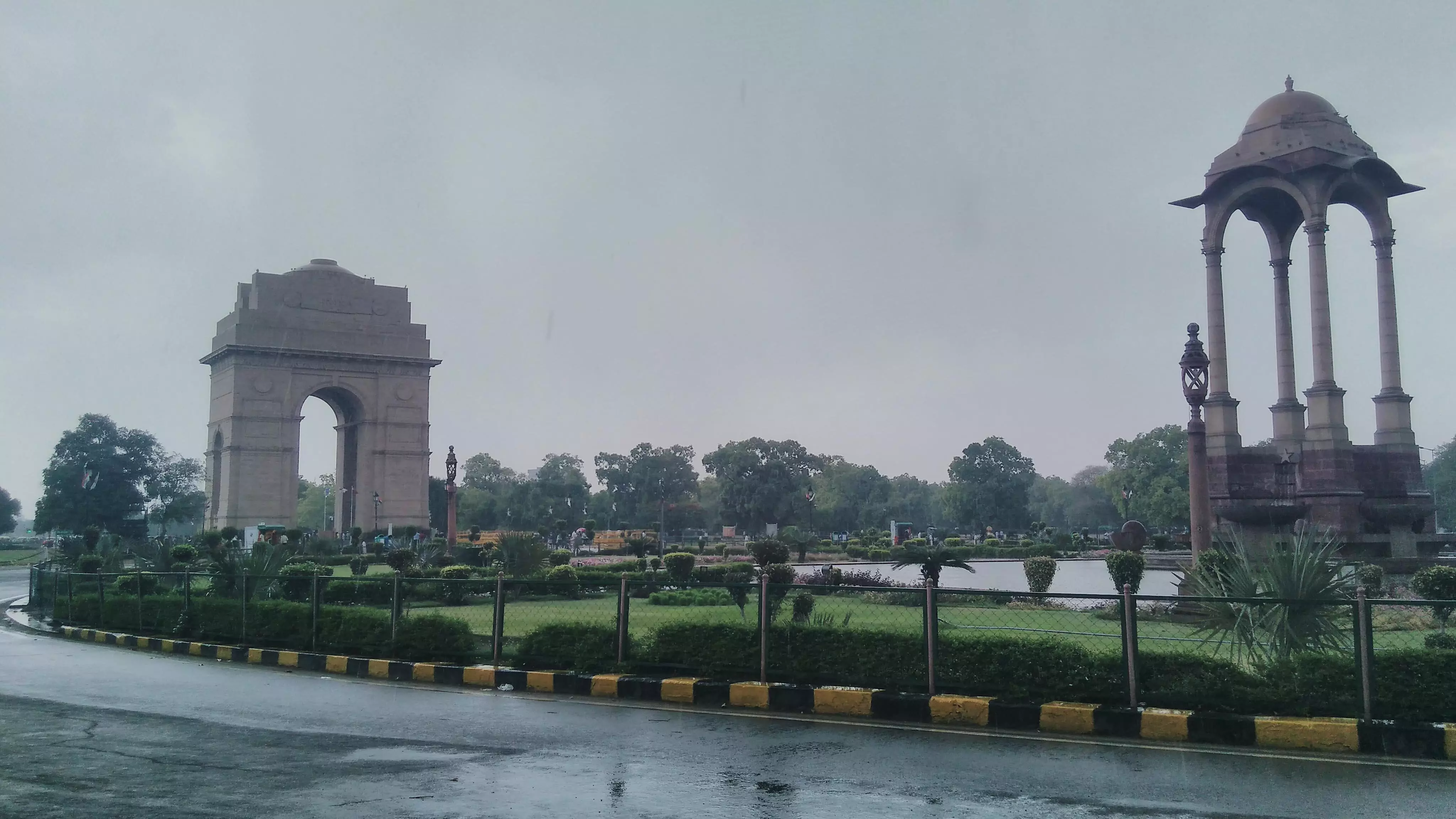
New Delhi, Sept. 7 -- Delhi, a city that continues to struggle with some of India's worst air pollution during winter, has climbed to the 21st position in the Centre's Swachh Vayu Sarvekshan 2026, ranking ahead of cities such as Bengaluru, Srinagar, Mumbai, Chennai and Kolkata. The latest survey, released by the Union Environment Ministry on Monday, recognises cities for their pollution control measures and implementation under the National Clean Air Programme (NCAP), rather than ranking them by current air quality levels. Uttar Pradesh's Lucknow secured the top position among cities with populations above 10 lakh.
The fifth edition of the Swachh Vayu Sarvekshan assessed 130 NCAP cities across three population categories. The evaluation was carried out through self-assessments by cities, scrutiny by state-level monitoring committees, review by the Central Pollution Control Board, and field verification by independent teams.
Lucknow topped the million-plus city category with 198 points, narrowly ahead of Indore, which scored second after leading the rankings last year. Jabalpur finished third with 195 points, while Bhopal and Agra shared fourth place with 192 points each.
Delhi scored 172 points and shared the 21st rank with Visakhapatnam. Patna performed better than the national capital, finishing 16th with 178 points, while Hyderabad ranked 19th. Delhi also placed above Srinagar, which ranked 26th with 162.6 points, Mumbai at 28th with 160.8 points, Bengaluru at 32nd with 152.6 points, Chennai at 35th with 147.7 points, and Kolkata at 38th with 142.2 points.
The survey measures cities on actions taken to improve air quality, including road dust control, solid waste management, management of construction and demolition waste, reduction of vehicular and industrial emissions, and public awareness campaigns. This means a city can rank higher if it has shown stronger implementation of pollution control measures, even if its air remains heavily polluted.
Delhi's rise is notable because its air quality remains poor. The capital's Air Quality Index frequently crosses 400 during winter, entering the "severe" category, and at times exceeds 450. In January 2026, authorities activated Stage IV of the Graded Response Action Plan after pollution levels reached the highest category.
The ministry said 2025 was Delhi's best year for particulate pollution since 2018, excluding the Covid-affected year of 2020. Even then, the city's annual average PM10 concentration stood at 198 micrograms per cubic metre and PM2.5 at 97 micrograms per cubic metre, both well above India's annual standards of 60 and 40 micrograms per cubic metre, respectively.
Delhi had ranked 32nd in the 2025 edition of the survey with a score of 157.3, making this year's performance a significant improvement in terms of implementation.
In the category of cities with populations between 3 lakh and 10 lakh, Rourkela in Odisha secured the top position. Firozabad in Uttar Pradesh and Guntur in Andhra Pradesh shared second place, while Amravati in Maharashtra finished third. At the lower end of this category were Gaya, Gulbarga, and Jalandhar.
Among cities with populations below 3 lakh, Odisha dominated the rankings. Kalinga Nagar topped the list, followed by Angul and Talcher. The lowest-ranked cities in this category were Kohima, Dera Bassi, and Byrnihat.
Speaking at the awards ceremony, former Calcutta High Court Chief Justice Prakash Shrivastava said, "The awardees have shown that clean air is not an aspiration but a practical goal that can be achieved with proper planning and ground-level implementation." He added that development and environmental conservation can progress together while improving citizens' quality of life.
The ministry also released a Compendium of Best Management Practices under NCAP, documenting successful measures adopted by cities and state pollution control boards in controlling road dust, industrial emissions, vehicular pollution, and waste management.
According to the ministry, 108 of the 130 NCAP cities recorded lower PM10 levels in 2025-26 compared with the 2017-18 baseline. Of these, 72 cities reduced PM10 concentrations by more than 20 per cent, 26 cities achieved reductions above 40 per cent, and 14 cities met the National Ambient Air Quality Standards.
Published by HT Digital Content Services with permission from Millennium Post.