
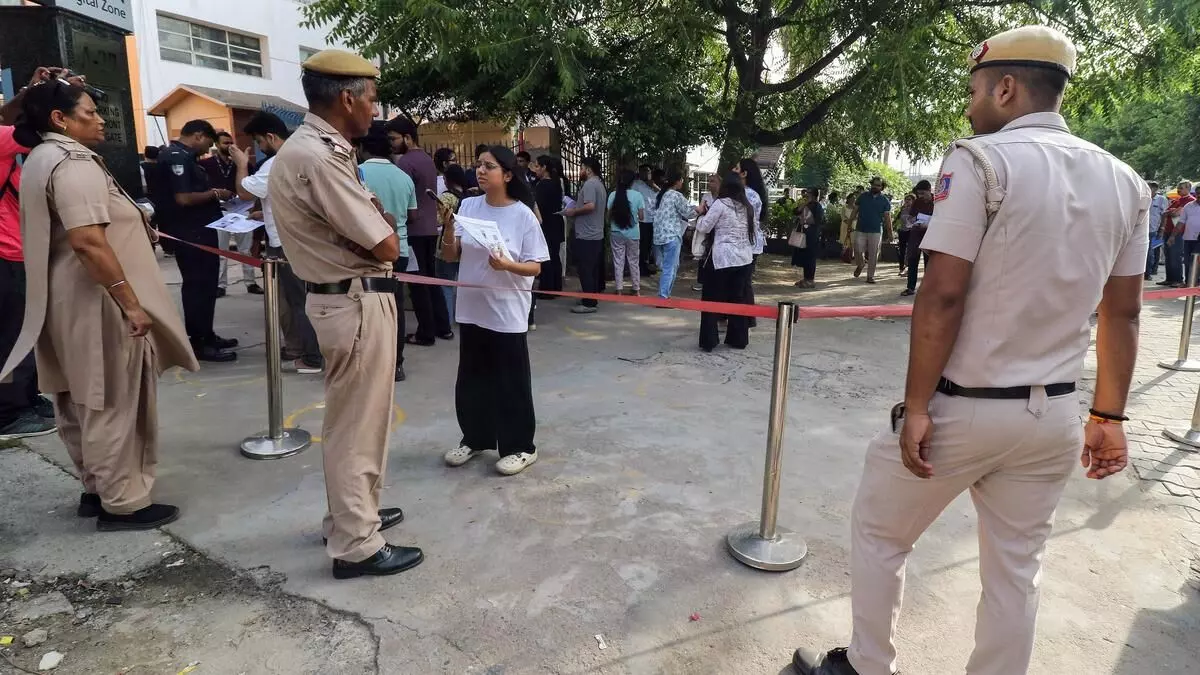
New Delhi, Sept. 27 -- The National Testing Agency (NTA) has moved its confidential and sensitive operations to a new office in central Delhi, where 39 Central Industrial Security Force (CISF) personnel have been deployed to strengthen access control and security following controversies over examination paper leaks and administrative lapses.
The new facility, spread across more than 55,000 square feet in the Government of India Press Building on Minto Road, has been allotted space on the fifth floor and parts of the fourth and sixth floors. A senior official said the NTA shifted its confidential operations to the building over the past month.
The Home Ministry has approved CISF security for the premises, with personnel deployed at entry and exit points to regulate access to confidential areas. Security measures will include frisking, X-ray baggage screening machines and Door Frame Metal Detectors.
"The CISF is being deployed at suitable locations at all the entry and exit points for monitoring and regulation of access into the confidential area," the official said.
The move follows serious concerns over security arrangements at the NTA's previous office in Okhla. According to a CBI chargesheet in the NEET-UG paper leak case, three subject experts allegedly acted as primary sources of the leaked paper. The chargesheet said there was no checking or frisking of experts entering or leaving the confidential section, allowing them to carry portions of the question paper written on small chits made from plain sheets supplied for rough work and translation.
The CBI also found that the NTA office did not have a dedicated control room for live monitoring of CCTV footage, allowing the activities of the accused experts to go unnoticed.
The NEET-UG paper leak triggered nationwide protests and led to the resignation of then Union Education Minister Dharmendra Pradhan. A day later, Prime Minister Narendra Modi announced a high-powered task force headed by Infosys co-founder Nandan Nilekani to recommend reforms to make examination systems more secure. The panel has not yet submitted its report.
The latest security measures also come after the Supreme Court criticised the NTA following the 2026 paper leak, observing that the agency "has not learnt its lessons".
The NTA, established in 2017 under the Ministry of Education to conduct fair, transparent and standardised examinations, is also working on technical safeguards. These include stricter access controls, encryption standards, immutable logging and tamper-evident storage for examination-critical systems.
The agency plans security readiness reviews of systems before every examination cycle, covering areas such as candidate registration, admit cards, computer-based testing, OMR processing, result systems and examination-day workflows. The measures will also include biometric authentication, face matching, CCTV and live monitoring. The NTA is preparing examination-specific cyber-incident response arrangements, including enhanced Security Operations Centre monitoring and rapid-response capabilities on examination days.
A dedicated chief information security officer has also been planned. The post of general manager and CISO has been advertised, and the selection process is at an advanced stage, the official said. Independent cyber-security audits by CERT-In and C-DAC-empanelled agencies are also continuing.
The NTA had previously been the subject of a high-level review after the 2024 NEET paper leak. A committee headed by former ISRO chairman K Radhakrishnan had recommended stronger security controls covering question paper systems, registration, payment, admit cards, testing platforms, OMR processing, normalisation and results.
The Government of India Press Building already has CISF security in other areas. The NTA's new arrangement makes it one of the examination-related establishments receiving such protection, alongside the Union Public Service Commission, which conducts recruitment examinations.
Published by HT Digital Content Services with permission from Millennium Post.