
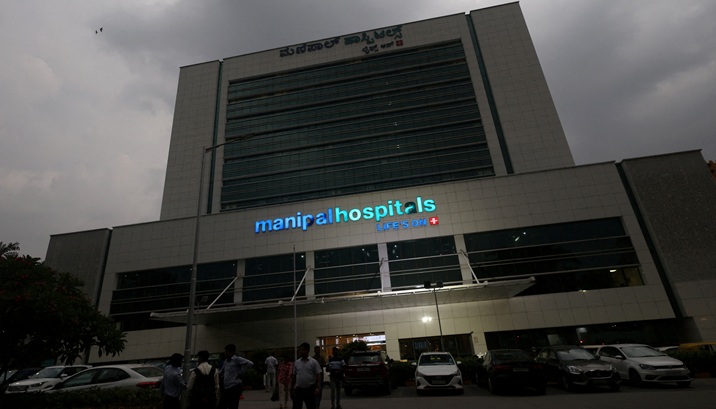
New Delhi, July 24 -- Singapore state investor Temasek is set to generate strong returns from its partial exit from hospital operator Manipal Health Enterprises Ltd even as the latter seeks a lower valuation than initially estimated in its initial public offering (IPO).
Temasek, along with US private equity firm TPG, two sovereign wealth funds, a US-based pension fund, a Danish investment firm, and the Manipal Group, will pare their stakes through the IPO.
The operator of Manipal Hospitals has now filed its red herring prospectus (RHP) with the Securities and Exchange Board of India (SEBI). While the fresh issue remains unchanged at Rs 8,000 crore ($828 million), the offer-for-sale (OFS) has been reduced to around 21.61 million shares from 43.23 million shares proposed in its draft red herring prospectus (DRHP) filed in March.
On Friday, the company set the price band at Rs 560-590 per share. The IPO size now is Rs 9,275 crore (about $960 million). At the upper end of the price band, Manipal Health is eyeing a post-listing market capitalisation of Rs 77,606 crore ($8.04 billion), according to VCCircle's estimates.
Apart from Manipal Education and Medical Group India Pvt Ltd and Temasek, the other selling shareholders are TPG, Brunei Investment Agency, Abu Dhabi's Mubadala Investment Company, the California Public Employees' Retirement System (CalPERS), and Denmark's Novo Holdings.
Temasek owns a 50% stake in Manipal Health, while Manipal Group chairman Ranjan Pai and various group entities together hold 31.4%. TPG owns 10.34%, Mubadala 3.67%, Novo 1.22%, CalPERS 1.02% and Brunei Investment Agency 1.88%, according to the prospectus. Ahead of the IPO, TPG scooped up Rs 30 crore by selling about half a million shares to the Manipal Group at a deeply discounted price.
The company plans to use Rs 5,552 crore from the fresh issuance to repay debt, Rs 574 crore to buy a minority stake in step-down subsidiary Sahyadri Hospitals Pvt Ltd, and the balance for general corporate purposes.
This would be Temasek's fifth exit move from its India portfolio this month. Previously, it has clocked partial or full exits from auto marketplace CarTrade, drugmaker Integrace, Policybazaar parent PB Fintech, and eyewear retailer Lenskart.
Temasek's bet, estimated returns
Temasek first acquired a stake in Manipal Hospitals in 2017 from PE firms True North and Faering Capital, picking up around 18.1% of the company. The deal gave the hospital chain an enterprise value of $1.14 billion.
In 2023, the Singapore firm took a controlling stake in Manipal Health by buying out India's National Investment and Infrastructure Fund (NIIF) and picking up part of the stake held by TPG.
In 2024, Temasek sold an 8% stake in the company to a consortium of investors, including Mubadala Investment Company, Novo Holdings, and CalPERS. This brought down Temasek's stake in Manipal Health to 50% from nearly 59%.
Overall, Temasek has invested around Rs 17,880 crore in Manipal Health via its three entities, according to VCCircle's calculations. One entity harvested Rs 3,205 crore through the partial exit in 2024. The second entity, Imperius Healthcare, will now pare its stake through the IPO.
Temasek, through Imperius Healthcare, invested a total of Rs 1,440 crore in Manipal Health between 2017 and 2024. A bulk of this amount, almost Rs 1,095 crore, was deployed in 2017. Imperius Healthcare owns a 17.77% stake in Manipal Health. This is valued at around Rs 12,366 crore at the upper end of the price band set on Friday. The partial exit will fetch Rs 637.7 crore in the IPO for the Temasek entity.
Back-of-the-envelope calculations show that the partial exit will generate a multiple on invested capital (MOIC) of 10x and an internal rate of return (IRR) of around 30% in rupee terms. This is the higher end of the 20-30% IRR return that private market investors typically target in local currency. In dollar terms, the MOIC would be around 6.7x, while the IRR would be around 24% due to the rupee's depreciation over the years, VCCircle's estimates show. This is still above the 15% dollar benchmark.
Background, IPO plans
As of September 30, 2025, Manipal Health operated 48 hospitals in India, totalling 12,367 licensed beds. In July 2025, it had agreed to acquire Pune-based Sahyadri Hospitals. With the acquisition, Manipal Health added 1,606 beds to its network as of October 2025. By 2030, the company plans to add about 483 licensed beds across its existing hospitals and 1,943 licensed beds through greenfield projects to support its next phase of growth.
Speaking at a press conference ahead of the IPO, managing director and CEO Dilip Jose said the company aims to add around 3,000 beds over the next four-five years and invest around Rs 4,000 crore in capital expenditure across brownfield and greenfield expansion. The company's total licensed bed capacity is likely to increase to around 15,500 beds by 2030, Jose said, adding that Manipal Health expects to become net-debt zero following the IPO.
For the six months ended September 30, 2025, Manipal Health's revenue from operations stood at Rs 4,713 crore, with a net profit of Rs 571.8 crore.
A person familiar with the matter told VCCircle in March that the company could target a valuation higher than Max Healthcare's, but didn't specify the exact level. Media reports at the time estimated the company's target valuation at around $12-15 billion. Bloomberg said in March that Manipal Health could chase a valuation of $13 billion. At that valuation, the IPO size would exceed Rs 12,000 crore and Manipal Health would have become the biggest hospital operator in India by market value, according to VCCircle's estimates.
Apollo Hospitals is currently the top-listed hospital chain with a valuation of Rs 126,703 crore, followed by Max Healthcare, with a market capitalisation of Rs 105,103 crore. Fortis Healthcare, controlled by Malaysia's IHH Healthcare Bhd, is the third-largest listed hospital chain, with a market value of Rs 71,419 crore, according to stock exchange data.
In FY26, Manipal Health recorded 25% growth in revenue from operations to Rs 10,335 crore, with a net profit of Rs 916 crore, according to its prospectus. Karnataka is the company's largest market, with it deriving more than 43% of its revenue from the southern state. Eastern India accounts for around 21%, the rest of India over 18%, and Maharashtra and Goa more than 16%.
Published by HT Digital Content Services with permission from VC Circle.