
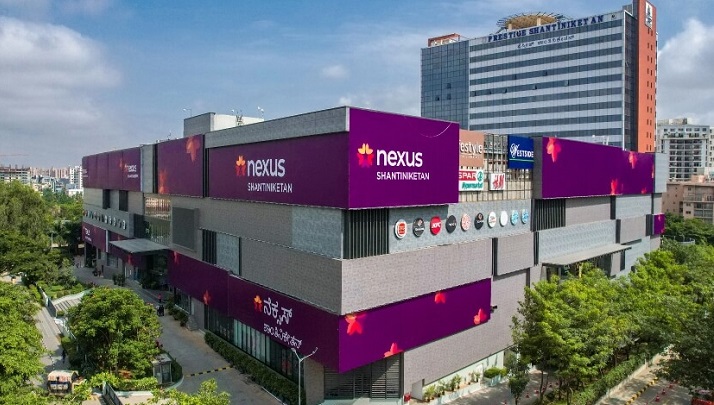
New Delhi, June 24 -- For most of its existence, Nexus Select Trust has been a creature of India's north, west, and south. The Blackstone-backed real estate investment trust, India's first and only listed retail REIT, built a formidable portfolio of Grade-A malls in markets it knew well. East of Nagpur, it had almost nothing: a single mall in Bhubaneswar and little else to show for a geography that accounts for a meaningful share of the country's consuming population.
Nexus now wants to change that, and the way it is going about it reveals both the ambition and the complications of a trust that has set itself a demanding five-year growth target.
The eastern bet
In April this year, Nexus announced the acquisition of Diamond Plaza, a small neighbourhood mall in Kolkata, for Rs 347.5 crore ($37.5 million then), with the transaction expected to close in the first half of FY27. The asset is modest, roughly 0.2-0.3 million square feet, and not inexpensive on a per-square-foot basis. Its rationale is primarily strategic: a bolt-on to South City Mall, a far larger Kolkata asset that currently sits on Blackstone's balance sheet rather than inside the REIT.
South City is the more complicated story. Blackstone acquired it in June 2025 for Rs 3,250 crore ($376.8 million then) as part of a multi-asset deal that also included Sri Lankan residential inventory because the seven vendor families holding stakes in the combined special purpose vehicle (SPV) refused a piecemeal exit that would have created tax leakage for them.
The REIT could not participate directly. The Securities and Exchange Board of India's (SEBI's) rules bar listed REITs from holding foreign assets.
The stated plan is to divest or demerge the overseas holdings and then transfer South City to Nexus. Two paths are being pursued: a formal demerger or an outright sale of the foreign assets, whichever closes first. Neither has a disclosed timeline. Until one of them is completed, South City is an asset that benefits the sponsor but not the REIT's unitholders.
For investors, this creates a real visibility problem. The Diamond Plaza acquisition implicitly prices in a future two-mall Kolkata play - shared management, cost synergies, tenant mobility across both properties - that remains contingent on a process Nexus neither controls nor has publicly committed to a timetable for.
Beyond Kolkata, the trust is evaluating assets in tier-II eastern cities, including potentially Guwahati, through unit-swap structures in which sellers receive REIT units in lieu of cash. The management estimates total consideration for four to five near-term acquisitions, including the eventual South City transfer, at Rs 5,000-6,000 crore, with roughly Rs 2,000 crore in cash and the rest in units.
Swap deals are capital-efficient on paper. They also introduce unitholder dilution and depend on sellers in relatively nascent markets valuing the trust's units at levels that make the exchange worthwhile.
The numbers
The eastern push comes against a backdrop of solid, if not flawless, operating performance. For FY26, Nexus posted revenue from operations of Rs 2,568 crore and net operating income of Rs 1,929.6 crore, up 13% from the previous year. Tenant consumption rose 19% in the fourth quarter to Rs 3,510 crore, driven by fashion, beauty and personal care, jewellery, and entertainment.
The portfolio was independently valued at Rs 30,558 crore as of March 2026. The trust has maintained 97% occupancy for 12 consecutive quarters since its May 2023 listing.
The headline metrics carry one notable blemish. In Q4 FY26, consolidated net profit collapsed 91% quarter-on-quarter to Rs 12.18 crore, driven by an effective tax rate of over 93%, a deferred tax liability that the management attributed to accounting timing rather than any operational deterioration.
As of December 2025, the trust's gross debt stood at Rs 6,088 crore, with a comfortable loan-to-value (LTV) ratio of 21% on a gross basis and 18% on a net debt basis, providing considerable financial flexibility, according to ICRA.
The trust met its FY26 distribution guidance of Rs 9.1 per unit and is guiding for FY27 NOI of Rs 2,050-2,070 crore, and distribution per unit of Rs 9.8-10.
The structural disadvantage
The comparison that follows Nexus most persistently is with Phoenix Mills, a developer-operator not obligated to distribute 90% of its cash flows. Phoenix retains and reinvests. Markets reward that: Phoenix trades at roughly six times book value, while Nexus trades at about 1.75 times. The gap reflects reinvestment optionality that the REIT structure, by regulatory design, does not fully provide.
Nexus's management acknowledges this. One person with direct knowledge of the trust's thinking said the REIT structure anchors the market's perception of the vehicle as a yield product rather than a growth compounder.
The management's counterargument is that the valuation gap should narrow with a longer listed track record. Phoenix built its portfolio over 25-30 years, while Nexus reached comparable scale in around a decade.
At the margin, conditions are improving. The Reserve Bank of India (RBI) recently permitted banks to lend at the REIT level rather than only through individual SPVs, which should modestly lower borrowing costs. The trust is also reportedly in discussions with the International Finance Corporation (IFC), the private sector investment arm of the World Bank Group, for a Rs 2,000-crore green financing facility, a potential diversification of its lender base and recognition of its more than 60 MW solar portfolio across its malls.
The Blackstone question
Blackstone held roughly 43% of Nexus at listing and cut that to around 21% via a block deal in August 2024, selling 31.55 crore units at Rs 138 apiece for Rs 4,355 crore. A June 2026 exchange filing showed that the sponsor group had pledged 22.8 crore units, about 15% of the outstanding units, as collateral. Lock-in periods on part of the residual stake have now expired.
The market has been speculating about a full exit ever since.
The structural case against such an exit rests on three factors. Retail real estate is operationally intensive, and Nexus's management team carries knowledge that does not transfer cleanly if the sponsor walks away. Blackstone holds South City with the stated intention of transferring it to Nexus; exiting the REIT while sitting on an asset earmarked for it creates an obvious misalignment. Further, FDI regulations impose a three-year lock-in on Blackstone's June 2025 South City acquisition, meaning any transfer to Nexus before mid-2028 would have to be structured as a unit swap, keeping Blackstone's interests in the trust alive regardless of intent.
Partial dilution to manage fund life cycles remains plausible. However, a complete exit, finding a willing sponsor of comparable scale for India's only listed retail REIT, is a harder proposition than market chatter sometimes implies.
Can Nexus get to 30 malls?
India has approximately 140 Grade-A malls, of which 60-70% are held by institutional players such as Phoenix, DLF, Prestige, and Brigade, none of which appears to have any evident motivation to sell. The addressable universe is, generously, around 60-70 assets.
Getting from 20 malls today to over 30 by FY30 means roughly three acquisitions a year for four consecutive years in a market where deal flow is episodic and the most important pending transaction, South City, still has no confirmed timeline.
The trust's execution record in operational acquisitions is solid. Vega City in Bengaluru, bought for Rs 913 crore at a 10% discount to independent valuation in February 2025, was delivering 20% tenant sales growth within two quarters. The Chandigarh bolt-on was clean and quick. These are tractable deals.
Dombivali is different. The 0.7 million square feet under-construction mall in the Mumbai Metropolitan Region (MMR), tied up with Runwal Enterprises and expected to enter Nexus's books around FY29-30, involves genuine development management at a scale the trust has not previously attempted.
Construction risk, leasing risk on a blank-canvas asset and the distribution drag of capital locked in a non-income-producing project for several years are all real. The management describes it as a learning exercise as much as an investment, an honest framing, if not an unequivocal one.
Nexus Select Trust is a well-run business producing consistent income from a quality asset base. Its AAA/Stable credit rating, transparent governance, and three-year operating track record are genuine strengths.
However, the distance between that reality and the FY30 targets is substantial, and closing it requires a South City transfer on the sponsor's timeline, swap sellers in markets where the trust is still establishing itself, and a development outcome that will not be visible for years.
The ambition is legitimate. The execution, at this point, remains a projection.
Published by HT Digital Content Services with permission from VC Circle.