
New Delhi, Aug. 21 -- "Strategy is important, but execution and daily operational discipline are what ultimately determine market leadership in high-growth economies."
India's next phase of business growth may be decided by something less glamorous than funding, market share or brand visibility: how well a company runs when nobody is watching. As competition gets sharper and capital becomes more closely examined, the gap between businesses that grow and businesses that grow profitably is increasingly being created inside the organisation in procurement, inventory, finance, sales, production and people management.
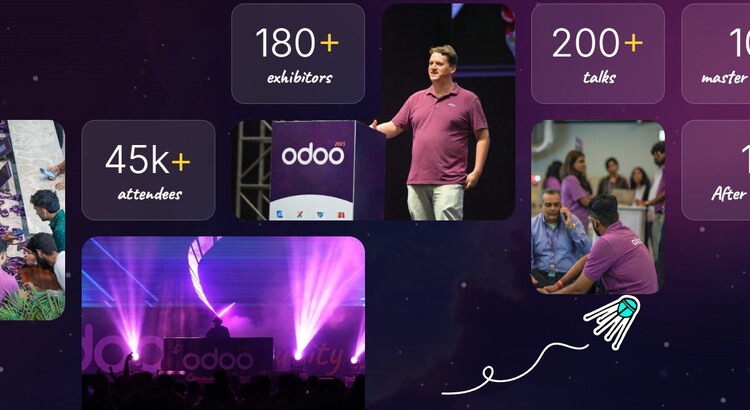
That is why conversations around enterprise technology are moving beyond digitisation for its own sake. Odoo Experience 2026, scheduled for September 11-12 in Gandhinagar, is tapping into this shift by bringing together business leaders, technology professionals and practitioners around more than 200 talks, workshops and expert sessions. Its master classes also go deeper into manufacturing, accounting, inventory and point-of-sale operations areas where small inefficiencies can quietly become high costs.
Growth Without Operational Control Has a Ceiling
The first step towards better operations is not buying another piece of software. It is understanding where time, money and information are being lost. A CEO should be able to answer relatively simple questions: How long does it take to convert an order into cash? Where is inventory accumulating? Which customers are profitable after servicing costs? How much working capital is tied up in slow-moving stock? Which processes still depend on spreadsheets, emails or repeated manual approvals?
This is where integrated business systems become useful. Their value is not simply that they replace paperwork. It is that they connect activities that were previously managed as separate functions. When sales, inventory, purchasing, accounting and production draw from the same underlying information, management gets a clearer picture of what is actually happening.
The Real Cost Is Often the Cost of Fragmentation
Indian businesses are also becoming more careful about the economics of enterprise technology. There are several strong enterprise platforms in the market, each with different strengths. The challenge for a growing company is that using several specialised systems can sometimes mean paying separately for applications, integrations, implementation and maintenance. The technology bill may therefore be only one part of the cost.
This is one area where an integrated approach can have an advantage. Odoo, for instance, currently offers its Standard and Custom plans with access to its broader application suite under a single subscription rather than pricing each application separately. For businesses that would otherwise assemble multiple tools, that model can make the overall technology stack more cost-conscious. The larger lesson, however, is not about one vendor. It is about reducing the number of places where information can get lost.
Better Operations Begin With Better Questions
Technology can expose inefficiency, but it cannot decide what a business should stop doing. That remains a management responsibility. Companies looking to improve operations should start with a process audit. Identify the five workflows that consume the most employee time. Map where approvals slow down. Track how often the same data is entered into different systems. Measure inventory ageing, order turnaround time, receivables and procurement cycles.
The next step is standardisation. If every branch follows a different process for purchasing or expense approvals, software will simply digitise inconsistency. Operational discipline requires businesses to first agree on the process and then automate it. The third step is accountability. Dashboards are useful only when someone owns the number. A delayed purchase order, excess stock or overdue receivable should trigger a decision, not simply appear on a screen.
The Advantage Will Belong to Businesses That Waste Less
This makes operational discipline a competitive issue rather than merely an internal management exercise. A company that turns inventory faster can deploy capital elsewhere. One that closes its books faster can make decisions sooner. One that has a clearer view of customers can allocate sales resources better. One that automates repetitive work can allow employees to spend more time on decisions that require judgement.
The competitive advantage, therefore, is not necessarily having the most sophisticated technology. It is having technology that employees actually use, and management can act upon. That is also the thinking behind Odoo Experience 2026. Beyond product demonstrations, its programme brings together practical workshops, expert discussions and business-focused sessions designed around how organisations can improve processes and use technology more effectively.
"Operational excellence is not an anchor that holds a business back; it is the launchpad that allows it to scale safely."
From Digital Adoption to Operational Discipline
India's technology story has often been told through the lens of adoption: how many businesses are moving to the cloud, using AI or digitising workflows. The next chapter could be more consequential: how much better those businesses operate because of it. For CEOs, the priority should be simple. Do not digitise every process simply because technology allows it. Find the bottlenecks, measure them, redesign the process and then use technology to make the improvement repeatable.
The companies that emerge strongest from India's next growth cycle may not be those with the largest technology budgets. They may be the ones that know exactly where every rupee, hour and decision is going and have built the discipline to make each work harder.
Unified Operations. Seamless Execution with Sustainable Scale.
Published by HT Digital Content Services with permission from VC Circle.