
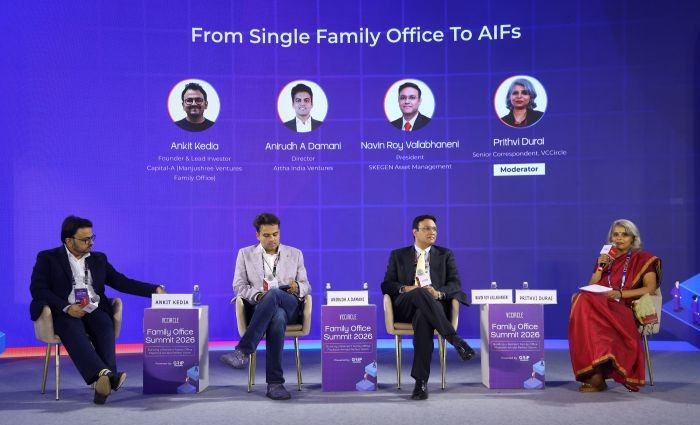
New Delhi, July 29 -- Family offices looking to switch to alternative investment funds must have substantial capital pools to deploy to ensure better deal flow, said panellists at the VCCircle Family Office Summit.
The panellists discussing the topic 'From Single Family Office To AIFs' included: Anirudh Damani, managing partner at Artha Venture Fund; Ankit Kedia, founder and general partner at Capital-A and Navin Roy Vallabhaneni, president, Skegen Asset Management.
Vallabhaneni, whose firm is backed by Bharat Biotech's Family Office, said firms looking to transition to AIF structures must create larger pools of capital to deploy.
"Today, if you want to get into a good deal, you need to have size, otherwise, nobody will even call you for a meeting. So I would say that [a large capital pool] is extremely important. If you're not able to deploy your capital, there's no point in having an AIF," he said.
Damani noted that a committed pool of capital from the family not only helped source good deals but also improved returns.
"I realised that the change was that I had a lot more capital at hand, which was committed. It wasn't just our capital, we're [only] 20% owners of most of our funds, but we also had a lot more capital available to commit to a founder... That actually got us deals at better prices, and then got us better deals because we could also double down," he said.
Damani added that Artha Ventures' first fund's net asset value had multiplied 7x in less than six years.
Vallabhaneni said another enabling factor for him has been the autonomy that the Bharat Biotech family has given him over investment decisions.
"You will find in many businesses, [there are] a lot of 'yes men'. There will be very few people who want to go against the promoter. And luckily, this family has given me the freedom to go against them when required. I make mistakes as well, and they correct me. So we have a very healthy relationship, which has helped us make some of the investment decisions so far," he said.
Drawing LPs, ensuring their rights
The panelists also spoke about how to draw limited partners (LPs) and ensure that every LP has a voice in decision making.
Capital A's Kedia, whose family exited the packaging firm Manjushree Technopak in 2024, said that a strong focus on thematic funds was essential to garner LP attention.
"The approach that we've taken for our fund is we want to raise it ourselves and not appoint distribution partners. That's because if you're running a thematic fund, you have your ecosystem of industrialists and peers who have operated in this industry, and you've had a successful exit. And if they don't believe in that vision, then something is definitely wrong with either your investment focus or with how you are positioning the thesis," he said.
Damani, from Artha Venture Fund, elaborated on the importance of setting up investment committees to ensure that no LP dominates decision making. He said the firm has created an investment committee of four members for each of his funds to filter out biases.
"We created a structure that ensured that, while I should be able to influence a decision, I cannot be the sole decider of a decision, and the team can put up a red flag whenever they want," Damani said.
Kedia echoed this opinion and added that the investee company's founder too has a responsibility of upholding a fund's vision, which needs to seep down to the operating team.
Published by HT Digital Content Services with permission from VC Circle.