
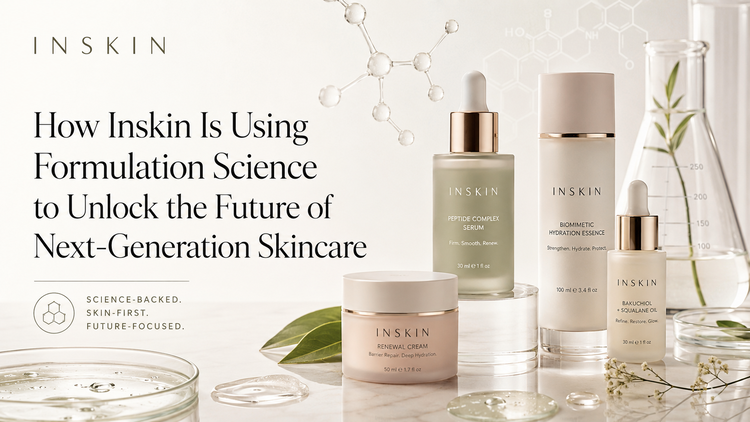
New Delhi, July 24 -- As biotech-inspired beauty accelerates, Inskin's formulation-first approach signals a new wave of IP-led, science-backed skincare innovation attracting rising PE-VC interest.
The New Science of Skin Health
Healthy skin is more than a matter of appearance. It's an intricate, living interface that protects the body, regulates hydration and houses trillions of microbes that shape immunity and aging. Dermatologists and biochemists often trace "the hallmarks of healthy skin" to a few key parameters - an intact barrier, balanced sebum production, optimal hydration, pigmentation and a resilient microbiome.
Yet achieving and maintaining these benchmarks is more complex than ever. Urban lifestyles, digital exposure, pollution and stress continuously strain skin health. As a result, the $160 billion global skincare market is racing toward more targeted, scientifically driven solutions. In this evolution, one emerging discipline stands out as both the engine of innovation and the moat for new brands: Formulation Science.
Moving Beyond Topical Promises
Modern skincare has long revolved around creams, serums, facial oils, under-eye treatments, and cleansing formulations addressing concerns like acne, pigmentation, dehydration, and aging. But the new generation of products is different. They're driven less by marketing and more by molecular efficacy. Where once ingredients like Hyaluronic acid or Vitamin C were buzzwords, formulation scientists are now deconstructing how these actives behave in skin, not just what they claim to do. It's about understanding what is anti-oxidative, barrier repair, cell renewal, pigmentation control, and sebum modulation and ensuring actives reach the right layer of the skin in the right dose.
"Skincare science today is where drug delivery science was two decades ago," observes Dr. Deepak Chitkara, Professor at BITS Pilani and founder of advanced science-driven skincare brand Inskin. "The challenge isn't about discovering new molecules - it's about delivering proven ones effectively, safely, and sustainably."
The Chemobiology of Everyday Skincare
At its core, Effective skincare formulation rests on 6 major functional blocks:
1. Hydrating and barrier-repair agents including Ceramides, Natural moisturizing factors (NMFs), Glycerin and Squalane that strengthen the Stratum Corneum.
2. Skin-renewal and exfoliating molecules such as Retinoids, Alpha-Hydroxy acids (AHAs) and Polyhydroxy Acids (PHAs) that accelerate cellular turnover.
3. Antioxidants and free radical scavengers like Vitamin E, Niacinamide and Green tea Polyphenols that defend against oxidative stress.
4. Pigmentation and tone regulators - Kojic acid, Arbutin and Resorcinol derivatives that help achieve even complexion.
5. Sebum regulators - Zinc derivatives or botanical extracts that help oily or acne-prone skin rebalance production.
6. Microbiome Harmonizers - Prebiotics and Postbiotics that restore the skin's natural microbial ecosystem, critical to immunity and resilience.
But these ingredients alone don't define efficacy. How they are combined and how deeply and evenly they penetrate determines the outcome. This is where formulation science becomes the true differentiator.
The Convergence of Pharma Logic and Cosmetic Appeal
Over the past decade, Cosmetic Chemistry has begun borrowing heavily from pharmacology. The concept of combination therapy using multiple agents in synergistic balance has entered skin formulations, aiming for complementary rather than compensatory effects. For instance, an anti-aging serum may blend Antioxidants that neutralize reactive oxygen species with peptides that stimulate Collagen biosynthesis and Humectants that maintain hydration. Alone, each may show mild improvement; together they can shift the anti-aging trajectory measurably.
"Synergism is a concept the pharma world mastered early," explains Dr. Chitkara. "We're now translating that rigor into skincare so that ingredients don't just coexist, they co-function."
This scientific transposition marks one of the largest value-creation opportunities in the beauty and wellness landscape where Cosmeceuticals meet Biotech.
Cracking the Skin Barrier Without Breaking It
The human skin, particularly the Stratum Corneum, is an evolved fortress. It keeps water in and external aggressors out. But that same structure is what limits the absorption of beneficial actives. Traditional creams and lotions often fail to get beyond the surface, meaning expensive ingredients deliver minimal real benefit.
The industry's latest advances are changing that calculus. Smart delivery systems developed originally for Pharmaceuticals such as Liposomes, Micelles, Nanoemulsions and Polymeric nanocomplexes now form the backbone of next-generation skincare.
Recent studies in RSC Advances described the use of Lipo-Polymeric nano-complexes capable of transporting protein-based actives across the skin barrier effectively, achieving over 50% permeation in ex vivo models after 24 hours, without disrupting skin integrity (pubs.rsc.org). This fusion of nanotechnology and dermatology makes previously "undeliverable" actives feasible for topical application.
Advances like these are central to Inskin, the line commercialized by Inskin, Dr. Chitkara's first venture. The products are powered by a proprietary nano-carrier platform designed to enhance stability, dermal permeation and bioavailability of actives, all this while maintaining cosmetic elegance. The brand's "Skin Science" philosophy emphasizes restoring balance through cellular-level nourishment rather than surface correction.
The 3Rs of Advanced Cosmetic Innovation
Dr. Chitkara calls the emerging paradigm the 3Rs of modern formulation - Right ingredient, Right concentration, and Right delivery. Each variable influences bioavailability, efficacy and consumer experience.
An antioxidant, for instance, may degrade within weeks if exposed to light or in a formulation with suboptimal pH. A moisturizer may fail if the humectant evaporates before it binds with skin lipids. Conversely, a well-stabilized nano-emulsion can improve penetration of both lipophilic and hydrophilic agents, sustain release and minimize irritation, a critical feature for actives like Retinoids and Exfoliating acids.
From Lab Bench to Beauty Counter
For the beauty industry, the emergence of formulation science represents both a technological and investment frontier. Brands that can translate deep science into accessible consumer benefit are attracting growing venture and private equity attention. Skincare startups rooted in clinical-grade science and nanotech innovation are being valued at multiples traditionally reserved for biopharmaceutical plays. Investors are drawn to their defensible IP, shorter regulatory cycles than drugs and high adoption rates driven by consumers seeking evidence-backed results.
In India, line Inskin illustrates this lab-to-market momentum. Since its founding in 2020, the company has scaled to 30+ SKUs, leveraging a formulation-first strategy and clinically tested advanced products. For PEVC investors, such models attract interest because they combine IP-led differentiation with recurring consumer revenue - a rare dual engine in the consumer healthcare segment.
The company aligns with broader global trends: functional skincare, dermatology-grade consumer wellness, and personalization. The upcoming stage, Chitkara notes, will focus on integrating AI-enabled formulation optimization through his second venture Zernyx Innovations, blending discovery data, efficacy validation and commercialization support for IP-driven consumer brands.
The Emerging PE-VC Playbook
The intersection of biotechnology, dermatology and consumer demand creates fertile ground for venture-backed innovation clusters. Globally, investors are recognizing that skin health lies at the junction of vanity and vitality - a category influenced equally by aesthetic aspiration and therapeutic science.
What makes formulation-led skincare ventures compelling for investors?
* Defensible IP: Proprietary delivery technologies or nano-formulation platforms. * Differentiated efficacy: Clinically validated, consumer-visible results. * Scalable cost structures: Once optimized, formulations offer significant margin leverage. * Expanded product lifecycle: Core technology can be adapted to multiple product lines
Toward Personalized, Precision Skincare
Emerging research underscores how microbiome-supportive formulations can restore barrier function, delay visible aging and reduce inflammation offering a route to long-term skin resilience rather than transient correction (anndermatol.org). Future products could adapt dynamically recognizing that skin conditions are not static but evolve with lifestyle, geography and time. In that vision, formulation science transforms from a supporting discipline into the strategic core of next-generation skincare integrating chemistry, biology, data and design.
The Takeaway
The next decade of skincare isn't going to be defined by new ingredients but by new intelligence. From Nano-complexes that transport peptides without irritation to AI-optimized formulations that adapt in real-time, Skin science is becoming deep science. And as investors increasingly back companies that blend biochemical innovation with consumer insight, the most valuable skincare brands of the future may well be built by formulation scientists.
NOTE: This article is a research publication for an external client. It may be reshared, republished or redistributed only with proper attribution to the VCCircle (HT Media Group).
Published by HT Digital Content Services with permission from VC Circle.