
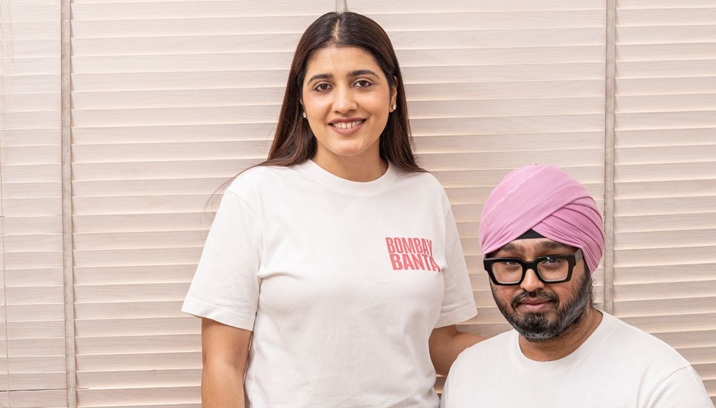
New Delhi, July 15 -- When life gave lemons to the husband-wife founder duo behind the beverage brand Bombay Banta, they didn't just turn them into lip-smacking lemonades, but also built a fast-growing business around them.
While most early-stage startups rely heavily on digital platforms or quick commerce to get a foot in the door, Akkshita Malhotra and Meet Singh Malhotra, who founded the brand in 2021, took a less traversed path. They launched with a well-laid strategy targeting larger HoReCa (Hotels, Restaurants, and Catering) clients.
The New Delhi-based venture began after successful kitchen experiments by Meet, a qualified chef, who perfected their signature masala soda recipe. From there, he and Akkshita began scaling the business by partnering with local cloud kitchens.
Bombay Banta, operated by Kbev Industries Pvt Ltd, soon started supplying to HoReCa clients such as Faasos, Behrouz Biryani, and Rebel Foods' quick-service restaurants.
"Our initial focus was on HoReCa," says Akksita, who is also the chief marketing officer at Bombay Banta with previous experience at multiplex chain PVR and FMCG giant Nestle in operations.
"Our claim to fame and our true validation of the product happened when Vistara gave us the opportunity," she says, recalling their tie-up with the airline which included Bombay Banta's masala lemon water on their menu.
She says the company spent 45 days making changes to their product based on the chef's feedback at Vistara and finally helping them land a contract.
But why did the firm start with HoReCa clients instead of targeting the masses?
"We first wanted to gain confidence in our product, and that's like, the survival of the fittest. I think for around two-and-a-half years to three years, we were by ourselves, trying to survive, and that survival-of-the-fittest mindset brought the best out of us in terms of building our presence," says Akkshita.
However, their startup journey soon met a roadblock. Their contract with Vistara got axed with the merger of the airline with Air India in late 2024 followed by a cost-cutting spree by the merged entity.
"We lost the (Vistara) business, so instead of spending four months on it, in 45 days, we launched (on quick commerce). We had our own hiccups," says Akkshita, referring to the lack of enough bottlers. This prompted the company to set up its own bottling and manufacturing capacity.
Today, its carbonated range of beverages include masala cola, masala soda, kala khatta, jeera soda, and lemon soda, while its non-carbonated range has low-sugar, vitamin-infused lemonades-masala shikanji, lemon shikanji and jamun shikanji. It also recently launched its low-sugar vanilla cola variant.
At present, Bombay Banta boasts of a 40,000-square-feet bottling and manufacturing plant at Sonipat, near Delhi. The facility produces 2.5 lakh bottles a day currently.
The company is now looking at expanding its team and doubling its production capacity following its pre-Series A funding round a month ago.
Consumer-focused VC firm DSG Consumer Partners doubled down on the company in its pre-Series A funding round, investing around Rs 8 crore, which valued the firm at around Rs 80 crore, according to media reports.
The VC firm had first invested in Bombay Banta's seed round in 2023. At the time, the company raised Rs 4.1 crore, according to VCCEdge.
Financial report card
Bombay Banta is a relatively new entrant in the Indian flavoured beverages market, where Delhi-based Lahori Zeera and Hector Beverages are already established brands. Larger companies have also introduced Indian desi drinks to their portfolio, such as Parle Agro's Dhishoom, Coca-Cola's Rimzim and House of Bindu's Bindu Fizz.
But, unlike peers with strong offline presence, Bombay Banta derives nearly all its revenue from quick commerce, with only a meagre amount from its HoReCa clients.
In FY26, it recorded a massive six-fold revenue growth, driven by strong demand on quick commerce platforms, Akkshita told VCCircle.
In FY25, the company generated net revenue of Rs 7.8 crore, up from Rs 6.7 crore the year before. Back-of-the-envelope calculations indicate FY26 revenue could have reached around Rs 46 crore.
Akkshita clarified that 2026 was the first summer sale for the brand on quick commerce platforms, as it had just launched its D2C business the previous year.
"We have to first cater to the demand we are getting through quick commerce because the entire modern trade has shifted to quick commerce, and great demand is being generated until now," she said.
While the company reported an operating profit of Rs 45 lakh in FY25, Akkshita conceded that the ongoing war in West Asia has increased raw material and packaging costs by nearly 50%. As a result, the company is talking with its suppliers and mapping costs.
For the current financial year, the company is aiming to hit sales of around Rs 60 crore, excluding the goods and services tax and platform commissions, with full focus on quick commerce channels.
"For the next year, we just have to fulfil that (demand on quick commerce), and then later on we will definitely plan to enter the offline market as well," she said when asked about the company's growth strategy.
Published by HT Digital Content Services with permission from VC Circle.