
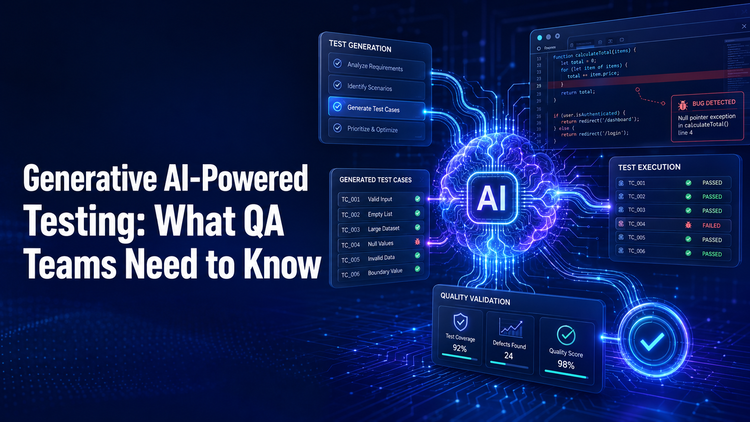
New Delhi, July 31 -- Generative AI is changing how QA teams create, maintain, and review automated tests. Instead of writing every test step manually, teams can use natural-language instructions, requirements, and existing test cases to generate initial testing assets. This can reduce repetitive work and help organizations expand automation more efficiently.
In this blog, we will explain how generative AI-powered testing works, where it provides value, and how teams can introduce it into their existing workflows. We will also cover what to evaluate before choosing a platform and the continuing role of QA professionals.
What Is Generative AI-Powered Testing?
Generative AI-powered testing uses artificial intelligence to create or modify test cases, scripts, test data, assertions, and documentation from inputs such as requirements, user stories, application information, and existing tests. It translates high-level testing goals into detailed actions that teams can review or execute. Unlike traditional automation, which often depends on code, selectors, and framework-specific commands, this approach allows users to describe testing needs in natural language. Some platforms generate editable code, while others execute readable tests without exposing traditional scripts.
How Generative AI Supports QA Teams
Generative AI can support several stages of the testing lifecycle, from planning and test creation to execution and maintenance. Its value depends on the quality of the input, the complexity of the application, and how carefully teams review the generated output. Clear requirements and human oversight remain essential.
1. Faster Test Creation
Creating automated tests can take significant time when engineers must write each action, selector, and assertion manually. Generative AI can produce an initial test from user stories, acceptance criteria, manual test cases, or plain-language instructions. This gives QA teams a faster starting point and may help them add automated coverage earlier in development. Generated tests still need review to confirm that the steps, data, and expected results are correct.
2. Broader Test Case Coverage
Generative AI can suggest additional scenarios based on requirements or existing coverage. These suggestions may include negative paths, invalid inputs, boundary conditions, and alternative user actions. This can help testers examine a feature from more than one perspective. QA professionals must still determine which scenarios are relevant, valuable, and worth maintaining.
3. Plain-Language Test Development
Natural-language testing can make automation more accessible to manual testers, product specialists, and business analysts. Team members can describe actions and expected outcomes without first mastering a full programming language or automation framework. This may improve collaboration because technical and non-technical stakeholders can review the same test logic. Clear standards are still needed to keep tests consistent and maintainable.
4. Test Maintenance Assistance
Automated tests often fail when interfaces, element locations, labels, or workflows change. Generative AI can help identify updated elements, recommend repairs, or modify certain steps when the original test no longer matches the application. This may reduce the time teams spend maintaining stable regression coverage. Any automatic change should remain visible, reviewable, and connected to the original test purpose.
5. Failure Analysis
Large test suites can produce many failures after application, environment, or data changes. Generative AI can summarize logs, group similar failures, and suggest possible causes. This can help teams distinguish between product defects, test problems, unstable environments, and incorrect data. The results should guide investigation rather than replace technical analysis.
Key Benefits of Generative AI-Powered Testing
When implemented carefully, generative AI can help QA teams reduce repetitive effort and make automation more accessible. It may also improve how testing information is created, organized, and reviewed. These advantages are most useful when the technology supports a clear QA strategy.
Potential benefits include:
Faster creation of initial test cases Reduced manual scripting effort Additional ideas for edge cases and negative scenarios Easier participation for non-developers Improved test documentation and readability Faster grouping and review of test failures Maintenance support when applications change Greater reuse of business-level testing knowledge
These benefits do not remove the need for skilled testers. Instead, they allow QA professionals to spend more time on test strategy, exploratory work, risk analysis, and complex investigation. The quality of the results still depends on strong requirements and careful review.
How to Introduce Generative AI into Testing
Teams should introduce generative AI gradually so they can evaluate its value without disrupting existing QA workflows. A controlled approach also makes it easier to identify risks and establish clear standards.
Start with a focused use case: Choose a stable task, such as generating tests for a common workflow, suggesting negative scenarios, or summarizing failures. Define success criteria: Measure test creation time, manual corrections, execution stability, maintenance effort, and debugging quality. Require human review: Ask QA engineers to verify generated tests, assertions, expected results, dependencies, and duplicated coverage. Establish governance rules: Create policies for approved platforms, acceptable data, access permissions, ownership, and documentation. Expand based on results: Introduce AI into additional workflows only after the pilot produces reliable, secure, and measurable benefits.
This step-by-step approach helps teams adopt generative AI carefully while keeping testing quality and accountability under human control.
What to Evaluate Before Choosing a Platform
Generative AI testing platforms differ in how they create, maintain, and analyze automated tests. A generative AI-based test automation tool such as testRigor may suit teams that want readable tests created from plain-language instructions, while other platforms may focus on generated code, self-healing, or failure analysis. Teams should also confirm that the platform supports the application types they need to test.
Before choosing a platform, evaluate integrations, reporting, maintenance requirements, data security, and the level of human control over generated changes. A short proof of concept using realistic workflows can show how the platform performs during test creation, execution, debugging, and application updates. This helps teams determine whether the solution fits their skills, development process, and long-term testing needs.
Does Generative AI Replace QA Engineers?
Generative AI can automate parts of test creation and analysis, but it cannot take full responsibility for software quality because it does not independently understand customer expectations, business priorities, legal obligations, or the consequences of serious failures. QA engineers provide the context needed to identify risk, review generated output, investigate unusual behavior, and decide where deeper testing is required. As the technology becomes more common, the QA role may shift toward strategy, exploratory testing, analysis, review, and governance. Human expertise will remain essential because generated tests can still contain incorrect assumptions, weak validation, or missing coverage.
Conclusion
Generative AI-powered testing can help QA teams create tests faster, expand coverage, reduce repetitive work, and analyze failures more efficiently. However, its value depends on clear requirements, strong assertions, human review, secure data practices, and consistent governance. Teams should begin with a focused pilot, compare the results with their current process, and expand only when the technology proves reliable and maintainable. The strongest approach combines AI-assisted efficiency with human judgment and a clear understanding of software risk.
Published by HT Digital Content Services with permission from VC Circle.