
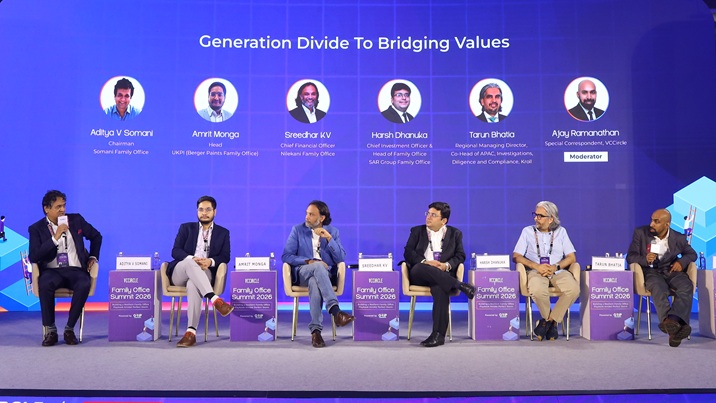
New Delhi, July 28 -- Family offices should establish a set of non-negotiable core values that can be followed across generations, industry executives said at the VCCircle Family Office Summit 2026 held in Mumbai.
The executives, who were speaking during a panel discussion on the 'Generation Divide to Bridging Values' at the event, said also that third-party professionals can play an important role in ensuring that generational transition within family offices is managed smoothly.
The panellists included Aditya V Somani, chairman of Somani Family Office; Sreedhar KV, chief financial officer at the Nilekani Family Office; Amrit Monga, head of UKPI (Berger Paints Family Office); Harsh Dhanuka, chief investment officer and head of SAR Group Family Office; and Tarun Bhatia, regional managing director and co-head of Asia Pacific in the Investigations, Diligence and Compliance practice at financial and risk advisory firm Kroll.
"I have seen certain family offices define non-negotiables, which are values that cannot be compromised. If every family office can put their non-negotiable, it makes it easier for the next generation to relate and build on it," said Bhatia.
The panellists said that, broadly, family offices are better structured now than before, wherein, investments are managed by specific teams. Also, family offices have more choice on capital allocation.
Nilekani Family Office's Sreedhar KV said that families are increasingly institutionalizing their day-to-day affairs wherein they are separating management from ownership. Specifically, they are appointing chief investment officers, formulating an investment policy statement, a family constitution, and setting up a dispute resolution process, he said.
Somani highlighted that, while family offices followed a more "patriarchal" structure before, the younger generation within family offices can discuss day-to-day affairs more openly now. "There is also more respect for the professional. That has made a huge difference," he said.
On the other hand, family offices may run into some common pitfalls.
"Family offices professionalize by bringing in people (third parties) but do not professionalise the decision-making process. They still want to have the final say," Bhatia said, adding that resistance among entities to change the governance mechanism is also a limitation.
Broadly, the panellists highlighted the need to identify key decision makers within large families.
"If there are 20 members in a joint family, you create a family council and identify decision makers and majority stakeholders so that there are fewer brains in the room to argue," Monga said.
Dhanuka highlighted the importance of stewardship, wherein core values are transmitted from one generation to the other. Professionals can facilitate this process.
"There is a lot of education that needs to be done by the earlier generation wherein family values can be passed on. Professionals can play a role in these subject matters such that the transition happens seamlessly," he said.
Published by HT Digital Content Services with permission from VC Circle.