
New Delhi, July 29 -- Why Is Commute a Capital-Allocation Question?
Scaling headcount across cities like Bengaluru, Delhi-NCR, Mumbai, Pune or Hyderabad is facing one problem head on - the daily commute. This is one of the biggest challenges for an employee, one which can cause attrition due to transport fatigue, if not taken care of. It's also a major safety liability for the company and even affects your decision of where to sign the next lease. Employees who spend long hours commuting end up being fatigued, unproductive and in the end, unhappy. Travel time is also considered by many employees while accepting an offer, hence it affects your talent acquisition.
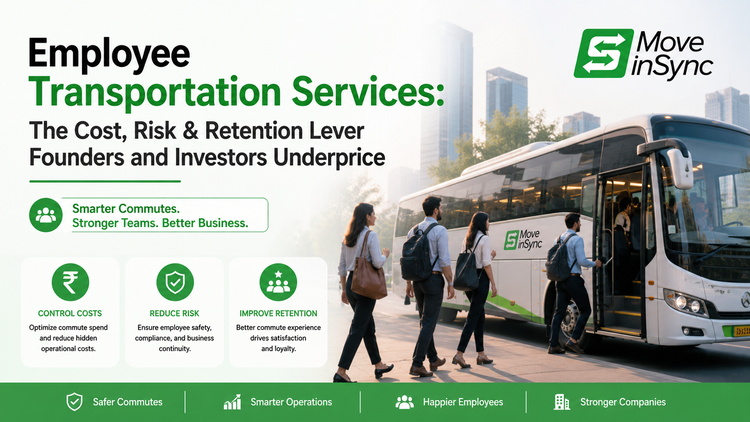
For founders and CXOs, that makes transportation a structural cost. Usually, employee transport is hidden between the lines of opex and mostly unoptimized. This makes benchmarking employee transportation critical. It is a cost, risk and also a retention lever, and deserves the same attention you put into any other seven figure line item.
What is an employee transportation service?
Employee transportation services are end-to-end managed commute programs that run at an enterprise level, handling the entire journey - pickups, drops, vehicle supply, maintenance - in a single system. This is a structured and coordinated system of trip management.
Unmanaged commute is often an expensive and compounding liability due to unpredictable costs, lack of safety tracking, missing auditable data. An employee transportation service is one which can eliminate all of these bottlenecks with a system that can provide predictability, safety and auditability.
What does an employee transportation service cover?
The best way to understand why an employee transportation service is useful, is to understand the problem that it solves - cost, attrition, safety or location.
Home to office pick up and drop: It is the solution that has the greatest relevance to attrition due to commute issues. Door-to-door pick ups can cut a large chunk of the travel time for employees and in major cities this can make a huge difference. Two hours of commute one way is a genuine issue that causes people to quit. Very few companies take this into consideration but it's vital to note that the cost of replacing a lost talent is much more than retaining them.
Shuttle services: This is the best way to reduce cost per person, using fixed routes and timings for campuses with a large number of employees. By putting several employees on fixed buses, the cost per person becomes substantially cheaper than hiring private cabs for everyone. In most cases, it will be the biggest expense reduction by far. And it is also easy to scale as your team size grows.
On demand services and rentals: They handle the extras - visitors or temporary travel requirements like airport pick ups and drops, client visits, surplus workers or spikes, without having to pay for vehicles during periods when they are not needed. Size your fleet for the regular volume and rent for the peak volumes.
Metro and the last mile connections: These are vehicles that connect the nearest metro station to the workplace itself. The workplace does not have to be near a metro station to be able to operate. It expands the choices of possible workplaces, it is a consideration that happens to be bundled with the transportation decision. Good to keep in mind the next time a promising place gets nixed because of difficult access.
Safety features for women: Features like trip tracking, SOS services, verified drivers and route planning would never leave an employee feeling alone throughout the journey, especially during dark hour shifts. In today's scenario, this is no more just a value addition for companies but rather a matter of compliance and liability. In many states of India, it is mandatory for companies to provide safe and accessible transportation for employees, especially during dark hours.
Multi-city, multi-shift, multi-vendor management: This is the layer that allows all the functions to be managed in a seamless way across all cities, uniformly. Without this layer, each new city would be an independent, fragmented system.
Why a software is needed for employee transportation service
At any real scale, managing employee commute seamlessly does not work in spreadsheets. Employee transport management software is exactly how you make this program scalable.
Route optimization: That's what makes all the difference between cost of transportation that explodes with growing headcount and one with diminishing per person costs. AI-led Route optimization consolidates trips and eliminates unproductive trips. Without route optimization, all you get is extra buses and kilometers that you're being charged for, for no reason.
Real-time vehicle tracking: All other features depend on it. The safety and compliance considerations would only mean something if you know exactly where each and every vehicle is at the current moment. If you are unable to track your vehicles in real time, then that poses as a severe safety and compliance gap.
Vendor and fleet dashboards: If there are four vendors operating in five cities, one dashboard is exactly what makes it possible to compare invoices with trips. This accessible information is exactly the thing that your team would be grateful for, when the time comes to audit the data.
Analytics: Trips, cost per mile, vehicle utilization rate, missed trips, incidents. This is exactly the kind of reporting that a CFO or investment portfolio manager will want in any case.
To sum up, software is how the employee transportation program becomes predictable, auditable and scalable, the three most important things that matter for the leadership.
How It Manifests in Diligence
The rationale here is clear - managed transportation turns an uncertain reimbursement check into a predictable cost which can also be forecasted for the upcoming quarters. It reduces the safety and compliance risk. It reduces commute-related attrition, which helps you keep the people you've already hired and trained. It also expands the potential locations for your office by solving the last mile problem. Hence the message is unambiguously positive. A company with a transportation program based on data and analytics exhibits the same financial discipline across the rest of its operations. It's the main difference between a company managing its costs and one simply incurring them. It's a sign of maturity, and it doesn't cost much to get there.
The Takeaway
Employee transport for fast-growing companies are already an operating lever, even if nobody sees it that way. The issue spans cost, risk, retention, and location simultaneously. Deal with it as genuine infrastructure, and you'll be able to control costs and risks in no time. Worth looking into prior to the next hiring wave at your organization.
Published by HT Digital Content Services with permission from VC Circle.