
New Delhi, July 29 -- You're carrying high-interest credit card debt. Your bank keeps sending you balance transfer offers with attractive-looking 0% intro rates. A friend mentioned a debt consolidation loan instead. Both promise to shrink your interest bill, but they solve the problem in completely different ways, and picking the wrong one can cost you more than you'd save.
This is a debt consolidation loan vs balance transfer question, and the honest answer depends on two things: what kind of debt you're actually carrying, and how fast you can realistically pay it down. Here's exactly how each option works, with real India-specific numbers, so you can make the call with your eyes open.
What Is a Credit Card Balance Transfer?
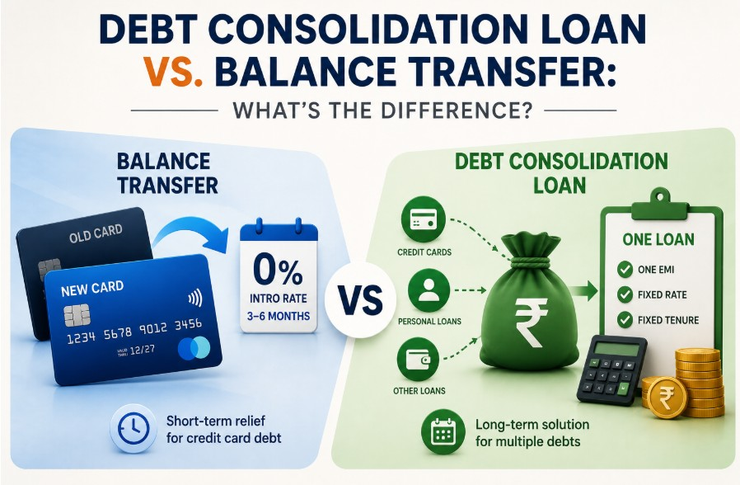
A balance transfer moves your existing credit card balance to a new card that offers a lower or sometimes 0%, introductory interest rate. In India, this intro period typically runs 3 to 6 months, depending on the bank and the specific card offer.
Most major banks offer this facility, including HDFC, ICICI, SBI, Axis, and Kotak. Each one has slightly different terms, so the exact window and eligibility criteria vary. A processing fee usually applies too, generally somewhere in the range of 1% to 3% of the amount you're transferring. On a Rs.1,00,000 balance, that's roughly Rs.1,000 to Rs.3,000 upfront, just to move the debt.
Here's the constraint that trips a lot of people up. Balance transfers generally only work between credit cards, not personal loans. So this route only helps if your debt is mostly sitting on cards. If you're also carrying a personal loan alongside your card dues, a balance transfer won't touch that loan at all. It only moves the card balance.
There's a second catch, and it's the one that quietly costs people the most money. If you don't clear the transferred balance before the intro period ends, the interest rate jumps back up, often to 24% or higher. Picture this: you transfer Rs.80,000 at 0% for 4 months, but you only manage to pay off Rs.50,000 in that window. The remaining Rs.30,000 now starts accruing interest at the reverted rate, sometimes higher than what you were paying on the original card. The savings you thought you locked in can vanish quickly.
A balance transfer, in short, is a short-term tool. It buys you a window of low or no interest. It is not a permanent fix, and it works best when you already have a realistic plan to clear the balance before that window closes.
What Is a Debt Consolidation Loan?
A debt consolidation loan is a new loan, usually a personal loan, whose proceeds go directly toward paying off your multiple existing debts at once. This can include credit cards, personal loans, or a mix of both, depending on what you're carrying.
Once that payoff happens, you're left with a single EMI at a fixed interest rate, over a set tenure (loan duration), commonly running anywhere from 12 to 60 months in India. Say you're juggling Rs.1,20,000 in credit card dues at 32% and a Rs.1,50,000 personal loan at 18%. A consolidation loan combines both into one new loan of Rs.2,70,000, at a single fixed rate, with one EMI, one due date, and one lender to deal with going forward.
Unlike a balance transfer, a consolidation loan isn't limited to credit cards. It can absorb a genuinely broader mix of debt types in a single transaction. It also gives you a fixed payoff date and a fixed EMI amount from day one, which matters a lot if you'd rather have predictability than race against a ticking intro-period clock every few months.
You can start this process through FREED's Debt Consolidation Program, which handles the matching and payoff coordination for you.
Balance Transfer vs. Debt Consolidation Loan: Side by Side
Balance Transfer Debt Consolidation Loan What it moves Credit card balances only Credit Cards, Personal loans or a mix Interest Rate 0% or low, for 3-6 months, then reverts high Fixed rate for the full tenure Fees Typically, 1-3% processing fee Origination/Processing Fee, Varies by lender Best For Card-Only Debt, Repayable within the intro window Mixed Debt or Repayment needs longer than a few months Payment Structure Minimum/Variable until intro ends Fixed EMI, fixed payoff date
The core difference comes down to scope and timing. A balance transfer is narrow in what it covers, but fast in how it's set up. A consolidation loan is broader in scope, but built around a longer, steadier runway. Neither is better in the abstract. Each fits a different shape of debt.
Which One Actually Saves More?
There's no universal winner here, and it's worth being suspicious of any article that claims one option is always better. It genuinely depends on two things: what your debt looks like right now, and how quickly you can realistically pay it down.
A balance transfer saves you more only if you can genuinely clear the balance within that 3 to 6 month intro window. If you're confident you'll hit that timeline, and your debt is purely credit card balances with nothing else mixed in, this route can work out cheaper overall, since you avoid interest almost entirely during that stretch. But if the balance is still sitting there when the intro period quietly ends, the reverted high rate can erase most, or all, of what you saved. This is the single biggest risk with balance transfers, and it's worth being honest with yourself about your repayment speed before choosing this path.
A consolidation loan tends to save more in two specific situations. First, when your debt includes a personal loan alongside credit cards, since a balance transfer simply cannot touch that personal loan, no matter how good the card offer looks. Second, when your repayment timeline realistically needs longer than a few months, since a fixed-rate loan spread over 12 to 60 months doesn't punish you for taking your time, the way a reverted card rate would.
A simple way to think about it: short debt, cards-only, with genuine fast payoff capacity points toward a balance transfer. Mixed debt, or a longer payoff timeline that a few months won't cover, points toward a consolidation loan instead.
How FREED Helps
FREED is a Loan Management Company that runs a matching process for exactly the second situation described above, borrowers whose debt doesn't fit neatly into what a balance transfer card can handle.
If your debt is a mix of credit cards and personal loans, or your repayment timeline stretches longer than a promotional card window can realistically accommodate, FREED assesses your full debt picture first. It looks at every loan and card you're carrying, the rates on each, and your overall repayment capacity. Based on that, FREED matches you to a lending partner from its network, and that lending partner's loan consolidates everything into a single new loan.
This approach covers a genuinely broader mix of unsecured debt than a balance transfer card ever could, since it isn't restricted to cards alone. You get a fixed EMI and a fixed tenure from the very start, with no dependency on clearing a balance before some promotional rate quietly expires in the background while you're focused on other things.
The first consultation is free, with no upfront cost involved. You can learn more through FREED, a Loan Management Company, and get a clear picture of where your specific debt situation stands.
The Bottom Line
The right tool here depends on your actual debt mix and your realistic repayment timeline, not on brand preference or which offer happens to look flashier in your inbox this week.
A quick self-check settles it in most cases. Card-only debt, paired with a genuinely fast payoff plan, points to a balance transfer. Mixed debt, spanning cards and loans, or a longer runway than a few months, points to a consolidation loan. If you're not entirely sure which side of that line you fall on, FREED's team can walk through your specific numbers with you directly, free of charge, and help you see which path actually fits your situation.
NOTE: No VCCircle Journalist was involved in the creation of this content.
Published by HT Digital Content Services with permission from VC Circle.