
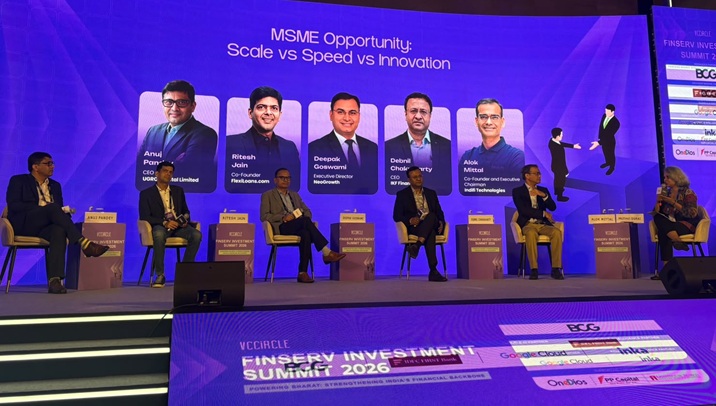
New Delhi, Sept. 21 -- The growing use of digitisation and artificial intelligence-based models is making it far easier for lenders to underwrite loans and draw repayment schedules for micro, small, and medium enterprises in India, according to panellists at the VCCircle Finserv Investment Summit 2026 in Mumbai on Friday.
The panel titled 'Scale, Speed, and Innovation: The Core Pillars Shaping the Next Frontier of MSME Lending' included Debnil Chakravarty, CEO of IKF Finance; Anuj Pandey, CEO of Ugro Capital; Ritesh Jain, co-founder of FlexiLoans; Alok Mittal, co-founder and CEO, Indifi Technologies; and Deepak Goswami, co-founder and executive director, NeoGrowth.
Chakravarty of IKF Finance, which has specialised in commercial and used vehicle financing for decades, said multiple and surrogate sets of data have made underwriting easier.
"The ease of getting a particular loan or underwriting is not at the cost of the underwriting capability or the underwriting principles. It is about organising the most unorganised and organised data, and bringing them into underwriting models," he said.
Ugro's Pandey said the dependence on collateral-backed loans has been reducing with the realisation that the bank statement of an MSME is the best cash flow statement, leading to a rise in unsecured lending.
"The moment the industry realised that (the bank statement of an MSME is the best cash flow statement), a lot of tools came up to decipher it in a better way, and hence the dependence on collateral-backed loans has started coming down. Most unsecured loans to MSMEs have started in the last five to seven years," he said.
Goswami from NeoGrowth echoed the view and said NeoGrowth looks at working on variables around the bank statement and not just point-of-sale machines that it first pioneered as a means of collateral in the initial years of its launch.
"The bank statement is where all the digital payments flow into cash deposits, and you get to see a little more data around how the money is being used, how disciplined customers are on the cash flow side. Today, if banks have to go beyond, say, Tier I, Tier II, they must diversify towards the bank statement," Goswami said, adding that the firm is continuously working on variables that can be drawn from the bank statement and not just PoS machines.
Pandey said repayment structures have also improved, helping small businesses repay loans daily, weekly or monthly.
Jain from FlexiLoans said that new-age digital lenders have the advantage of an asset-light model, adding that the opportunity in the MSME segment remains high.
"We could operate in that sweet spot of Rs 5-15 lakh (ticket size)... Only 15-20% of MSMEs get financed by organised players, and this opportunity is huge. You just have to be ahead of the curve in terms of innovation; try to have more and more data in operating and lending, including your processes, ahead of the incumbents," Jain said.
Mittal from Indifi said digitisation would be the key to gain access to underpenetrated small businesses.
"The developments in the last four or five years regarding account aggregators and co-lending structure are helping in that journey (of digitising MSME credit). I think even the policymakers and regulators do realise that digitisation will be at the core of solving for this," he said.
AI implementation
The panellists also referred to how AI models ease business operations, thereby improving work efficiency and penetration in the MSME segment.
Mittal said AI models have not only helped the firm in taking a subjective approach to each MSME amid fragmented data sets but also improved accuracy.
"More importantly, what AI models allow us to do is to get a more accurate calibration of absolute risk that we are taking. Unlike conventional policy systems, which tell you yes or no, an AI model will tell us whether one loan has a 2% probability of risk while another has a 4%. This allows you to accept both those customers and price them accordingly," he said.
IKF Finance has been making use of AI to empower its frontline managers with more information and help take decisions on underwriting, Chakravarty said. Goswami of Neo Growth said that "low-value" work such as information collation, analysis and actionable insights is done by AI, while underwriters can focus on spotting "best value" from a transaction.
"AI is being used in various models and workflows at various levels of intervention. On the total AI scale. I don't think we have reached that area yet," he said.
At Flexiloans, AI agents have replaced traditional communication modes, leading to a conversion rate of 20%, said Jain.
Pandey said Ugro Capital's proprietary underwriting model has also become dynamic and improved since the advent of Gen AI.
Published by HT Digital Content Services with permission from VC Circle.