
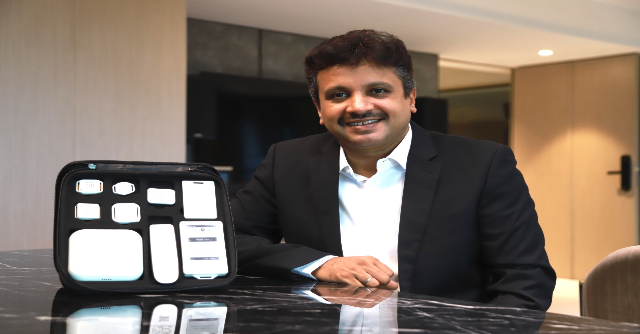
New Delhi, May 7 -- Hospitals have digitized records and billing, but the operational layer has stayed largely invisible. Trackerwave is changing that by bringing real-time location intelligence to the hospital floor. In a conversation with TechCircle, Co-Founder and Director Pradeep Vadakkekhatt shares how RTLS is transforming everything from porter management to OT utilization, and why, if your system works in India, it's ready for the world.
Edited Excerpts:
Trackerwave positions RTLS as a foundational layer for hospital operations-how do you see it fitting into hospitals' broader digital transformation journey today?
Over the last few decades, hospitals have focused extensively on digitizing healthcare information. Socialist healthcare economies like the UK, where healthcare is largely government-run, prioritize EMRs, while insurance-driven economies like the US and India focus on billing and revenue-based hospital information systems. Through all of this, operational excellence received remarkably little attention: the things that happen on the ground, every single day.
How efficiently is a porter transporting a patient? Are your OTs being utilized to their full potential? Are appointment queues being managed with minimal human intervention? These questions remained largely unanswered. Today, RTLS is becoming the operating system for hospital operations. Every task, from the simplest to the most complex, becomes location-aware: quantified, measurable, and improvable. This visibility dramatically boosts performance and patient satisfaction in ways that were previously impossible. Hospital CIOs are rapidly recognizing this, and adoption is accelerating.
Working with leading institutions like Apollo Hospitals and Medanta, what have you learned about how hospitals approach digital transformation differently in practice versus strategy?
We have spent years designing and deploying healthcare systems globally: from NHS UK to US healthcare networks to precision-critical medical hardware. But nothing quite prepares you for the scale and intensity of Indian healthcare. The demands are comparable to anywhere in the world, but the challenges are several notches higher. With our population, the pressure on quality healthcare is immense, and hospitals are in a constant pursuit of improvement and system downtime is simply not a conversation anyone is willing to have.
To put this in perspective: a single Medanta facility processes over 2,500 tasks every single day, without manual supervision. If each request saves just 10 minutes, and in practice our savings are often far greater, that's 400+ person-hours saved daily. Not absorbed into admin, not lost to inefficiency, but directed straight back into patient care. We've learned enormously from these environments and evolved our systems accordingly. As they say, if your system works in India, it's ready for the world.
Hospitals often operate on complex, legacy systems-how does Trackerwave ensure seamless integration with existing HIS, EMR, and IT infrastructure without disrupting operations?
Integration is not optional for us but central to delivering a seamless user experience. We have built an extensive library of HL7 (Health Level Seven) interfaces that allow us to connect with most hospital systems within three to seven days. For context, HL7 is a set of international standards designed specifically to make sharing data between healthcare systems easier, more efficient, and far less painful than older methods. Having a deep library of these interfaces means we're not starting from scratch every time; we plug in, speak the language the hospital already understands, and go live fast. We've worked with everything from global platforms like InterSystems and Oracle to leading India-based HIS and EMR systems. Where HL7 isn't feasible, we support REST-based APIs, so we're never boxed in by whatever a hospital already has in place. The goal is always zero disruption. Hospitals can't afford downtime. And frankly, neither can we.
Your platform leverages existing WiFi infrastructure to reduce costs-how critical is this approach in accelerating adoption, especially in cost-sensitive healthcare environments?
It is absolutely fundamental. Hospitals invest heavily in their network infrastructure, often with built-in IoT capabilities already baked in. We saw an opportunity to unlock that latent value rather than ask hospitals to invest in yet another layer of hardware.
We've partnered with virtually every major network infrastructure provider: Cisco, Meraki, Aruba, Ruckus, Juniper, and Extreme Networks. Regardless of what a hospital has deployed, we can work with it. This approach dramatically lowers the barrier to adoption and makes enterprise-grade RTLS accessible even in cost-sensitive environments.
From your experience, what are the biggest organizational or behavioural challenges hospitals face when implementing RTLS and workflow automation technologies?
RTLS gives hospitals something they have never truly had before: complete, granular visibility into operations. Suddenly, there's a number against every routine activity. How many tasks is each staff member completing per day? What's the average patient transport time? Which assets are sitting underutilized? What does it cost to maintain one brand of equipment versus another? When this level of detail surfaces for the first time, it raises a lot of questions, and naturally, some people take time adjusting to that transparency.
Once teams see the data working in their favor, recognizing strong performance and giving people a way to show what they've actually been contributing, it stops feeling like oversight and starts feeling like support. The long-term benefits are undeniable for everyone.
Trackerwave delivers measurable efficiency improvements-how do you quantify ROI for hospital stakeholders, and which metrics tend to matter most to them?
Trackerwave spans more than 25 distinct workflows, each addressing a different area of hospital operations, and each with its own ROI story. Some customers see returns within three to six months of going live; others have longer payback horizons of one to two years, depending on the workflow.
Porter management is a strong example. We consistently deliver a 30 to 40% improvement in operational efficiency, with workforce allocation optimized ward-by-ward. That's not a marginal gain: it translates directly into cost savings, staff satisfaction, and fewer patient complaints.
The metrics that matter most to stakeholders tend to be the ones closest to cost and throughput, such as asset utilization rates, average service times, workforce productivity, and turnaround times in high-value areas like OTs. Once you can put a number to these, the conversation shifts from "why should we do this?" to "how quickly can we scale?"
As hospitals move toward smarter, data-driven operations, how do you see technologies like IoT and RTLS evolving-will they remain support systems, or become central to clinical and operational decision-making?
We've moved from an era of digitization to an era of AI, and that changes the game entirely. IoT and RTLS generate enormous volumes of operational data, but raw data sitting in a dashboard is not the destination. The real value lies in applying AI to surface the right insight, at the right moment, for the right person, so that decisions get made faster and smarter in an environment where every second counts.
Equally important is breaking down data silos. When operational data from RTLS is correlated with clinical events and patient outcomes, the picture that emerges is far more powerful than either dataset alone. You're no longer just tracking what's happening on the floor; you're understanding how it connects to what's happening at the bedside. That is where the real decisions get made. The trajectory, then, is clear: AI-integrated IoT for real-time, assistive decision-making. Not a support layer tucked quietly in the background, but an intelligent operational backbone that the hospital of the future is built around.
Published by HT Digital Content Services with permission from TechCircle.