
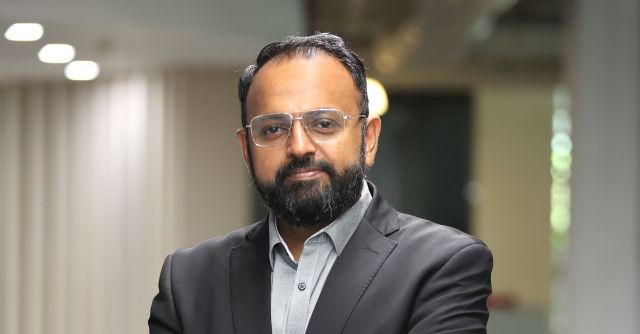
New Delhi, July 6 -- Manufacturers are entering a new phase of digital transformation where artificial intelligence is moving from isolated pilots to enterprise-wide deployment. For diversified industrial groups, the challenge is no longer adopting new technologies but embedding AI, data and automation across manufacturing, supply chains and customer operations to improve business outcomes. Godrej Enterprises Group is pursuing this through initiatives such as Amethyst, its enterprise AI platform, and Factory360, its manufacturing intelligence programme, while building common cloud and data foundations across businesses.
In an interview with TechCircle, Vijay Balakrishnan, Chief Digital and Information Officer (CDIO), Godrej Enterprises Group, explains why Agentic AI represents the next evolution of enterprise technology, why many AI initiatives fail to scale, and how the role of the technology leader is becoming increasingly intertwined with business strategy. Edited excerpts:
What are the biggest technology priorities shaping Godrej Enterprises Group's next phase of growth?
Technology priorities today can no longer be separated from business priorities. For us, the objective is not to adopt every emerging technology but to invest in capabilities that improve manufacturing, customer experience and enterprise decision-making. The first priority is building an AI-led enterprise. Through Amethyst, we are embedding AI into core business processes so employees can make faster and better-informed decisions across manufacturing, supply chain and corporate functions.
The second priority is creating a connected data ecosystem. Initiatives such as Unified Customer ID are helping us move beyond fragmented information towards a single enterprise-wide view of customers and operations. The third priority is manufacturing intelligence. Through Factory360, we are integrating machine data, plant operations and analytics to improve visibility, predictability and operational performance across factories.
How do you create a common technology strategy across multiple businesses?
Every business has different operational priorities, but they share common technology needs. Our approach has been to build shared platforms for AI, cloud, cybersecurity and data while allowing individual businesses to solve their specific challenges.
A manufacturing business may use AI for predictive maintenance and production scheduling, while another may apply the same platform to customer engagement or sales planning. The underlying technology remains common, allowing us to scale successful innovations across the Group without compromising governance, security or architectural consistency.
How are technologies such as AI, IoT and cloud improving manufacturing and supply chain operations?
Factory360 captures machine-level information across plants in near real time, giving production teams visibility into equipment performance, quality parameters and energy utilisation. Instead of reacting after problems occur, teams can identify patterns early and intervene proactively. Across supply chains, cloud-based platforms improve planning, inventory optimisation and demand forecasting. We are also exploring digital twins to simulate disruptions and strengthen operational resilience.
Automation has similarly evolved beyond reducing manual effort. AI-assisted workflows in areas such as order management, invoice validation and contract analysis allow teams to focus on higher-value work while improving speed and accuracy.
Where has AI delivered the strongest business impact, and why do many AI initiatives fail to scale?
The conversation around AI has moved well beyond automating repetitive tasks. The next phase is about automating cognitive processes, where AI can understand context, retrieve enterprise knowledge, reason across multiple data sources and support business decision-making. At Godrej Enterprises Group, we increasingly view this through the lens of Agentic AI. Rather than deploying isolated AI models for individual use cases, we are building intelligent agents that can orchestrate workflows, recommend actions and assist decision-making across manufacturing, supply chain and commercial operations. In manufacturing, Factory360 combines machine intelligence, operational data and AI to improve production visibility, predict equipment issues before they occur and strengthen quality outcomes. Across enterprise functions, AI is also helping reduce turnaround times in areas such as order management, contract analysis and invoice validation by enabling faster, more informed decisions.
In our experience, organisations do not struggle because of AI models-they struggle because the underlying processes are not ready. Successful AI deployments begin with simplifying, standardising and digitising business processes before introducing AI. Equally important is having a common enterprise platform such as Amethyst, which allows AI capabilities to be reused across businesses instead of creating isolated pilots. As AI systems become increasingly autonomous, responsible governance, human oversight and trust become even more critical.
Ultimately, organisations that derive the greatest value from AI will be those that treat it as an enterprise capability for augmenting human decision-making rather than as a collection of disconnected automation projects.
How do you see the balance between human expertise and autonomous AI evolving?
The real opportunity is not replacing human judgement but improving the quality of decision-making. Industrial enterprises operate in environments where decisions directly affect product quality, employee safety and business continuity. AI is exceptionally good at analysing large volumes of data and recommending the next best action, but accountability, contextual understanding and long-term judgement remain human responsibilities.
Our approach is to build AI as a decision-support capability rather than a decision-replacement capability. Through initiatives such as Amethyst, we want AI to reduce the effort involved in analysing information so that people can spend more time evaluating trade-offs, solving problems and making informed decisions.
What organisational changes have been most critical in driving digital adoption?
Digital transformation succeeds only when people adopt it. Through programmes such as AI Ignite and DigiNext, we are helping employees across functions understand how AI and digital tools can improve the way they work and make better decisions. Equally important has been stronger collaboration between business and technology teams. Business leaders help define priorities, success metrics and implementation roadmaps from the outset, ensuring technology investments remain closely aligned with operational and commercial goals.
How are digital investments improving customer experience across businesses?
Customer expectations have changed significantly over the last few years. Whether someone is buying furniture, home appliances or security solutions, they expect the same level of convenience, personalisation and continuity across physical and digital touchpoints. At Godrej Enterprises Group, our focus is on building connected customer journeys rather than digitising isolated touchpoints. Through Amethyst, we are bringing together customer intelligence from retail stores, e-commerce platforms, CRM systems, service interactions and channel partners to create a unified customer view.
These capabilities are already creating measurable customer value. At Godrej Interio, AI-powered Visual Search and 3D Room Planner have been used by more than 25,000 customers and have improved conversion rates by nearly 6%. In Appliances, connected products enable predictive service interventions and faster issue resolution, while in Security Solutions, AI-powered monitoring platforms allow customers to remotely manage security infrastructure with faster alerts, proactive service and improved incident response. Beyond individual businesses, AI-powered sentiment analysis and social listening help us continuously analyse customer feedback, identify emerging trends and translate those insights into product improvements, service enhancements and more personalised customer engagement.
As Chief Digital and Information Officer, how has your role evolved over the past few years?
The role of the Chief Digital and Information Officer has changed fundamentally. A few years ago, success was largely measured by system availability, cost optimisation and the delivery of technology projects. Today, technology has become central to business strategy, and the expectation is to contribute directly to growth, operational excellence and customer experience. A significant part of my role now involves helping business leaders identify where technology can create measurable value by redesigning processes, strengthening data foundations and embedding AI responsibly across the enterprise. Technology decisions are increasingly linked to commercial priorities, operational outcomes and customer expectations.
What will define the next generation of industrial enterprises?
The future will not be defined by smart factories alone but by connected enterprise intelligence. Manufacturing is becoming an integrated value chain where data generated on the shop floor continuously improves supply chains, product development and customer service. Preparing for that future requires more than technology investments. Organisations need trusted data, responsible AI frameworks, resilient digital infrastructure and, most importantly, people who can confidently work alongside intelligent systems. The winners will not necessarily be the companies with the most advanced AI models. They will be the organisations that connect intelligence across the value chain and consistently translate it into faster decisions, better operations and superior customer outcomes.
Published by HT Digital Content Services with permission from TechCircle.