
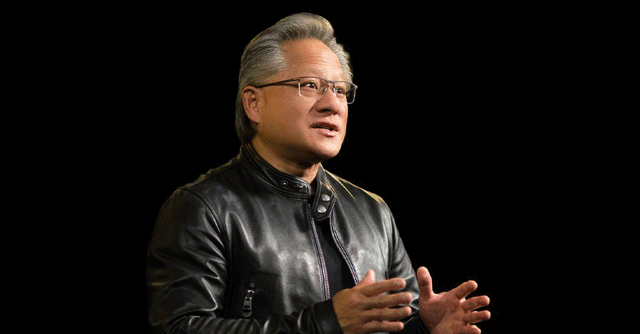
New Delhi, March 17 -- At the opening keynote of NVIDIA GTC 2026, the company's annual global developer conference, NVIDIA CEO Jensen Huang outlined the chipmaker's long-term artificial intelligence roadmap, saying the company now has over $1 trillion in AI revenue visibility through 2027 as global demand for accelerated computing surges. While Huang's keynote traditionally sets the tone for the annual developer conference, this year, he focused on the next phase of AI compuVting-from generative AI to agentic and physical AI systems capable of autonomously executing complex tasks across industries.
Roadmap for next-generation AI infrastructure
A key highlight of the keynote was NVIDIA's next-generation Vera Rubin architecture, designed to power future AI supercomputing infrastructure. The platform includes the newly introduced Vera CPU, built specifically to support large-scale AI workloads and next-generation AI data centres.
NVIDIA also unveiled the Vera Rubin DSX AI Factory reference design, a blueprint for building large-scale AI data centres capable of training and serving AI models at industrial scale. Huang described these facilities as "AI factories", where compute infrastructure continuously produces and deploys AI models.
To support large inference workloads, the company said its Dynamo inference operating system has entered production. The platform is designed to orchestrate massive GPU clusters used in AI factories and optimise real-time AI services.
Focus on agentic AI platforms
Another major theme of Huang's keynote was the rise of agentic AI, where software systems act autonomously across digital workflows. To support this shift, NVIDIA introduced an open agent development platform and NemoClaw, a framework designed to help developers build autonomous AI agents. The company also expanded its Nemotron family of open AI models and launched the Nemotron Coalition, bringing together global AI labs to advance open frontier models.
AI expansion across industries
The conference also highlighted how NVIDIA's AI platforms are being deployed across sectors including robotics, telecom and automotive. The company unveiled an Open Physical AI Data Factory blueprint aimed at accelerating development of robotics, vision AI and autonomous vehicles. Automakers including BYD, Geely, Nissan and Xiaomi are adopting NVIDIA's DRIVE Hyperion platform for Level-4 autonomous vehicles, while Hyundai Motor Company and Kia expanded partnerships with the chipmaker.
A strong India push
The announcements come as India rapidly expands its AI computing infrastructure. The government-backed IndiaAI Mission is aimed at building large-scale domestic GPU capacity and supporting AI model development in the country.
Several Indian companies are already building AI infrastructure platforms using NVIDIA technologies. Yotta Data Services is expanding its Shakti Cloud platform with hyperscale GPU clusters, while Reliance Jio has partnered with NVIDIA to build AI cloud infrastructure for developers and enterprises.
Engineering conglomerate Tata Group is also investing in AI data centres and digital infrastructure through its technology businesses, while E2E Networks has launched GPU cloud services targeted at startups and enterprises building AI applications. Also, Mumbai-based Fractal Analytics launches LLM Studio Platform with NVIDIA NeMo and NIM Microservices.
Separately, Tata Consultancy Services announced a new enterprise platform powered by NVIDIA technologies called Rapid Outcome AI, designed to help organisations move from AI experimentation to production deployment. The platform integrates generative AI, predictive analytics and computer vision to automate decisions and improve operational visibility across sectors such as manufacturing, telecom, banking and retail.
As enterprises and governments globally scale AI adoption, Huang said the industry is entering a phase where AI infrastructure will become foundational to digital economies, positioning data centres and GPU clusters at the centre of the next technology cycle.
Published by HT Digital Content Services with permission from TechCircle.