
New Delhi, May 8 -- From printed business enquiries sent via fax and speed post in the late 1990s to AI-powered voice assistants handling buyer conversations today, IndiaMART says the evolution of India's MSME ecosystem has fundamentally reshaped how businesses discover and communicate with each other online.
As the B2B marketplace completes 30 years, the company is deepening its investments in artificial intelligence, multilingual search and voice-led commerce to support India's increasingly digital small-business economy.
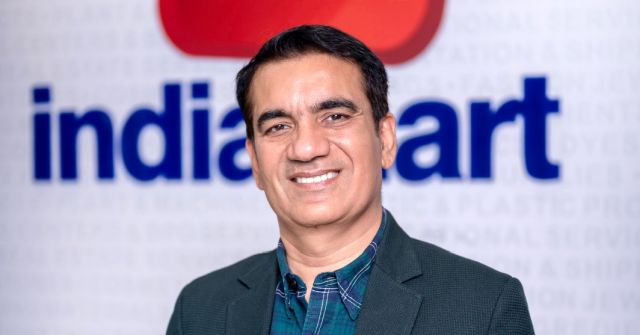
"From solving the problem of online visibility to ensuring faster search, discovery, relevant leads and minimal friction from search to conversation, we have come a long way," said Dinesh Gulati, COO of IndiaMART InterMESH Limited, in a recent interaction with TechCircle.
IndiaMART today hosts more than 8.4 million seller storefronts and 119 million product listings across 56 industries, while facilitating over 29 million business enquiries annually. The company says AI is now deeply embedded into its discovery engines, matchmaking systems and communication workflows.
"When AI was still in its infancy around 2021, we were already experimenting with AI-led behavioural matchmaking and catalogue enrichment. Today, the technology has become much faster, more inclusive and more efficient," Gulati said.
The company's latest push is IM VANI, a voice AI assistant that interacts with buyers, understands product requirements and connects them with suppliers without relying on scripted IVR systems.
According to Gulati, the system has been trained across more than one lakh B2B categories and can understand multilingual, unstructured speech patterns common among Indian MSMEs.
"Indian MSMEs operate in a vastly unstructured ecosystem. You have businesses with two-person teams, low literacy levels, Hindi and non-Hindi speakers, alongside large enterprises operating in a structured way," he said. "The challenge is to build technology that works across all these formats of communication."
The company says IM VANI currently supports nine Indian languages and can process conversations involving regional accents, mixed Hindi-English speech, informal measurements and interrupted conversations.
"For instance, a buyer may speak in Hindi with English keywords, pause mid-sentence to consult a colleague and mention specifications in informal units. A human agent would use context and common sense to understand that conversation. IM VANI is designed to do the same, just at a speed impossible to achieve manually," Gulati said.
The shift also reflects broader changes in how India's MSMEs communicate and transact online. IndiaMART began as an export-focused online directory where supplier enquiries were physically printed and couriered to businesses. As internet adoption expanded, email replaced fax communication, followed later by app notifications, WhatsApp integrations and CRM tools.
The company subsequently launched Lead Manager, its CRM platform for sellers, and IM Insta, which enables buyers to receive supplier details directly on WhatsApp. "MSMEs have gone digital in their own way, and we are trying to meet them where they are," Gulati said.
AI is now also being used to improve search relevance and buyer-seller matchmaking. IndiaMART says its machine learning models process around 65 lakh misspelt or Hinglish search queries every month across nine Indian languages.
The company claims AI-assisted sellers on the platform have seen first-response times reduce significantly, while vernacular search failures have also declined.
"Our AI models analyse buyer intent signals such as location, product fit and order value to improve relevance for both buyers and sellers," Gulati said.
Beyond discovery, the company is deploying AI for spam detection, fraud prevention, catalogue enrichment and internal productivity tools. AI is also being used internally for sales scheduling, call auditing, meeting summarisation and employee training workflows.
However, Gulati said the company's AI strategy remains centred on simplicity and usability rather than flashy automation. "When we build for MSMEs, we have to assume the platform should work equally well for someone who learned to use WhatsApp last year," he said. "Our focus is on small changes that save time rather than complicated features users may not even need."
Looking ahead, IndiaMART sees generative AI playing a larger role in conversational commerce and intelligent business discovery. "I believe AI has the potential to fundamentally transform how businesses operate," Gulati said. "IndiaMART is more than prepared to not just embrace that transformation, but lead it."
Published by HT Digital Content Services with permission from TechCircle.