
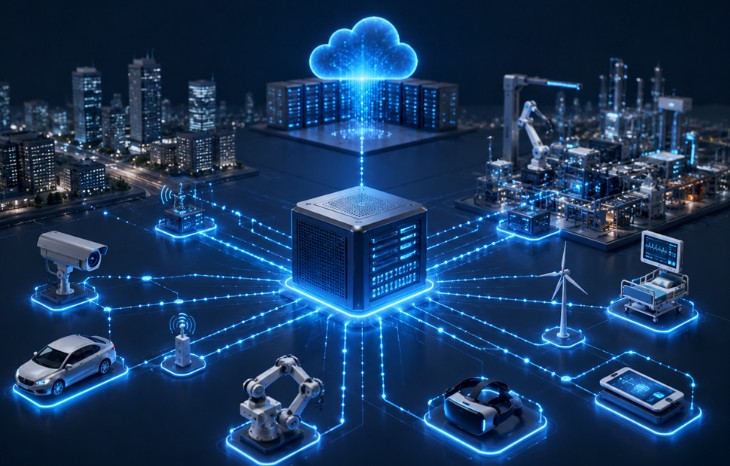
New Delhi, June 4 -- The cloud has been central over the years in web activities. This was relayed to distant servers which were to be handled, and this was virtually a magical experience in the first place. But in a world already crowded with appliances that are networked together and which demand immediate reaction, the outdated model has already started to display its weaknesses. A few seconds may be a very long time to ensure that a car notices something wrong, or a robot adjusts the working system on the factory floor. This is where edge computing is brought in, and the direction which the information will take is altered.
Processing now may be done at the point of origin or in the immediate vicinity, as opposed to cross-network travel to a centralized data center to obtain the information. It is, in fact, like giving a tiny but powerful brain to all intelligent appliances. The given change may not be as obvious, but it entirely changes the way in which modern networks should be constructed. It is not literally a one-highway, but a net of local streets-decisions that are not centrally made, and quick.
Why Real Time Demands Drive Architectural Change
The range and congestion lag has been so significant that the traditional architectures are not able to sustain the stress of real-time applications. Even the speed of the connection it boasts of is time-consuming when attempting to transfer information to areas that are to be analyzed. Edge computing is a relatively short cut. The modification makes the networks open and free. Central servers are no longer needed. Instead, they drive intelligence to the extremes of the system.
This is more pronounced where there is no time to make decisions. A self-driving vehicle cannot wait to be taken on a round trip to the cloud to start braking. A little hiccup in recognizing an abnormal reading cannot be tolerated in a medical machine that is tracking the vital signs of a patient. The sensors in industry, which measure the behavior of machines, ought to do so at the time when vibrations or the quantity of heat change-indications that the machine is malfunctioning. The processing at the edges of these decisions is now made virtually instantaneously, and this redefines the assumptions of how networks should be structured.
Closer Processing Creates Leaner and Smarter Flow
This implies that networks are made more even and effective by moving the computations towards the periphery rather than the center. Raw data are no longer a problem since edge devices can filter and interpret the raw data onboard. Only the most essential information should be raised to the cloud to be analyzed further or stored there. This will give it more efficient circulation and reduce the load on central infrastructure.
Natural improvement of security will also be gained as the distance information travels will be less. Sensitive data is also stored nearer to its source, and risks associated with its transfer are reduced. This is particularly applicable in fields like medicine and finance, where data confidentiality is highly valued. The larger the number of such localized interactions in a network, the stronger that network is, as there is always the possibility of the connections being too weak, allowing the edge to be operational independently.
Real Examples That Push Networks to Evolve
Industries already feel the revolution. Cameras and sensors in smart cities react to traffic instantly but do not need to send gigantic video files to the cloud. This offers cross-intersections that automatically align to reduce congestion. Retail stores are also using edge-powered analytics to understand the behavior of the shopper while the customer is still shopping so that service or stock can be altered right away. Factories are employing edge devices to predict the need for maintenance to prevent costly downtime. Wearables are providing healthcare professionals with more trustworthy and timely data that is not necessarily dependent on frequent connectivity to central servers.
Entertainment is also being redefined. Gaming services and streaming are taking the processing closer to the audience and players than ever before to make performances smoother and more responsive. Any player can imagine how valuable this change can be, since he or she has experienced lag in one of the competitive games. Even when there is network pressure, edge computing helps in preserving quality.
The Emerging Shape of Modern Networks
As edge computing is used more, the shift is towards a more hybrid type of network, with the cloud working in concert with the edge rather than competing. The cloud is still used for large-scale analysis, storage, and speed of thought. It is a joint venture that develops more flexible, more customizable architectures to accommodate the burdensome growth of connected devices in the future.
The networks also have the obligation to stay abreast of innovation with real-time applications. It lies in the problematically conceived requirements of speed, efficiency, and reliability. Edge computing is not a new tool, yet it is the redefining tool that is restructuring the principles of digital systems to the extent that they can sustain the modern speed of life.
Conclusion
The new system of network architecture and digital experience delivery is called edge computing. The point is that the level of intelligence can be extended to the point of making the data create real-time applications that are responsive enough. As the wave continues to expand, it has already been felt in the medical sector, transport, and entertainment, among most other sectors. The more the networks are redesigned to accommodate this new model, the more they are distributed, the more reliable they become, and the more they adapt to a world that requires instant results. This is what is coming next with real-time systems-taking computing prowess to our networked world instead of keeping it off-site in the cloud.
NOTE: No TechCircle Journalist was involved in the creation/production of this content.
Published by HT Digital Content Services with permission from TechCircle.