
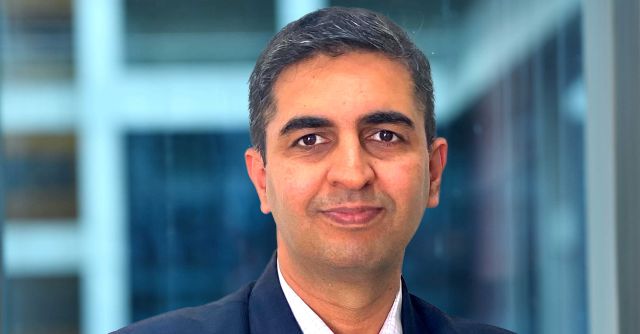
New Delhi, June 25 -- India's cash economy may be digitising rapidly, but cash itself is far from disappearing. For one of India's largest cash management companies, CMS Info Systems, that duality is shaping both its technology strategy and future growth plans. In an interview with TechCircle, Rajeev Bhatia, Chief Information Officer at CMS Info Systems, said the company has spent the last 17 years building a technology architecture that treats cash and digital payments not as competing ecosystems, but as parts of a single operational platform.
"India is not choosing between cash and digital - both are scaling simultaneously," Bhatia said. "We made a deliberate decision to build physical and digital operations on a single technology foundation, not as parallel stacks that talk to each other, but as one operational platform."
The company, historically known as India's largest cash logistics provider, now operates across ATM management, retail cash solutions, currency logistics and payment technologies. Its technology backbone is built around three proprietary platforms: HAWKAI, a Vision AI platform; ALGO, its software layer; and Retail 360, a retail cash optimisation platform.
Bhatia said the architecture is designed to create a "compounding effect", where operational scale generates data, data improves AI models, and AI-driven optimisation improves both physical and digital services.
That technology-first positioning is increasingly resonating with banks. CMS recently secured a Rs.400-crore, five-year mandate from HDFC Bank to manage 6,000 ATMs, including AI-led monitoring and managed services. The deal follows a major engagement with State Bank of India and an ATM outsourcing partnership with ICICI Bank.
"The more interesting signal here is architectural, not commercial," Bhatia said. "Banks historically managed ATM networks as physical infrastructure. What is changing is that banks are now treating ATM networks as technology infrastructure, with the same expectations they apply to core banking systems."
He added that banks are increasingly looking beyond uptime and cash replenishment. "The question banks are now asking is not who can keep ATMs running, but who can make the network intelligent."
AI has become central to that transformation. CMS uses machine learning models to forecast cash demand at individual ATMs based on transaction history, seasonality and vault data, helping reduce both cash shortages and excess idle cash.
On the maintenance side, predictive analytics models analyse hardware behaviour and error codes to anticipate failures before they occur. AI bots also review electronic journals and automatically reconcile transactions, reducing manual intervention across thousands of machines.
The company's HAWKAI platform now deploys more than 50 proprietary computer vision models that monitor intrusion attempts, loitering, and cassette validation and compliance requirements. Bhatia said the platform has grown from 20,000 live sites in FY22 to 50,000 sites in FY26.
"Our Vision AI platform has scaled from 20,000 live sites in FY22 to 50,000 in FY26 across urban centres and remote locations," he said. "An architecture that performs consistently across urban centres and remote locations is meaningfully harder to build than one optimised for controlled conditions."
A significant differentiator, according to Bhatia, is the company's ability to leverage operational data generated across its vast physical network. Every ATM transaction, cash replenishment route, monitoring event and field service visit is captured and consolidated into a centralised data lake built on Snowflake. The platform provides real-time visibility into service levels, cash positions, resource utilisation and operational exceptions.
"The question we asked ourselves is whether that data sits as a historical record or becomes the operating system for the business," he said. "We made a deliberate architectural choice to build toward the latter."
Bhatia believes this growing data asset is becoming a competitive moat. "A competitor can replicate the technology stack in isolation. They cannot replicate seventeen years of operational data generated at this network density across India's full range of infrastructure environments."
As financial services increasingly move toward real-time operations, CMS Info Systems is also investing heavily in edge computing. Bhatia argued that a purely cloud-based architecture is insufficient in a country where connectivity quality varies widely.
"Edge compute is becoming critical," he said. "Processing at the device level means a transaction is captured, validated and acted on locally without waiting on a central round-trip."
Looking ahead, Bhatia expects the next phase of financial infrastructure to be driven by autonomous systems rather than traditional monitoring tools. "The shift that matters most is not any single technology; it is the move from systems that detect and alert to systems that decide and act," he said.
He expects AI agents to increasingly manage routine operational workflows, from fault detection and technician dispatch to parts ordering and ticket closure, with minimal human intervention. "India's financial infrastructure over the next five years will be defined by technology networks that are increasingly self-monitoring and self-optimising," Bhatia said. "The move toward autonomous operations is already underway."
Published by HT Digital Content Services with permission from TechCircle.