
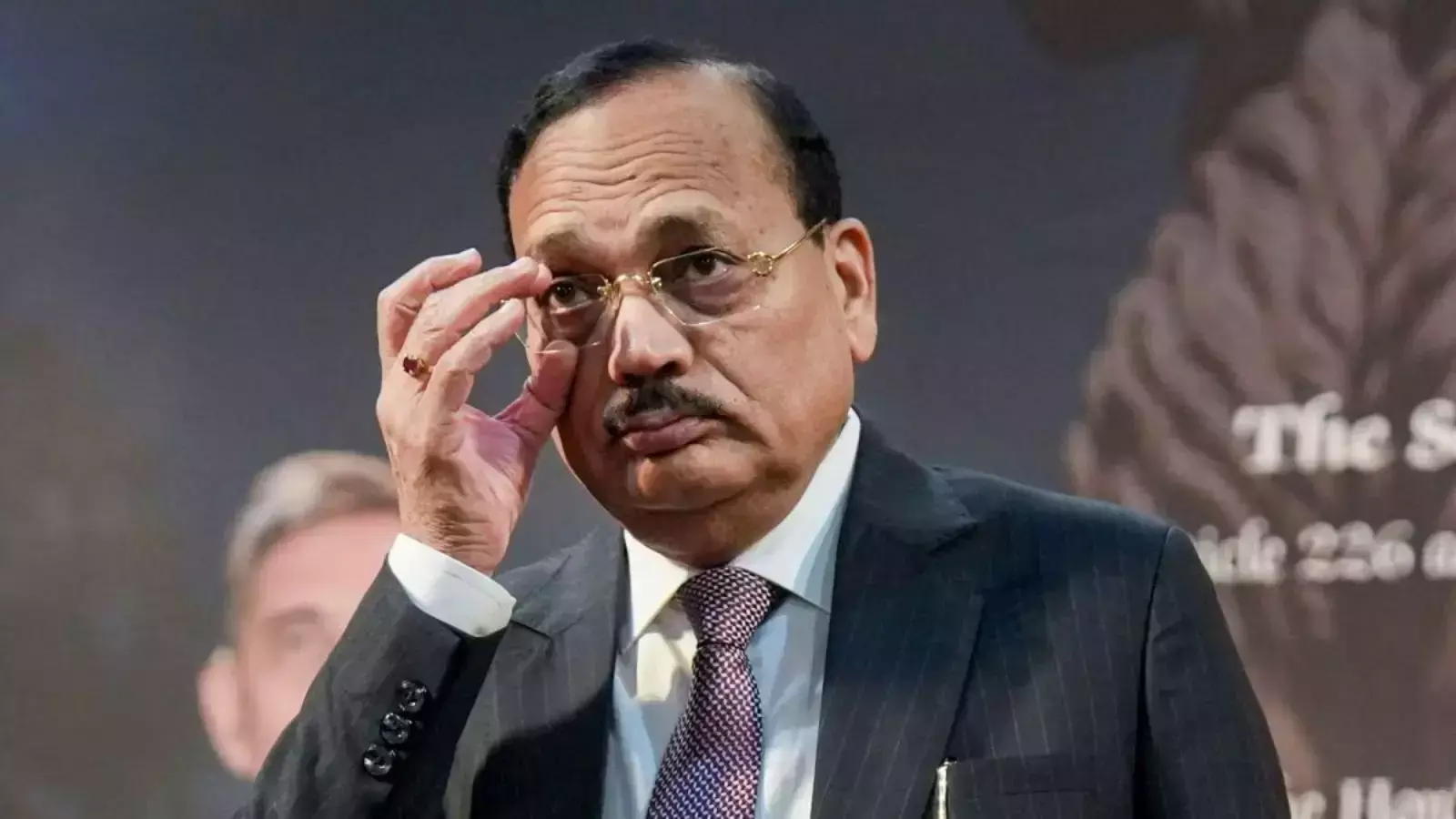
New Delhi, Aug. 31 -- Chief Justice of India Surya Kant has highlighted the enormous scale of global money laundering, saying that if estimates are even broadly accurate, the amount of money laundered worldwide in a year would be enough to buy a standard laptop for every one of the roughly 8 billion people on Earth, with money still left over.
Speaking at the 43rd International Symposium on Economic Crime in London, the CJI also stressed the need for stronger international cooperation to tackle economic offences, fraud and illicit financial flows. Surya Kant said that despite the vast amount of illicit money moving across borders, only a very small portion is ultimately recovered. He said that even under generous estimates, less than one in every 100 units of illicit money is recovered. The CJI also discussed the growing challenge of digital arrest scams, in which fraudsters pose as police officers, judicial officials or government authorities over video calls to deceive victims. He said the Supreme Court has taken suo motu cognisance of the issue and directed the Centre and states to examine its scope. He also referred to the need for a separate offence for digital arrest, with punishment linked to the extent of the harm caused.
Speaking about India's legal framework for dealing with economic crimes, Surya Kant referred to laws including the Prevention of Money Laundering Act and the Fugitive Economic Offenders Act. He acknowledged concerns over aspects of the enforcement process, including allegations regarding the grounds for arrest and prolonged custody, while noting that courts have intervened in such cases to safeguard due process. The CJI also referred to the Supreme Court's judgment in the Arvind Kejriwal case, saying that although the court found the arrest legally valid, it granted bail because prolonged detention before trial should not become a form of punishment.
He said that principles such as due process, proportionality and the presumption of innocence have remained central to the judicial approach despite changes in laws and procedures. Surya Kant further highlighted the role of civil recovery mechanisms alongside criminal proceedings, referring to the Insolvency and Bankruptcy Code. He said mutual legal assistance treaties with other countries can be more reliable than extradition for recovering assets, despite shortcomings in their implementation. Drawing on Kautilya's Arthashastra, the CJI noted that concerns over the misuse of public funds are not new and have existed for centuries. He said the nature of illicit wealth and economic crime means such activities do not respect national borders, making international vigilance and cooperation essential. He concluded by saying that the success of efforts against economic crime should not be judged merely by how well the problem is discussed, but by how effectively countries work to curb fraud and illicit financial activity after returning home.
Published by HT Digital Content Services with permission from Millennium Post.