
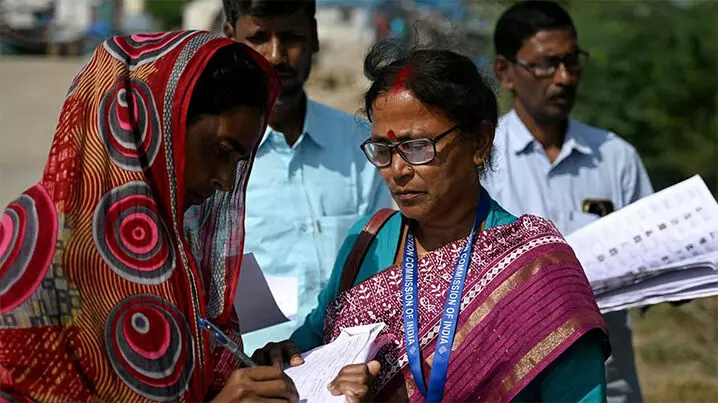
New Delhi, Oct. 11 -- "The vote is most precious."
- John Lewis
Imagine discovering that you exist everywhere except where it matters most. Your Aadhaar may say you are you. Your bank account may say you are you. Your electricity bill, school records, ration card, passport, property papers, tax records and mobile number may all carry the same name. But open the electoral roll and. You are not there.
That is the harsh reality behind the staggering 13.37 crore names left out of the draft electoral rolls after the Special Intensive Revision of voter lists across 30 states and Union territories. It is important to remember that these are draft-roll exclusions, not 13.37 crore confirmed cases of ineligible citizens being permanently deleted.
There is a process of claims, objections and re-enrolment still available. The Election Commission has also directed states where the exercise is complete to conduct special drives to enrol voters left out of the rolls. But that explanation, while necessary, does not make the anxiety disappear. Because for the citizen, the first shock is brutally simple: "My name is missing."
The Paperwork
Then begins the great Indian pilgrimage of proving that you are who you say you are. Documents. Old records. Addresses. Dates. Applications. Queues. Websites. Forms. Searches that do not work. Officials who are already dealing with thousands of cases. Elderly people trying to understand procedures. Families discovering that one member is on the roll while another has vanished.
For a migrant worker, a tenant, a person who has changed homes, a woman whose name or address changed after marriage, an elderly citizen or somebody whose records contain a spelling or address mismatch, this can become more than an administrative inconvenience.
Reports have shown how bewildering the exercise can feel on the ground. In Chandigarh, for instance, nearly 200,000 names were missing from the draft roll, including long-time residents who had voted for decades. This is the point where the debate needs to move beyond numbers.
The electoral roll is not merely another government database. It is the register that gives a citizen access to one of the most fundamental acts of citizenship: choosing who governs. If the name is absent, the citizen may still be an Indian citizen. But on polling day, citizenship alone does not put a ballot paper-or its electronic equivalent-in the voter's hands. That is a serious distinction.
More Than A Vote
The deeper problem is psychological. A country cannot casually make people feel that their existence is conditional on their ability to navigate paperwork. Voting is not a privilege handed out by the state as a favour. For an eligible citizen, it is a constitutional democratic right, subject to the law. The system, therefore, has two equally important responsibilities: keep ineligible names out, and make absolutely certain that eligible citizens are not stranded outside it.
The first protects the integrity of elections. The second protects the integrity of citizenship. The consequences of getting the second part wrong are larger than one election.
India has spent decades building systems around the idea that an ordinary citizen can establish an identity, obtain documents, send children to school, access subsidised food, receive welfare, open a bank account, travel, work and participate in public life without having to repeatedly prove that he or she belongs here.
That is what makes the sight of crores of people suddenly having to ask, "Am I still on the voter list?" so unsettling. There is also something deeply embarrassing about it-not because India is undertaking a revision of its electoral rolls. Clean and accurate rolls are essential to a functioning democracy. The embarrassment lies in the possibility that a citizen who has lived, worked, paid taxes, raised a family and voted for years can be made to feel like an administrative stranger in his own country.
Sensible Way Out
There is a lesson here for everyone. The Election Commission must be able to clean electoral rolls. Citizens must be able to challenge exclusions. Political parties must have a role in scrutiny. The system must be tough on bogus entries without becoming intimidating for genuine voters. But the burden of correction should not fall disproportionately on the person who has already been left out.
The sensible path is straightforward: make inclusion easier than exclusion. If a name is missing from a draft roll, the citizen should be told why, what evidence is required, where to submit it and how the case will be resolved. Quickly. There should be simple digital and physical routes, accessible assistance for the elderly and vulnerable, and enough time for genuine mistakes to be corrected.
Most importantly, a citizen who was on the electoral roll should not feel that he has suddenly become a new applicant for the right to vote. The number 13.37 crore is so enormous that it risks becoming just another headline. It should not. Behind that number are 13.37 crore names. And behind every name is a person who expects the Republic to know that he or she exists. That is not too much to ask.
Views expressed are personal. The writer is a journalist & communications specialist
Published by HT Digital Content Services with permission from Millennium Post.