
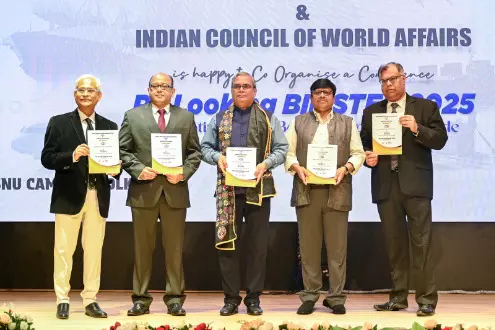
Kolkata, March 20 -- The BIMSTEC programme at Sister Nivedita University (SNU) in Kolkata stressed the importance of paperless trade for economic integration and facilitating FTA among BIMSTEC countries, while stating that in times of global crisis, working closely could be a blessing for the members.
Titled 'Relooking BIMSTEC 2025', the programme deliberated on the importance of moving away from traditional trade and going digital to enforce speed and create ease of doing business.
In his welcome address, Prof (Dr) Dhrubajyoti Chattopadhyay, Pro Chancellor, TIG Group of Universities & Central Academic, said: "Transforming what was traditionally a paper-based documentation system into an electronic format can speed up trade and ease the cost of doing business in today's interconnected world." HE Amb Indra Mani Pandey, Secretary General BIMSTEC Secretariat, Dhaka, said: "Regional organisations are more effective and efficient due to their small membership, which makes it easy to build consensus and find solutions. Regional organisations are also not impacted by global political upheavals."
Dr Prabir De, Professor, Maritime Economy and Connectivity (CMEC) RIS, New Delhi, said: "BIMSTEC is going to be a panacea for the needs of the seven member countries. Because of the number of crises across the globe, the members are facing a shared challenge, starting with the shipping crisis. Most of the BIMSTEC countries are in medium to high impact zones if the war continues in the Gulf. Our regional trade percentage is low at 7 per cent, compared to other such understandings. We are hoping that in 2026 the regional trade volume will touch 60 billion to 68 billion, making it 8 per cent."
Abhijit Chakraborty, Joint Secretary, ICWA, New Delhi, said that paperless trade is often seen as a solution to supply chain disruption and a means to reduce operational costs.
Published by HT Digital Content Services with permission from Millennium Post.