
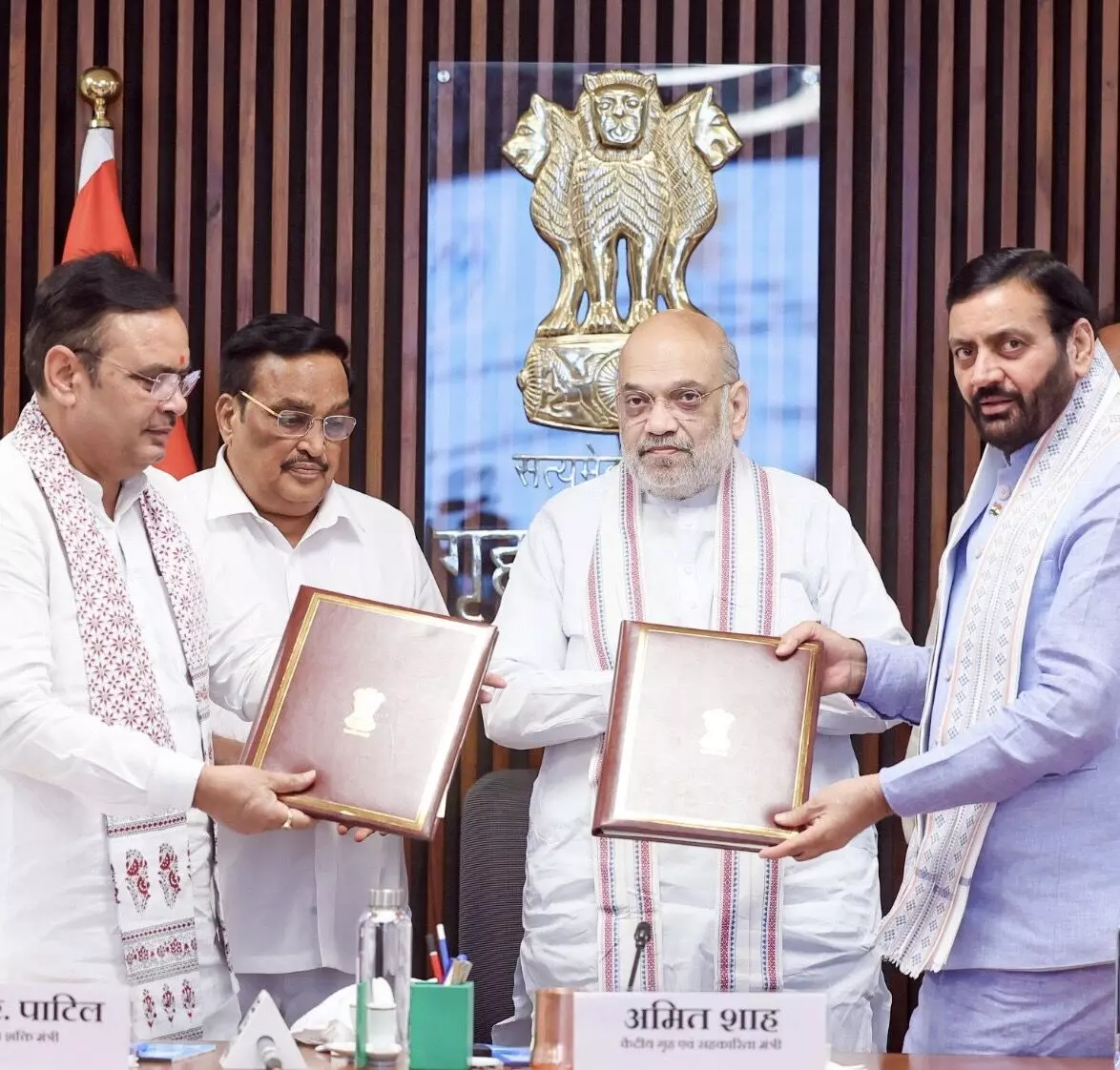
New Delhi, June 29 -- In a major breakthrough in a nearly three-decade-old water-sharing dispute, the governments of Rajasthan and Haryana on Friday signed an agreement for the construction and implementation of the Yamuna Water Project in the presence of Union Home Minister and Cooperation Minister Amit Shah.
The agreement marks a significant step towards resolving a long-pending issue between the two states through dialogue and mutual cooperation. The pact was formally signed in New Delhi in the presence of Rajasthan Chief Minister Bhajan Lal Sharma, Haryana Chief Minister Nayab Singh Saini and Union Jal Shakti Minister C.R. Patil.
Addressing the gathering, Amit Shah described the agreement as an example of Prime Minister Narendra Modi's cooperative and consensus-based approach to governance. He said the dispute, which had remained unresolved for nearly 30 years, was settled through discussions and coordination rather than confrontation.
The project aims to ensure the supply of drinking water to several districts in both states. Under the agreement, about 580 million cubic metres of water will be transported annually from the Western Yamuna Canal to Rajasthan between July and October through three underground pipelines, each more than 3.6 metres in diameter.
The arrangement is expected to benefit Rajasthan's districts of Sikar, Churu and Jhunjhunu, as well as Haryana's Bhiwani and Fatehabad districts. The underground pipeline network has been designed to facilitate efficient and regulated water distribution.
Shah said the agreement clearly outlines the financial responsibilities of both states, the mechanism for sharing project costs, water allocation and procedures for operation and maintenance of the infrastructure.
The project will help Rajasthan receive its share of water allocated under the 1994 agreement concerning the Upper Yamuna Basin. The use of underground pipelines is expected to minimise losses and improve the efficiency of water transportation.
Officials said the project would provide reliable drinking water to millions of people and could also contribute to groundwater recharge in water-stressed areas. The initiative is expected to particularly benefit the arid and semi-arid regions of Rajasthan.
Published by HT Digital Content Services with permission from Millennium Post.