
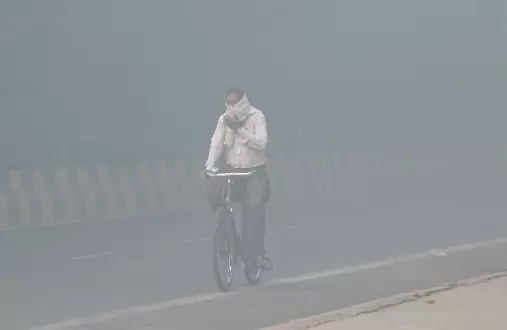
New Delhi, Nov. 9 -- Delhi recorded its most polluted Diwali in five years but the extent of its severity was likely worse than official figures showed as several monitoring stations went offline on Sunday night during the peak period of firecracker use in the Capital, raising questions over the reliability of the AQI tracking exercise itself.
AQI (air quality index) readings put out by private agencies did, in fact, paint a much more unpleasant picture than what the official figures reflected, with most parts of Delhi-NCR reporting extremely hazardous air pollution levels, leading experts to cast doubts over government data.
Experts tracking the numbers in real time said key monitoring stations stopped reporting data during the night - when pollution levels shot through the roof as the Supreme Court-mandated time restrictions on the use of fireworks went up in smoke - while flagging significant discrepancies between the readings reported by government and private monitoring agencies.
Ruing the absence of credible official data during the worst period of pollution, Anumita Roychowdhury, executive director of the Centre for Science and Environment (CSE), said the monitoring network's failure to provide real-time readings was inexplicable despite substantial public investment in its establishment and maintenance.
"When substantial public funds have been invested in establishing Delhi-NCR's air quality monitoring network - the densest in the country - backed by active operation and maintenance contracts, a data eclipse precisely during peak Diwali pollution is inexplicable," she said.
She said real-time data should have driven targeted public health advisories and calibrated emergency responses.
"While the severity of exposure is evident on the ground, credible official data is needed for institutional accountability, public awareness and mitigation. Losing data does not reduce the public health emergency," Roychowdhury said.
Responding to a query about the issue at a press conference, Delhi cabinet minister Kapil Mishra asked reporters to share details of AQI monitoring stations reported to be non-functional, saying he would seek action on the matter.
From midnight to 2 am, more than 20 stations were not reporting data during peak smog hours, according to an analysis by the Centre for Research on Energy and Clean Air (CREA). Data from Delhi's 59 air quality monitoring stations showed that the number of stations with missing readings increased sharply as Diwali night progressed, peaking in the early hours of Monday.
While only one station had missing data at 7 pm on Sunday, the number rose to seven by 10 pm and 23 by 11 pm. By midnight, 29 stations were not reporting data, with the number rising further to 36 at 1 am on Monday. This meant that only 23 of the city's 59 monitoring stations were reporting readings at that time.
The gap remained high at 2 am, when 35 stations had missing data, before gradually declining. At 3 am, 30 stations were not reporting, while the number dropped to 20 by 4 am, 19 by 5 am and 16 by 6 am.
Missing readings at several monitoring stations and sharp variations between official and private AQI figures triggered fresh concerns over data reliability. The AAP alleged manipulation, while experts stressed the need for transparency, accountability and accurate pollution monitoring during the crisis.
Published by HT Digital Content Services with permission from Millennium Post.