
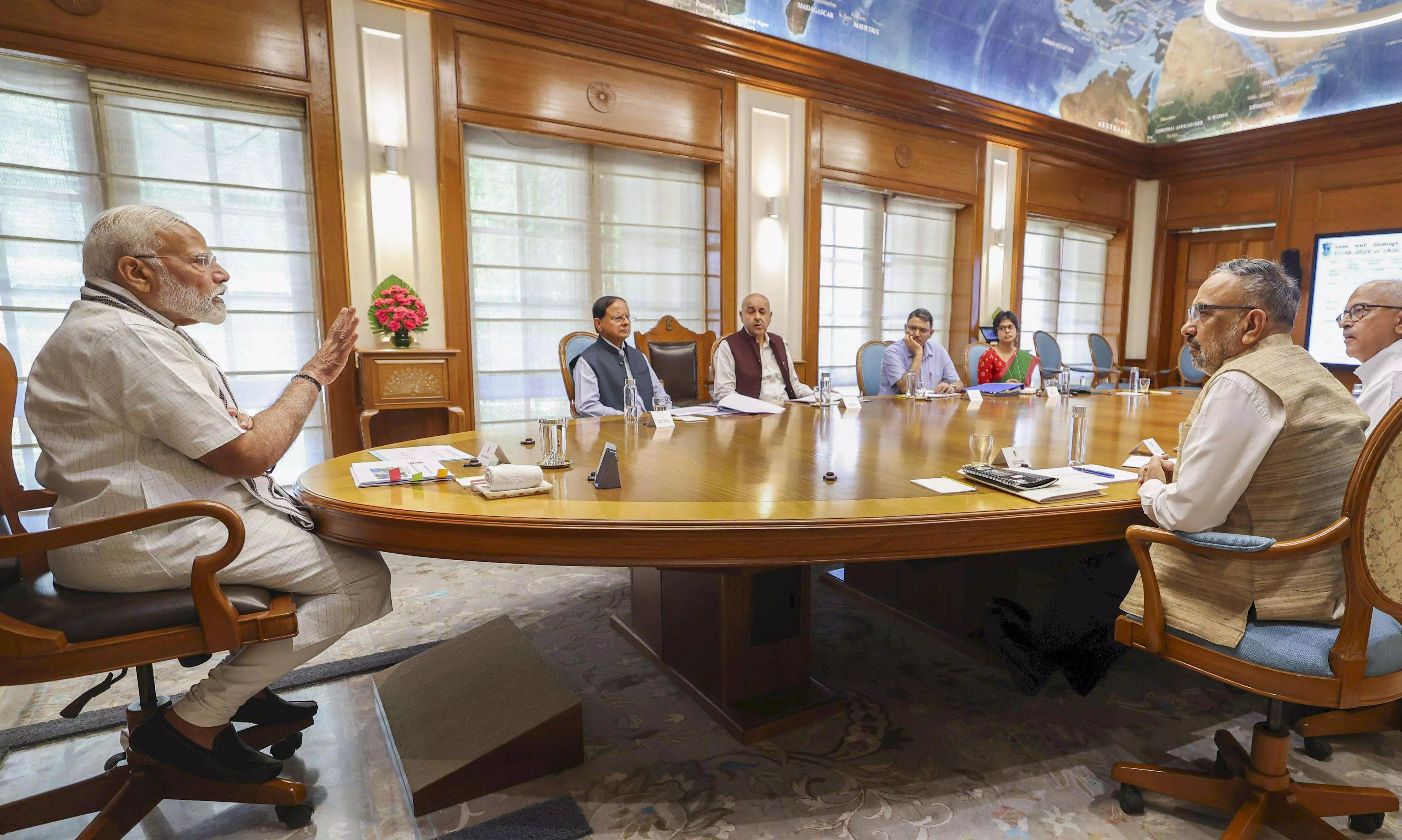
New Delhi, March 22 -- The Cabinet Committee on Security on Sunday carried out a comprehensive review of the situation arising from the ongoing conflict in West Asia, assessing its implications for India's economy and the availability of essential commodities. The high-level meeting, chaired by Prime Minister Narendra Modi, focused on ensuring uninterrupted access to food, fuel and energy for citizens while preparing both immediate and long-term responses to the evolving crisis.
According to an official statement, the prime minister directed the creation of a dedicated group of ministers and senior officials to adopt a whole-of-government approach in handling the fallout of the conflict. The aim is to coordinate responses across sectors and minimise disruption to daily life.
Describing the situation as fluid with global consequences, Modi said the conflict is affecting countries worldwide in varying degrees. "All efforts must be made to safeguard citizens from its impact," he said, calling for close coordination among all arms of government to ensure minimal inconvenience.
The CCS, the country's top decision-making body on strategic and security matters, reviewed in detail the availability of critical supplies. These included food grains, fertilisers, fuel, electricity and other essentials that directly affect households and businesses. The meeting also examined the broader macroeconomic outlook and potential policy responses.
Officials said the discussions covered a wide range of sectors, including agriculture, fertilisers, petroleum, power, shipping, trade, finance, supply chains, MSMEs and exports. The expected short, medium and long-term impact of the conflict on the global economy, and consequently on India, was assessed alongside possible countermeasures.
In a post on X after the meeting, Modi said there were extensive deliberations on steps such as ensuring continued fertiliser availability for farmers, diversifying import sources and identifying new export markets. "We are committed to safeguarding our citizens from the impact of the conflict," he said.
The requirement of fertilisers for the upcoming kharif season was reviewed, with officials noting that stockpiling measures taken in recent years would help maintain adequate supply. The government also explored alternative sourcing options to secure future availability and maintain food security.
On the energy front, it was assessed that sufficient coal stocks at power plants would prevent electricity shortages. The situation relating to crude oil, natural gas and other petroleum products was also reviewed in light of the disruptions triggered by the conflict.
Sources said the meeting placed strong focus on maintaining uninterrupted supply chains, stable logistics and efficient distribution systems across the country. Measures were also discussed to diversify import sources for key industrial sectors such as chemicals, pharmaceuticals and petrochemicals, which are sensitive to global supply disruptions.
At the same time, the government is planning to expand export outreach to new destinations to support Indian businesses affected by shifting trade patterns. Several proposals put forward by different ministries will be finalised and implemented after consultations with stakeholders in the coming days.
Cabinet Secretary T V Somanathan made a detailed presentation on the global situation and the steps already taken by various ministries. Future plans were also outlined as part of a coordinated response strategy.
The prime minister instructed officials to work closely with state governments to prevent hoarding and black marketing of essential commodities, ensuring that supplies remain accessible and affordable for consumers.
The meeting was attended by Defence Minister Rajnath Singh, Home Minister Amit Shah, Finance Minister Nirmala Sitharaman and External Affairs Minister S Jaishankar, who are members of the CCS. Several other senior ministers were invited due to the cross-sectoral nature of the crisis, including Shivraj Singh Chouhan, J P Nadda, Piyush Goyal, Ashwini Vaishnaw, Sarbananda Sonowal, Manohar Lal Khattar, Pralhad Joshi, Kinjarapu Rammohan Naidu and Hardeep Singh Puri.
National Security Advisor Ajit Doval and senior officials from the Prime Minister's Office were also present.
The conflict in West Asia began on February 28, when the United States and Israel carried out strikes on Iran. Iran responded with attacks targeting Israel and several Gulf countries hosting US military bases, escalating tensions across the region.
A key concern for India and other energy-importing nations has been the situation in the Strait of Hormuz, controlled by Iran. The route accounts for about 20 per cent of global energy shipments. Since the outbreak of hostilities, Iran has allowed only limited shipping through the passage, leading to significant disruptions in global energy supply.
The prime minister had earlier, on March 12, described the conflict as having triggered a worldwide energy crisis, calling it a test that requires calm, patience and awareness. He had also said that efforts were underway to address disruptions in international supply chains.
In recent weeks, Modi has spoken with leaders from several countries, including Saudi Arabia, the United Arab Emirates, Qatar, Bahrain, Kuwait, Jordan, France, Malaysia, Israel and Iran, as part of diplomatic outreach linked to the crisis.
Officials said the government would continue to monitor the situation closely and adjust its response as the conflict evolves, with the priority remaining the protection of citizens and economic stability.
Published by HT Digital Content Services with permission from Millennium Post.