
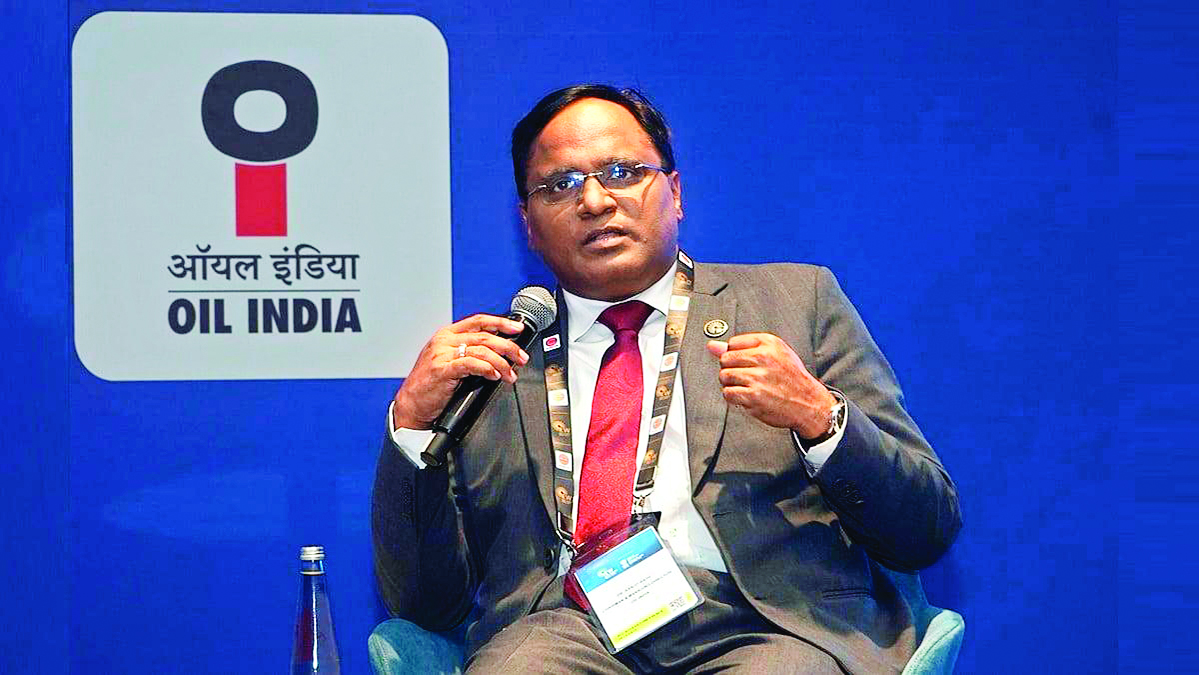
New Delhi, Sept. 17 -- Oil India Ltd (OIL) will be increasing its exploration efforts in deep-water and ultra-deep-water blocks through technological collaboration and possible collaboration with International Oil Companies (IOCs) and National Oil Companies (NOCs), as OIL, which is one of the seven Maharatna public sector undertakings (PSUs), plans to counter the high geological and financial risks of offshore exploration.
Talking to Millennium Post on the sidelines of the 67th Annual General Meeting of OIL, the company's Chairman and Managing Director Ranjit Rath said OIL already has a technology service agreement with TotalEnergies for its offshore exploration efforts.
"We have a technology service agreement with TotalEnergies for all our offshore explorations. In addition to that, we are also looking for collaboration from IOCs/NOCs internationally in the upcoming bidding rounds for OLP-10 and OLP-11," Rath added.
The official further said that OIL is looking into some of the potential blocks where OIL could collaborate with IOCs and NOCs, and OIL is gearing up for the coming bidding rounds.
According to Rath, the success of OIL in exploration in the Andaman and Nicobar islands area has increased their confidence in taking up offshore activities. The company has proved that there is natural gas in two out of the three drilled wells."OIL has gained confidence from it, and these global partnerships will help us in our Samudrayaan initiative," said Rath.
The company will follow a phased approach for its offshore exploration where first a well will be drilled and then, depending on the outcome of the first well, another will be drilled.
Rs 15,000 crore capital provision for offshore exploration projects
According to Rath, OIL has made a capital provision of about Rs 15,000 crore for its offshore exploration plans. The company will get further insurance coverage from the offshore exploration plan launched by the government.
The offshore project can require investment of about Rs 1,300-1,500 crore, whereas government support can range up to Rs 675 crore.
"This will give us plenty of risk coverage, and it will happen on an annual basis. We can make plans about our capital expenditure in such a way that we are planning for a three-year capex," Rath said.
Large-scale seismic surveys and parametric or stratigraphic wells can lower the risks of geology.
Andaman discovery set for appraisal
In relation to the Andaman discovery, Rath said that OIL would carry out an appraisal program before making the decision regarding development. There is already confirmation of the presence of hydrocarbons in the area, but the exact extent of the commerciality of the discovery is to be appraised.
"Exploration has to come first before the development of any infrastructure. After the evaluation and correlation of the discovery, infrastructure development will take place," he said.
As far as deep water and ultra deep water discoveries are concerned, OIL believes there will not be any problem with infrastructure.
Gas, clean energy to dominate
OIL will continue with both onshore and offshore exploration and development. It conducted drilling at 74 wells in the previous year, of which 22 were exploratory, and 52 were developmental, as well as 307 workover drilling operations. Its current oil production is estimated at 86,000 barrels per day.
There will be more emphasis on natural gas, with Rath forecasting gas production at about 5 BCM, while that of oil will be at more than 4 million tonnes. There will also be an increase in PNG and CNG usage in the Northeast and gas supply for industries and fertilisers.
In addition to hydrocarbon production, OIL is also making investments in solar and wind energy, compressed biogas, geothermal energy, and carbon sequestration. The latter will comprise compressed biogas plants that can process about 1,500 tonnes of municipal solid waste daily at four sites, among other initiatives.
Published by HT Digital Content Services with permission from Millennium Post.