
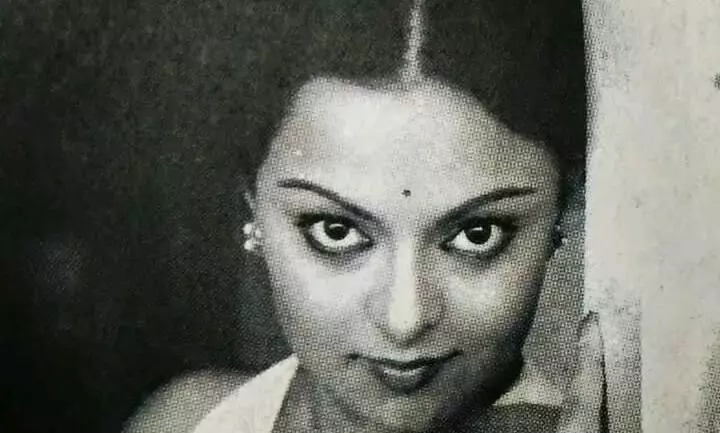
New Delhi, Sept. 21 -- The year was 1975. 'Swayamsiddha', directed by Sushil Mukhopadhyay, had been released. My father and my uncle, both in their second year of college, went to watch the Bengali film at Rupkatha theatre in Habra, a not-so-developed city then in North 24 Parganas, around 47 km from Kolkata.
In the film, actress Mithu Mukherjee's newlywed character is in for a rude shock when she discovers that her husband, played by Ranjit Mallick, has intellectual disabilities. When she learns that her brother-in-law is responsible, she takes matters into her own hands. The film featured some of the stalwarts of Bengali cinema, including Chhaya Devi, Utpal Dutt, Bhanu Banerjee, Kali Banerjee and Satya Bandopadhyay. But Mithu held her own. We talk about 'women rage bait' today, a term used mostly by Gen Z. But way back in 1975, a Bengali commercial film depicted an angry woman who took charge of the narrative, sought justice and set out to avenge the wrongs done to her.
On Sunday night, at the age of 71, Mithu passed away at a private hospital in Mumbai. She had been battling cancer for a long time. Bengali cinema saw several actresses emerge in the 1970s, but few managed to leave an impression quite like Mithu did. She didn't work in too many films, but the ones she did, like 'Marjina Abdullah', 'Mouchak', 'Swayamsiddha', 'Nishi Kanya', 'Pratima', 'Safed Jhooth' in Hindi and 'Ashrita', her last Bengali film, never quite left the minds of cinegoers.
But Mithu wasn't merely a brilliant, natural actress. Along with her organic acting skills, it was her vivacious screen presence that set her apart from her contemporaries. She possessed a spirited, mischievous and almost teasing personality, something that was brilliantly reflected in her characters in 'Marjina Abdullah', 'Mouchak' and 'Swayamsiddha'. Calling her merely glamorous would be an understatement. She was a complete package of beauty, sensuality, innocence, wit and mischief, with a dash of unpredictability that made her memorable among the leading actresses of her generation.
Remember the scene where Ranjit Mallick and Mithu wear masks of a tiger and a cow to hide themselves in a park where they had gone to meet? The 1974 film 'Mouchak', also starring Uttam Kumar and Sabitri Chatterjee, proved Mithu's acting acumen, her natural performance effortlessly blending with playfulness.
Born in Kolkata on June 19, 1955, Mithu entered the industry at the age of 17, making her debut with 'Shesh Parba' in 1972. Despite featuring stars such as Pahari Sanyal, Utpal Dutt, Sabitri Chatterjee and Samit Bhanja, the film didn't work. But later that year, 'Marjina Abdullah' came. As Marjina, Mithu not only displayed her strength as a natural actress but also her dancing skills and sensuous screen presence, winning over audiences.
She followed it up with 'Nishi Kanya' alongside Soumitra Chatterjee in 1973. But it was 1974 and 1975 that became the defining years of her career, with Arabinda Mukherjee's iconic 'Mouchak' and 'Swayamsiddha', respectively. Ranjit Mallick was her leading man in both. On Monday, Mallick posted a video message remembering his 'Mouchak' co-star. Yet to come to terms with her demise, the actor spoke of Mithu's stunning act in 'Swayamsiddha' opposite a legendary actress like Chhaya Devi. "She was younger than us. This kind of news is so shocking. I still can't believe this," he said.
Mithu became so popular with her 'Mouchak' act that it is said Uttam Kumar wanted her as his co-actress. In 1976, the two shared the screen in 'Hotel Snow Fox' and 'Chander Kachhakachhi', though neither film worked at the box office.
At the height of her career, Mithu also worked in Hindi films, mostly with veteran filmmaker Basu Chatterjee. In 1977, she made her Hindi film debut with Chatterjee's 'Safed Jhooth', a remake of the Bengali film 'Chhutir Phandey'. The film starred Vinod Mehra and Ashok Kumar. She subsequently acted in 'Dillagi' and 'Do Ladke Dono Kadke', both directed by Chatterjee.
Like Bollywood's iconic actress Rekha, who believed in enhancing her natural features, particularly her deep, expressive eyes and lips, Mithu too had a distinctive physical presence that needed little embellishment. It didn't take long for cinelovers to compare her with Rekha. Many film critics, however, also found shades of Mumtaz in her. Her jest, her dance moves and her pout, they believed, were more reminiscent of Mumtaz. Unlike the prim, proper and petite image associated with several Bengali actresses of the time, Mithu was raw and uninhibited, many critics believe.
In Bengali cinema, the legendary Suchitra Sen chose to leave the film industry gracefully and lead a private life. Mithu did something similar. After 'Prarthana' in 1984, she took a six-year hiatus before returning with the Bengali film 'Ashrita', directed by 'Don' Chandra Barot. The film became a huge hit. Yet after that, she largely stayed away from the spotlight. She had a house in Kolkata, which she later sold before settling in Mumbai.
Actress Rituparna Sengupta remembered Mithu for her rare, magnetic charm, something seldom seen in actresses. That stunning mole on her cheek and those endearing dimples were perhaps what made Mithu Mukherjee truly unique. Rituparna also recalled the 'Ashrita' poster and how Bijoli Cinema remained packed month after month, with the film running for nearly a year in Kolkata in 1990.
Talking about Mithu without talking about her songs would be blasphemy. 'Besh Korechi Prem Korechi' from 'Mouchak' or the famous 'Swayamsiddha' song, 'Alo Aar Alo Diye Mone Hoy'. Both were sung by Asha Bhosle. And how can Bengalis forget Marjina Abdullah's songs - 'Haay Haay Praan Jaay', 'Baje Go Beena', 'Maar Jharu Maar' and 'O Bhai Re Bhai' - all composed by veteran Salil Chowdhury.
In the circle of life, some actors continue to work until their last breath, while others work briefly but leave behind a lasting impact. Mithu Mukherjee belonged to the latter category. With a handful of films, an unmistakable screen presence and performances that refused to fade from memory, she carved out a place for herself in Bengali cinema, one that time couldn't quite erase.
Published by HT Digital Content Services with permission from Millennium Post.