
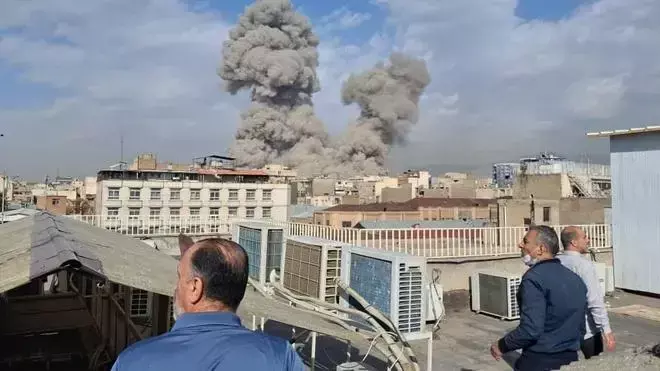
Dubai, Feb. 28 -- The US and Israel launched a major attack on Iran on Saturday, and President Donald Trump called on the Iranian public to "seize control of your destiny" by rising up against the Islamic leadership that has ruled the nation since 1979.
In retaliation, Iran fired missiles and drones toward Israel and US military bases at multiple locations in the region. Iran launched a wave of strikes toward Israel and US targets across the Middle East. Explosions were reported in the UAE, Qatar, Dubai and Bahrain, where a missile reportedly struck a US Navy base.
The United Arab Emirates called the conflict a "historic moment" in the Middle East, saying world leaders had failed to ensure the region's stability.
Some of the first strikes on Iran appeared to hit areas around the offices of Supreme Leader Ayatollah Ali Khamenei. Smoke could be seen rising from the capital as part of strikes that Iranian media said occurred nationwide. It wasn't immediately clear whether the 86-year-old leader was in his offices when the attack occurred.
Iranian Foreign Minister Abbas Araghchi told NBC News that Khamenei and President Masoud Pezeshkian are alive "as far as I know."
"When we are finished, take over your government. It will be yours to take. This will be probably your only chance for generations," Trump said in a video announcing "major combat operations." "For many years, you have asked for America's help, but you never got it."
Israeli Prime Minister Benjamin Netanyahu echoed that goal, saying, "Our joint operation will create the conditions for the brave Iranian people to take their fate into their own hands." The strikes during the holy fasting month of Ramadan opened a stunning new chapter in US intervention in Iran and marked the second time in eight months that the Trump administration has used military force against the Islamic Republic.
They also came weeks after a US military operation that captured Venezuela's president, Nicolas Maduro, and brought him and his wife to New York to face federal drug conspiracy charges. Democrats decried that Trump had taken action without congressional authorization. Rep. Hakeem Jeffries, the top House Democrat, said that though Iran is a "bad actor," the president must nonetheless "seek authorisation for the pre-emptive use of military force that constitutes an act of war."
Tensions have soared in recent weeks as American warships moved into the region. Trump said he wanted a deal to constrain Iran's nuclear program at a moment when the country is struggling at home with growing dissent following nationwide protests.
The immediate trigger for Saturday's strikes appears to be the unsuccessful latest round of nuclear talks. But they also reflect the dramatic changes across the region that have left Iran's leadership in its weakest position since the Islamic Revolution nearly half a century ago.
Israeli and American strikes last June greatly weakened Iran's air defences, military leadership and nuclear program. A regionwide war, sparked by Hamas' Oct. 7, 2023, attack on Israel, has left Iran's network of proxies across the Middle East greatly weakened. US sanctions and global isolation, meanwhile, have decimated Iran's economy.
Iran responded to the latest strikes as it had been threatening to do for months, including by launching missiles and drones targeting Israel as well as strikes targeting US military installations in Bahrain, Kuwait and Qatar. "The time has come to defend the homeland and confront the enemy's military assault," Iran's Foreign Ministry said in a statement on X.
At least 57 people were reported killed at a girls' school in southern Iran in the Israeli-US strikes, and dozens others were wounded, according to Iran's state-run IRNA news agency.
In an indication of the scope of the conflict, flights across the Middle East were disrupted and air defense fire thudded over Dubai, the commercial capital of the United Arab Emirates. Shrapnel from an Iranian missile attack on the capital of the UAE killed one person, state media said. The US military has for weeks amassed forces in the region, even as US and Iranian envoys held talks in Switzerland and Oman aimed at finding a diplomatic solution.
"Active and serious negotiations have yet again been undermined," Oman's Foreign Minister Badr al-Busaidi said on X. Al-Busaidi, a key mediator in the talks, traveled to Washington on Friday to meet with Vice President JD Vance.
"Neither the interests of the United States nor the cause of global peace are well served by this," al-Busaidi said. "And I pray for the innocents who will suffer. I urge the United States not to get sucked in further." Trump, in justifying the military action, claimed Iran has continued to develop its nuclear program despite asserting last year the program had been "obliterated" by an earlier round of strikes. He acknowledged Saturday that there could be American casualties, saying "that often happens in war."
It was a notable call on Americans to brace themselves from a US leader who swept into office on an "America First" platform and vowed to keep out of "forever wars" that had bogged down his recent predecessors. Trump's statement listed grievances beyond the nuclear program, stretching back to the beginning of the Islamic Republic following a revolution in 1979 that turned Iran from an American ally in the Middle East into a fierce foe.
The US president said he was aiming to "annihilate" the Iranian navy and destroy regional proxies supported by Tehran.
He also called on the Iranian Revolutionary Guard to lay down arms, pledging members would be given immunity, while warning they would face "certain death" if they didn't.
The strikes could rattle global markets, particularly if Iran is able to make the Strait of Hormuz unsafe for commercial traffic. A third of total worldwide oil exports transported by sea passed through the strait in 2025.
Iranian media reported strikes nationwide. Roads to Khamenei's compound in downtown Tehran had been shut down by authorities as other blasts rang out across the capital.
Hours after the strikes, Iran's paramilitary Revolutionary Guard said it launched a "first wave" of drones and missiles targeting Israel. There was no immediate word on any damage or casualties. Saudi Arabia said in an announcement on state-run media that Iran had targeted its capital and its eastern region in an attack that was repelled. Bahrain said a missile attack targeted the US Navy's 5th Fleet headquarters in the island kingdom. Witnesses heard sirens and explosions in Kuwait, home to US Army Central. Explosions could also be heard in Qatar. US embassies or consulates in Qatar, United Arab Emirates and Israel posted on social media that they told staffers to shelter in place and recommended all Americans "do the same until further notice." Bahrain said that a missile attack targeted the US Navy's 5th Fleet headquarters in the island kingdom. It offered no other immediate information about the attack.
Meanwhile, India expressed its concern over the growing military conflict between Iran and the Gulf region, urging both nations to exercise restraint in the matter and not to take any step that could further destabilise the region and threaten the lives of innocent citizens.
The statement issued by the Ministry of External Affairs (MEA) stressed that dialogue is the only way to resolve the conflict between the two nations, and therefore, all the nations involved must try to resolve the matter through peaceful means. "All parties must prioritise peaceful engagement to de-escalate tensions and address underlying issues," the MEA statement said, while also stressing the need to respect the sovereignty and territorial integrity of all nations.
The government has also stated that the Indian missions in the region are in close contact with the Indians living in the region and that they are keeping a close eye on the matter.
Published by HT Digital Content Services with permission from Millennium Post.