
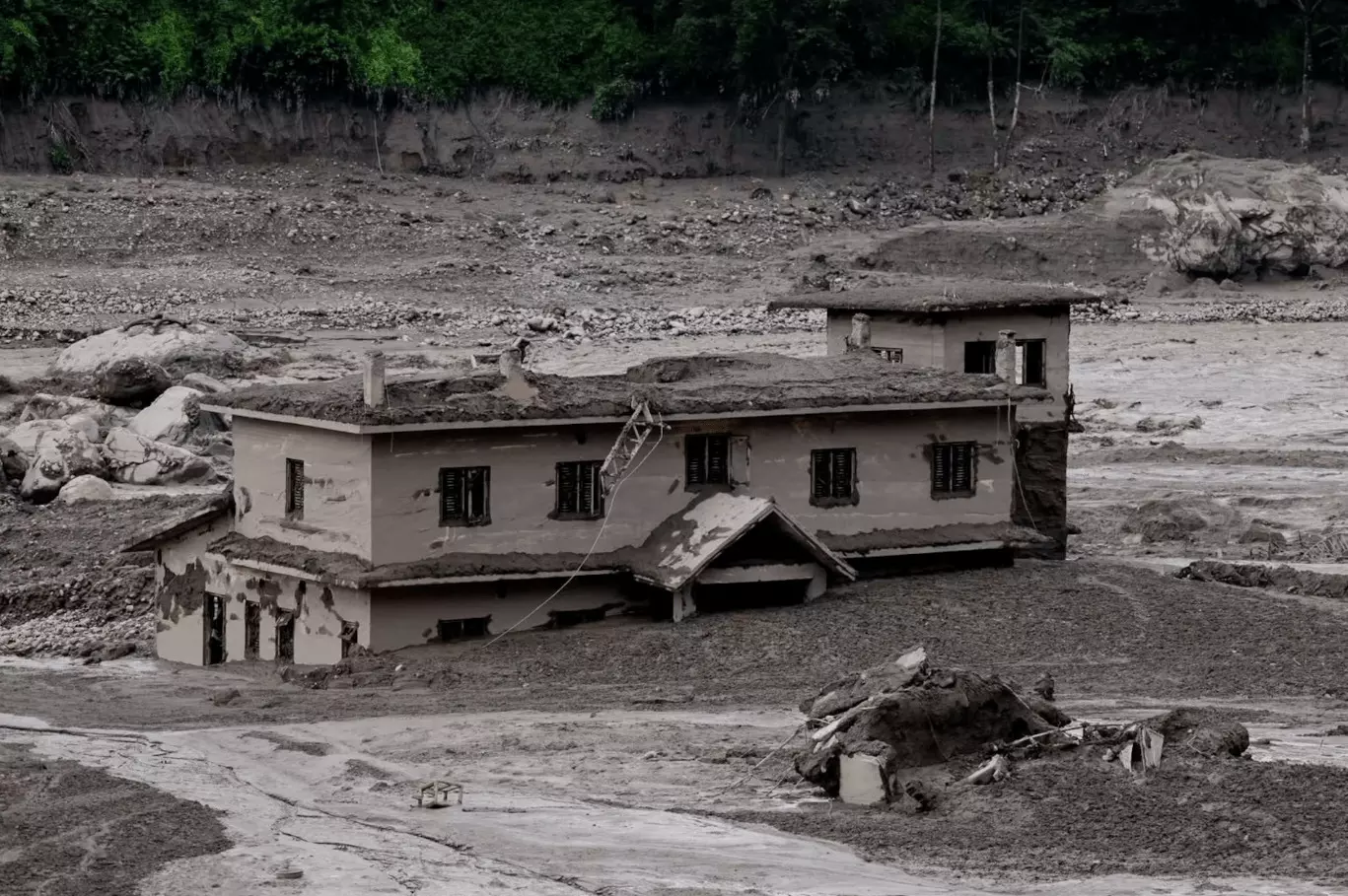
New Delhi, Oct. 10 -- Two devastating events in quick succession have brought forth the special challenge that mountains and glaciers pose in the face of climate change: the Broad Peak tragedy in late July 2026, where ten elite mountaineers perished, and the catastrophic floods in Nepal in late August 2026, which led to more than 1,000 deaths and massive destruction of infrastructure (such as power plants and roads) and houses. Both events had similar proximate causes: the loosening of a large cornice or serac, which broke away from a snowy rib in the case of Broad Peak, and the loosening of a 'hanging glacier' from the underlying slope, leading to massive volumes of water flowing down the Bhote Koshi River once the melted glacier broke free from its loose boundary. The ultimate cause was the rise in greenhouse gas emissions, which is leading to global warming and erratic weather around the world. In this three-part article, we will first look at the devastation in Nepal in the first article and the Broad Peak tragedy in the second article, and relate these to our economic and scientific models discussed earlier.
The Nepal floods
From publicly available information, it appears that the Nepal floods were caused by the collapse of a glacier and rock, which fell into the Lhende River. This happened in the upper reaches of the Tibetan Himalayas in Langtang National Park and led to massive volumes of water travelling at a speed of about 170 km per hour, destroying everything in their path, including the hydel power plants on the Trishuli River, roads, bridges, houses and other buildings. Some others have suggested that the floods were caused by the bursting of a glacial lake (or GLOF: Glacial Lake Outburst Flood) formed by the breaking away of a huge chunk of glacier. Whatever the cause, the devastation was unprecedented, and the death toll is reported to be more than 1,000, though many others may have perished.
Interestingly, such ice and rock falls or glacial floods in the Himalayas, the Karakoram and other high-altitude mountains are not new. An event that was very similar to the Nepal floods was the glacial and rock avalanche in Chamoli, Uttarakhand, in February 2021, which led to the destruction of power plants on the Rishiganga River and the washing away of infrastructure. The catastrophic GLOF in October 2023 in Sikkim and West Bengal is still fresh in the collective memory, and the region has yet to fully recover from the destruction of hydropower plants, roads and bridges. In this event, a massive chunk of the South Lhonak Glacier in North Sikkim triggered a GLOF, which led to massive volumes of water rushing into the Teesta River. In August 2025, a similar GLOF was witnessed in Dharali, Uttarakhand, causing massive floods on the route to Gangotri. There have been hundreds of such events across the Himalayas and Karakoram.
Many reports of the Intergovernmental Panel on Climate Change (IPCC) have warned of unstable glaciers and the threat of GLOFs, as has research on glaciers and mountain climate. Data compiled by the International Centre for Integrated Mountain Development (ICIMOD), Kathmandu, and other research published in Nature (and npj Natural Hazards) tell us that there has been a fivefold rise in the occurrence of GLOF events since 1950. Further, a large majority of these events occur during the summer monsoon months because of high temperatures leading to ice melt. Erratic monsoons, which lead to heavy rainfall over short periods, exacerbate this danger. Other related causes, such as permafrost thawing due to climate change as well as the destabilisation of underlying slopes, create a recipe for disasters waiting to happen. The scale of these disasters is so massive that no country's disaster management apparatus or early warning systems can adequately deal with them, leaving people completely helpless.
One widely cited study is the article titled "Glacial lakes and GLOFs in a warming Himalaya-Karakoram region: current understanding, challenges, and the way forward", published in npj Natural Hazards in January 2026 by Abid Farooq Rather, Rayees Ahmed, Ashim Sattar and others. It has highlighted the dangers of GLOFs, their changing nature and what can be done to adapt better to such events in the future. The article finds that global warming has led to chunks of glaciers breaking apart and forming large numbers of glacial lakes. These pose an ever-present danger, and most of them are not being monitored. Similar research articles in Nature and ICIMOD publications have found that such glacial lakes or unstable glaciers may impact millions of people in China/Tibet and South Asian countries where the Himalayan and Karakoram ranges are located.
Published by HT Digital Content Services with permission from Millennium Post.