
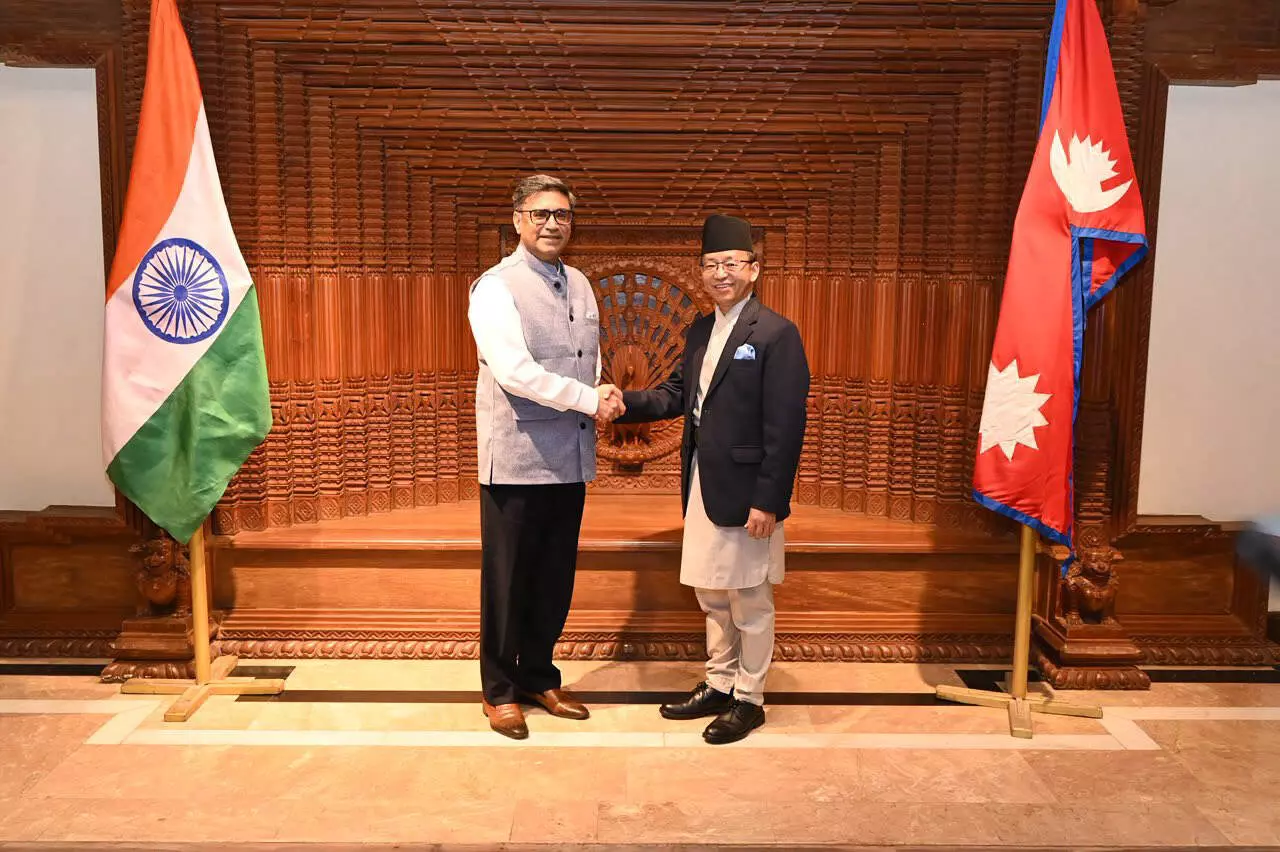
KATHMANDU, Nov. 4 -- Foreign Secretary Vikram Misri arrived in Kathmandu on Wednesday for a two-day official visit aimed at strengthening bilateral relations and preparing the ground for Nepalese Prime Minister Balendra Shah's proposed visit to India later this month.
Misri was received at Tribhuvan International Airport by Gehendra Rajbhandari, Joint Secretary at Nepal's Ministry of Foreign Affairs, and India's newly appointed Ambassador to Nepal, Sudhakar Dalela.
The visit, undertaken at the invitation of Nepalese Foreign Secretary Amrit Bahadur Rai, comes as New Delhi and Kathmandu work towards finalising arrangements for Shah's first bilateral visit to India since assuming office in March.
Misri paid a courtesy call on Nepal's Foreign Minister Shisir Khanal on Wednesday, with discussions focusing on deepening bilateral cooperation and strengthening the longstanding relationship between the two neighbouring countries.
He is also scheduled to hold bilateral discussions with his Nepalese counterpart, Amrit Bahadur Rai, during which the two sides are expected to review the entire spectrum of India-Nepal relations and exchange views on regional and international developments of mutual interest.
According to Nepalese foreign ministry sources, Misri is likely to meet Prime Minister Shah, whose proposed visit to India is expected towards the last week of November. However, the dates of the prime minister's visit have not yet been officially announced.
The Indian Foreign Secretary is also expected to engage with other senior Nepalese leaders and officials during his stay before returning to New Delhi on Thursday.
In a statement issued ahead of the visit, India's Ministry of External Affairs said the engagement would provide an opportunity to discuss bilateral, regional and global matters of mutual interest while further strengthening the comprehensive partnership between the two countries.
The ministry noted that India and Nepal maintained close and friendly relations that had witnessed progress across several areas of cooperation. It described Misri's visit as part of the tradition of regular high-level diplomatic exchanges.
The visit assumes significance as both governments seek to advance cooperation in trade, investment, energy, connectivity and infrastructure development while addressing longstanding bilateral concerns.
Cross-border connectivity, including road and railway links, air routes and electricity transmission infrastructure, is expected to feature prominently in the discussions. Nepal is also seeking greater Indian investment in hydropower, manufacturing, tourism and other sectors.
Energy cooperation has emerged as an important component of bilateral relations, with Nepal seeking to expand electricity generation and exports through cross-border transmission networks.
The two sides are also expected to discuss proposals concerning the revision of bilateral trade arrangements, investment protection and measures to facilitate the movement of goods and services.
Another area likely to receive attention is India's assistance in Nepal's reconstruction and recovery efforts following the devastating flash floods of August 26.
India had provided humanitarian assistance and emergency support following the disaster, including relief supplies and temporary bridge infrastructure. Nepalese officials are expected to seek further cooperation for reconstruction and rehabilitation.
The proposed visit by Prime Minister Shah could provide an opportunity for both governments to announce progress on development projects and identify additional areas for economic cooperation.
The diplomatic engagement follows a period of differences between New Delhi and Kathmandu over territorial claims involving Lipulekh, Limpiyadhura and Kalapani.
Nepal has maintained claims over these territories, while India has consistently asserted that they form part of Uttarakhand.
Relations faced renewed strain earlier this year after Shah suggested the involvement of China and the United Kingdom in resolving the border dispute. India rejected any third-party role, maintaining that outstanding boundary issues should be addressed through established bilateral mechanisms.
Subsequent diplomatic exchanges have sought to maintain communication and advance cooperation despite these differences.
In recent months, several senior Nepalese leaders, including Foreign Minister Khanal and Finance Minister Swarnim Wagle, have visited India for discussions with their Indian counterparts.
Wagle met External Affairs Minister S Jaishankar and Finance Minister Nirmala Sitharaman in September, when preparations for Shah's proposed India visit were also discussed.
Misri's current visit follows the arrival of Ambassador Dalela in Kathmandu on Tuesday and is expected to help coordinate the diplomatic and logistical arrangements for the proposed prime ministerial engagement.
This is Misri's second visit to Kathmandu since assuming office as India's Foreign Secretary in July 2024.
India and Nepal share extensive historical, cultural and economic ties, supported by an open border and substantial movement of people, goods and services.
Nepal's dependence on transit routes through India for international trade, alongside growing cooperation in electricity and infrastructure, makes bilateral engagement particularly important for both countries.
The proposed visit by Shah is expected to provide an opportunity for the leadership of the two countries to review outstanding issues, strengthen economic cooperation and identify priorities for future engagement.
Published by HT Digital Content Services with permission from Millennium Post.