
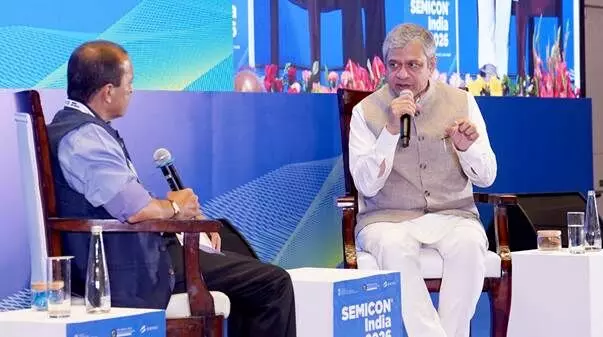
New Delhi, Sept. 18 -- From laying the foundation to building scale, India has progressed towards making a mark in the global semiconductor ecosystem as five semiconductor manufacturing plants have started commercial production, Union Electronics and IT Minister Ashwini Vaishnaw said on Friday.
Addressing the SEMICON India 2026, Vaishnaw said the next phase of India Semiconductor Mission 2.0 will focus on building a holistic ecosystem across six areas -- design, materials and machines, fabrication plants, advanced packaging and testing units, research and development, and talent.
He said the first phase of the mission, which was originally a six-year program, was able to achieve its goals within four years.
Now the government is looking to accelerate the second phase with increasing investor interest.
Vaishnaw said the five functioning semiconductor plants were a testimony to India's capability to manufacture semiconductors competitively on the parameters of cost and quality.
He said there was a robust demand for chips, and the production capacity was being ramped up as around 40 pc of the capacity of a fab that will start operating in 2028 has already been booked.
The minister highlighted that design was India's competitive advantage, adding that about 200 chip design companies are set to emerge under ISM 2.0.
In the first phase, more than 105 start-ups have got access to advanced Electronic Design Automation tools, while 20 start-ups have received venture capital funding.
Talking about skilling, Vaishnaw said around 70,000 design engineers have been trained in four years as against a target of 85,000. Nearly 400 engineering colleges have provided access to industry-grade design tools to students and given them an opportunity to take their taped-out design through to tape out.
In the second phase, while the focus would be on building a system design capability in addition to chip design, the government has set a target of training one lakh technicians. However, given the increasing demand, it may need to increase the target number, Vaishnaw pointed out.
India is on a trajectory towards becoming a product nation, said Vaishnaw, adding that India-designed chips find applications in strategic sectors and are being exported. India's ATMP units are already exporting to Japan and Indian chips and packages are being integrated into products destined for Switzerland, Germany, and other countries.
The minister said the convergence of electronics, semiconductor and AI manufacturing will bolster India's technology ecosystem.
Published by HT Digital Content Services with permission from Millennium Post.