
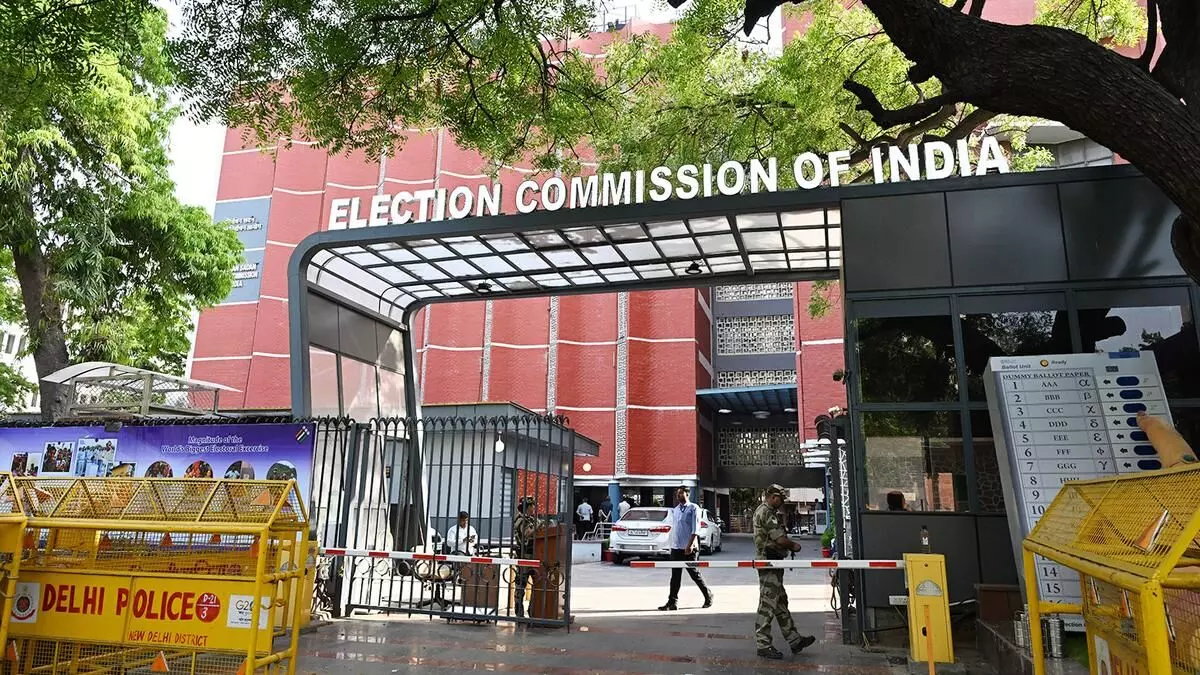
NEW DELHI, Oct. 27 -- The Election Commission of India (ECI) has told the Supreme Court that its major decisions concerning the Special Intensive Revision (SIR) of electoral rolls were taken unanimously, but its affidavit has left unanswered questions about actions allegedly carried out without the knowledge of two Election Commissioners. The affidavit, approved by Chief Election Commissioner Gyanesh Kumar and Election Commissioners Sukhbir Singh Sandhu and Vivek Joshi, maintained that observations, suggestions and queries recorded by individual Commissioners were part of the consultative process and did not themselves constitute decisions of the Commission.
However, an investigation by The Indian Express had earlier revealed that Sandhu and Joshi recorded at least 14 objections over 10 months, several of them after decisions had already been implemented or orders issued without their knowledge. The central question raised by the investigation was not whether the Commission subsequently approved the decisions, but whether all three members had been consulted before actions were taken in the institution's name.
One of the major issues concerns Form 6, the statutory application used by citizens seeking inclusion in electoral rolls. In May, Joshi had recorded that the form could not be modified without amending the Registration of Electors Rules, 1960. Sandhu had supported this position. Despite these observations, an additional SIR-related declaration appeared in the online version of Form 6 in July. Sandhu subsequently learnt about the change through a newspaper report and, in August, described the insertion as unauthorised and illegal. In its affidavit, the Commission maintained that the declaration was a separate document and did not constitute an amendment to the statutory form. However, it acknowledged that the online presentation could create the impression that Form 6 had been amended and that certain actions by officials required correction.
The Commission said a decision was taken on October 21 to separate Form 6 from the SIR declaration in the online application process. The affidavit did not identify who authorised the original online implementation or explain why it proceeded despite the Commissioners' earlier objections.
The Commission also addressed concerns regarding ECINet, the digital platform used for electoral roll management. It maintained that Electoral Registration Officers (EROs) retained statutory authority over voter records and that no entry could be added, deleted or modified without their orders. The affidavit referred to a committee involving experts from IIT Mumbai and the Indian Institute of Science, Bengaluru, to examine the platform's compliance with legal requirements. However, Joshi had proposed a similar independent technical review in May, expressing concern over the increasing centralisation of electoral roll databases. Sandhu subsequently supported the proposal and, in August, recorded that he was unaware of what action had been taken on the earlier observations. The affidavit presented the committee as a decision taken in September but did not refer to the earlier proposal.
Questions were also raised over the deletion of voters from electoral rolls in Goa. The Commission's affidavit referred to 97 voters excluded from the final electoral roll, stating that 88 had subsequently applied for inclusion through Form 6. However, the earlier investigation had highlighted that electoral authorities in Goa made eight requests over seven days in February to reverse certain deletions but were unable to implement their decisions through the software. An internal observation by a Deputy Election Commissioner had also maintained that the IT system could not prevent legally required action. The affidavit recorded subsequent developments but did not explain why the system had prevented officials from implementing their decisions at the time.
Another issue concerns appeals filed against orders restoring voters to electoral rolls in West Bengal. The Commission said the appeals were filed by officers attached to the office of the state's Chief Electoral Officer and that the matters had not been brought before the Commission. It also maintained that the officers were authorised to file the appeals under Supreme Court directions. However, earlier internal notes showed that Joshi had sought details about the appeals in August, while Sandhu subsequently raised questions about their authorisation. Sandhu had also recorded that the state's Chief Electoral Officer was unaware of the details of the matter. The affidavit did not reconcile these observations with its position that officers in the Chief Electoral Officer's office had filed the appeals. It also did not explain how a large number of appeals came to be filed on similar grounds or whether individual cases had been examined separately.
The affidavit also addressed a July order concerning the redistribution of administrative responsibilities within the Commission. According to the earlier investigation, a senior official holding temporary administrative charge had issued the order shortly after assuming responsibility. Joshi subsequently sought the relevant file but recorded that it had not been provided to him. The Commission stated that the order was never implemented after both Election Commissioners jointly intervened.
However, the affidavit did not explain why the order had initially been issued without the Commission's approval or why the file was not made available to a Commissioner. The ECI also maintained that it had neither released nor authorised the release of internal documents to any news organisation.
The affidavit was filed in response to a petition questioning the functioning of the Election Commission and seeking judicial examination of decisions allegedly taken without the participation of all three Commissioners. The petition raised constitutional questions about whether powers vested in the Commission as a collective body could be exercised without following the decision-making procedure prescribed under the 2023 law governing the Chief Election Commissioner and other Election Commissioners. While the Commission has defended the collective approval of its major decisions, the dispute continues to centre on whether individual Commissioners were adequately informed and consulted before administrative and electoral actions were implemented. The Supreme Court is examining the matter, with the Commission's explanations and the objections recorded in internal documents forming part of the controversy.
Published by HT Digital Content Services with permission from Millennium Post.