
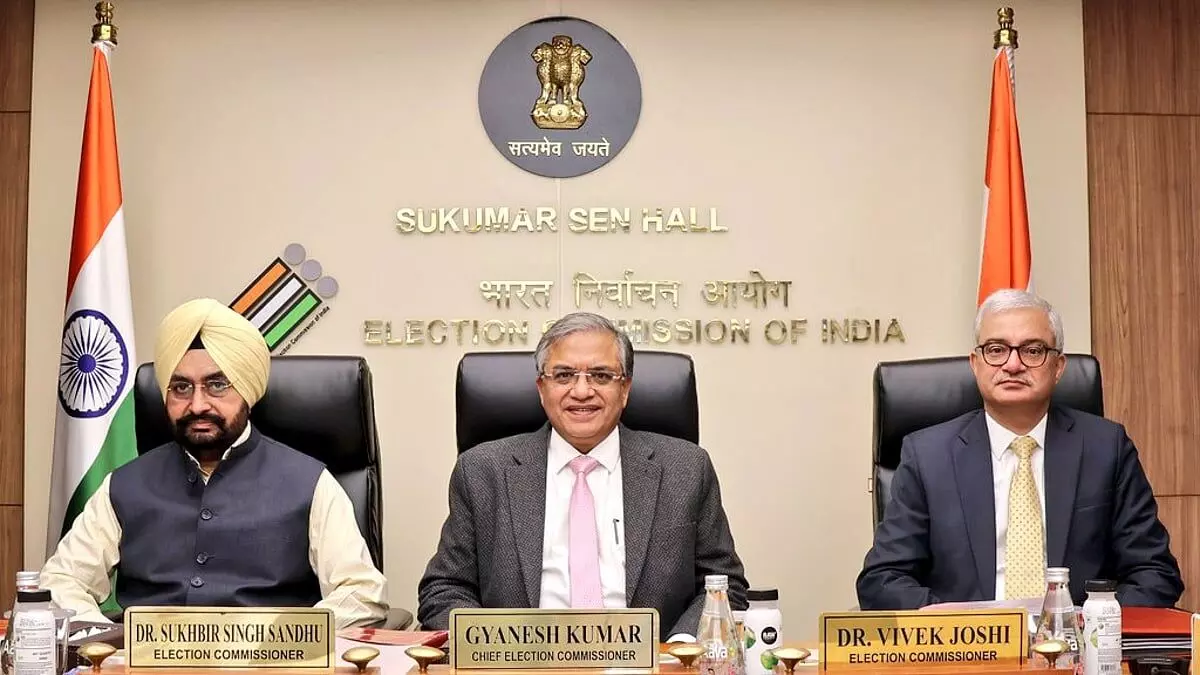
New Delhi, Sept. 25 -- The Election Commission of India is facing questions over reported differences between Chief Election Commissioner Gyanesh Kumar and Election Commissioners Sukhbir Singh Sandhu and Vivek Joshi. The controversy has emerged after the two Election Commissioners reportedly recorded objections on several decisions related to electoral rolls, voter registration and the poll panel's technology systems.
While the scrutiny has largely focused on Kumar, the reported dissent has also raised questions about the role of Sandhu and Joshi and the steps they took after recording their objections.
What is the controversy about?
The controversy follows reports that Sandhu and Joshi formally objected at least 14 times over a period of 10 months to decisions and orders issued in the name of the Election Commission.
The reported objections covered issues including the addition of new voters, deletion and restoration of names from electoral rolls, appeals against voter-related orders, access to voter data and the functioning of the Election Commission's IT systems. The objections were also shared with CEC Gyanesh Kumar.
The disagreements have emerged during the nationwide Special Intensive Revision (SIR) of electoral rolls, an exercise that has put the Election Commission under heightened scrutiny over the preparation and maintenance of voter lists.
What did Sandhu and Joshi object to?
One of the reported disagreements concerned changes to Form 6, which is used by adults to apply for inclusion in the electoral roll.
A new section was added to the form asking applicants whether their name, or that of a parent or grandparent, appeared in the electoral roll from the previous SIR. According to records cited in the report, Vivek Joshi had raised concerns in May that the form could not be changed in that manner without an amendment to the relevant rules. Sukhbir Singh Sandhu also agreed with the objection.
Despite those concerns, the change was introduced. Sandhu subsequently recorded an objection in August, describing the change as "unauthorised and illegal" and calling for its removal.
The two commissioners also raised concerns about the centralisation of the electoral-roll database and the functioning of the IT systems used to manage voter information.
Concerns over centralised voter data
Another major issue reported in the internal objections was the increasing centralisation of electoral-roll management.
Sandhu and Joshi reportedly raised concerns that centralised control of the voter database could reduce the role of state-level and ground-level electoral officials. Their objections included concerns over access to the electoral-roll software and the handling and security of voter data.
The report said the two commissioners also wrote separately to the Cabinet Secretary over changes in work allocation relating to the Election Commission's IT division. They argued that the changes had been made without their knowledge and had removed a layer of oversight over the IT systems used for electoral rolls.
Why are questions also being raised about the 2 ECs?
The controversy has not only put the CEC under scrutiny. It has also led to questions about what Sandhu and Joshi did after recording their objections.
The two commissioners continued to participate in joint public appearances and decisions of the Election Commission despite their reported differences. Between October 2025 and August 2026, the three commissioners appeared together at several public briefings and events.
The reported objections, however, were being recorded internally during the same period.
This has prompted questions over whether the two commissioners could have taken additional institutional steps to bring their concerns into the open or seek a formal resolution within the Commission.
What does the law say about decision-making?
The Chief Election Commissioner and the two Election Commissioners collectively constitute the Election Commission.
Under Section 18 of the Chief Election Commissioner and Other Election Commissioners (Appointment, Conditions of Service and Term of Office) Act, 2023, the business of the Commission is, as far as possible, to be conducted unanimously. If the commissioners differ on an issue, the matter is decided according to the majority view.
The same provision also deals with the Commission's procedure and division of work.
The reported objections are therefore significant because they concern how decisions were taken within the three-member body and whether all commissioners were involved in decisions issued in the Commission's name.
What has the Election Commission said?
The Election Commission has acknowledged that internal observations and objections were made but has maintained that its final decisions were unanimous.
The poll panel said differences of opinion, suggestions and observations are part of institutional deliberations. It argued that highlighting individual internal notes without considering the larger body of approvals, decisions, instructions and initiatives gives an incomplete picture of its functioning.
The statement was issued in the name of the full three-member Commission.
This means the Election Commission has distinguished between objections or observations raised during internal deliberations and the final decisions formally adopted by the full Commission.
The September 9 meeting
The reported differences also coincided with a period in which the three commissioners had not held a full meeting for several months.
According to the investigation, Sandhu and Joshi's communications regarding the IT division were followed by a meeting of the CEC and both Election Commissioners on September 9. It was reportedly the first full meeting of the three-member Commission in four months.
The meeting took place amid growing attention on the reported internal objections and the wider controversy surrounding the SIR exercise.
What is the question over accountability?
The controversy has resulted in demands for accountability from Kumar, particularly from Opposition parties that have criticised the Election Commission's handling of the SIR process.
At the same time, the reported objections by Sandhu and Joshi have raised a separate question: if the two commissioners believed certain decisions or procedures were unauthorised or improper, what further steps did they take to address those concerns?
Reports have noted that the two commissioners continued to participate in joint decisions and public briefings even while recording objections internally. Their communications, however, show that they did raise concerns through formal channels on multiple occasions.
The controversy therefore involves questions about the conduct and decision-making of the Election Commission as a three-member institution, rather than only the role of its chief.
What remains disputed?
The existence of the 14 objections and the issues they concerned have been reported in detail. The Election Commission has not disputed the existence of the internal notes but has rejected the suggestion that they demonstrate a breakdown in the Commission's final decision-making.
The poll panel maintains that its final decisions were unanimous, while the reported internal records show that Sandhu and Joshi raised repeated concerns about several processes.
The dispute is therefore centred on how those internal objections were handled, how decisions were ultimately taken and what role each of the three commissioners played in the process.
The developments have placed all three members of the Election Commission under scrutiny, even though the political focus has so far been concentrated primarily on CEC Gyanesh Kumar.
Published by HT Digital Content Services with permission from Millennium Post.