
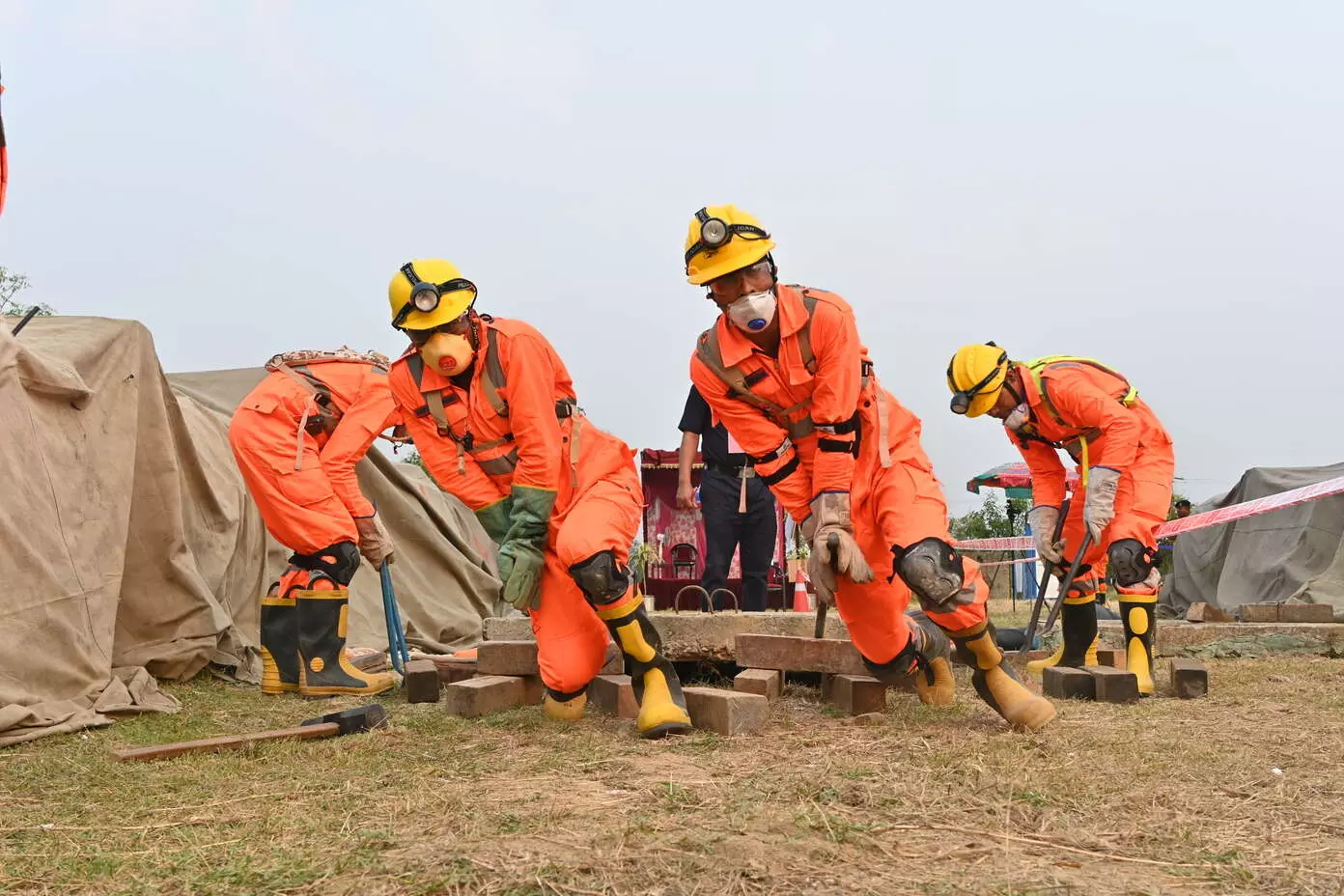
New Delhi, Aug. 28 -- The Centre has issued detailed guidelines for states and Union territories to establish, equip, train and operationalise State Disaster Response Forces (SDRFs) over the next five years.
Under the new framework, Agniveers and NCC certificate holders will receive preference in direct recruitment, while 15% of openings will be reserved for women.
The guidelines, issued by the National Disaster Management Authority in June and made public this week, seek to create a uniform structure for SDRFs across the country. The specialised units will be modelled on the National Disaster Response Force (NDRF) and will be tasked with responding to natural and human-made disasters at the state level.
The Disaster Management (Amendment) Act, 2025 requires every state and Union territory to have a dedicated SDRF for disaster response.
The forces are expected to work closely with the NDRF and neighbouring states' SDRFs when a disaster exceeds the capacity of a single state. The framework aims to ensure that local teams can respond quickly to emergencies while allowing the NDRF to concentrate on large-scale and catastrophic events.
According to the guidelines, each SDRF battalion will have between 600 and 1,200 personnel and will be headed by an officer of Director General of Police rank. A battalion may be divided into nine to 10 multidisciplinary teams, with each team comprising around 45 to 50 personnel equipped to handle rescue, medical, communication and logistical requirements.
The guidelines call for the recruitment of young and physically fit responders aged up to 50 years. While Agniveers and NCC certificate holders will be preferred for direct recruitment, personnel can also be drawn from state police and armed police forces, central armed police forces, the armed forces, ex-servicemen and former NDRF personnel.
Each SDRF is also expected to have specialised personnel, including engineers, technicians, medical staff, communication experts, dog handlers, divers and specialists trained in chemical, biological, radiological and nuclear emergencies.
The deployment of teams will depend on the terrain and the types of hazards prevalent in a particular area. Teams may be positioned across valleys, pilgrimage routes and areas vulnerable to landslides, with seasonal deployment planned during periods such as the monsoon, winter and peak pilgrimage seasons.
The SDRFs will also have responsibilities outside active disasters. They can conduct safety audits and mock exercises at heavily visited tourist, recreational and religious locations, particularly sites involving rivers, reservoirs, waterfalls, ghats, beaches, dams and water parks, as well as major religious gatherings and pilgrimage routes.
However, the guidelines make it clear that SDRFs should not be deployed for situations involving the use of armed force or law-and-order enforcement.
Published by HT Digital Content Services with permission from Millennium Post.