
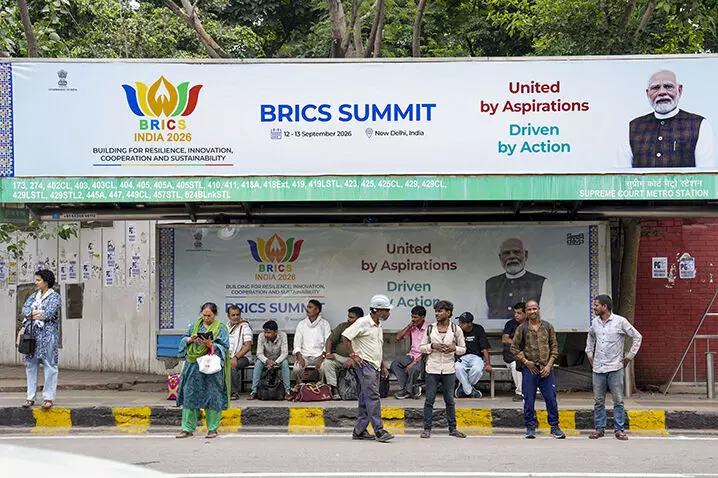
New Delhi, Sept. 8 -- India chairs the 18th BRICS+ Summit on 12-13 September, where global leaders Vladimir Putin, Xi Jinping, Masoud Pezeshkian, UN Secretary-General Antonio Guterres, and leaders from Brazil, South Africa, Egypt, Ethiopia, the UAE, and Indonesia are expected to gather to discuss this year's official theme: "Building for Resilience, Innovation, Cooperation and Sustainability". This year also marks the 25th anniversary of the iconic acronym "BRIC", which first appeared in a Goldman Sachs economic research report in 2001.
Currently, the 11 official BRICS members represent roughly 49.5 per cent of the world's population, account for nearly 40 per cent of global GDP, and command around a quarter of global trade. The expanded BRICS+ coalition accounts for over 42 per cent of global crude oil production and controls roughly half of the world's proven natural gas reserves. In the race towards artificial intelligence, electrification, and renewable energy, BRICS holds a structural advantage in critical raw materials. China processes over 80 per cent of the world's rare earth elements and controls the lion's share of global solar panel, battery, and EV processing pipelines. China's Cross-Border Interbank Payment System now links 1,800 institutions and had cleared the equivalent of $245tn in annual yuan transactions by March 2026. Iran's trade already clears outside the dollar through the yuan and barter. Every time the US Treasury threatens to weaponise the US-controlled SWIFT banking system, it boosts Beijing.
Combined with the 10 partner countries that joined in 2025, BRICS has solidified itself as one of the Global South's most formidable communities of shared interests.
BRICS emerged in the mid-2000s as a vehicle for emerging economies to secure a greater voice within global financial governance, advocating adjustments to the Bretton Woods institutions, expanded voting rights for developing economies, and a more representative multilateral order. The grouping has continued to prioritise the concerns of developing countries and reduce dependence on developed countries. Institutionally, BRICS has produced tangible outcomes, most notably the New Development Bank (NDB), designed to complement existing international financial institutions.
However, due to heightened geopolitical tensions and the absence of both the Chinese and Russian Presidents during the last Summit, Brazil's 2025 presidency (17th BRICS Summit) reflected minimal institutional consistency. Trade analysts observe that momentum on economic priorities, such as local currency trade mechanisms and the development of the Contingent Reserve Arrangement, as established during Russia's 2024 presidency, notably slowed.
The 18th BRICS Summit is being held at a time when the global order is clearly in transition. Institutions of global political and economic governance are struggling to deliver. Institutions like the UN Security Council, the World Trade Organisation (WTO), and even the World Health Organisation (WHO) are marked by dysfunction and limited effectiveness. Washington's imposition of sweeping tariffs in 2025, widely regarded as inconsistent with WTO rules, marked a significant departure from established global trade norms. The post-1945 world order has effectively come to an end, and power is no longer concentrated in a single civilisational or geopolitical bloc like the G7.
India's BRICS presidency, for the fourth time in the grouping's history, has remained relatively low-key so far. This has coincided with growing difficulties in India-US relations. Under these circumstances, New Delhi is unlikely to champion far-reaching BRICS initiatives that could further irritate Washington, particularly given President Trump's sceptical view of the grouping and his perception of BRICS as a challenge to US economic and strategic interests. The West Asian crisis has added another layer of complexity. The US-Israeli military action against Iran-an important BRICS member-and the subsequent Iranian retaliatory strikes against the UAE and Saudi Arabia, both fellow BRICS members, have generated fresh political and diplomatic challenges for India's BRICS presidency.
At the launch of the summit logo in January 2026, External Affairs Minister S. Jaishankar stated, "India views BRICS as a constructive platform for dialogue and development, complementing the broader multilateral system." As the group becomes increasingly heterogeneous, New Delhi has inherited a presidency that confronts several unresolved challenges-mounting tariff pressures, stalled currency diversification mechanisms, an undercapitalised New Development Bank (NDB), and a membership process without defined rules. The criteria for membership are undefined, while the role of partner countries within the bloc remains unclear. Saudi Arabia's inclusion in BRICS has been the most protracted case. It was officially invited to join in 2023, along with Argentina (which declined the invitation), Egypt, Ethiopia, Iran, and the United Arab Emirates. Though it has not formally accepted the invitation, Saudi Arabia has steadily participated in the bloc's discussions, including at the Rio Summit in 2025.
The 2026 BRICS Foreign Ministers' Meeting in New Delhi exposed the growing internal contradictions of an expanded BRICS at a moment of acute geopolitical instability. The clearest indication of these divisions was the inability of BRICS foreign ministers to agree on a full joint statement. In its place emerged a Chair's Statement. The Iran-UAE divide highlighted a deeper structural contradiction within BRICS expansion. In addition to these challenges, India's deepening strategic ties with the US and Israel have exposed deep fractures within BRICS, complicating New Delhi's role as chair of the BRICS Summit.
The BRICS+ bloc of emerging economies has established itself as a viable alternative to the clutch of developed economies-the Group of Seven (G7), led by the US. India must play a leadership role in deciding the future course of BRICS+, with whose members it enjoys millennia-old civilisational connections.
Views expressed are personal. The writer is a professor of Business Administration
Published by HT Digital Content Services with permission from Millennium Post.