
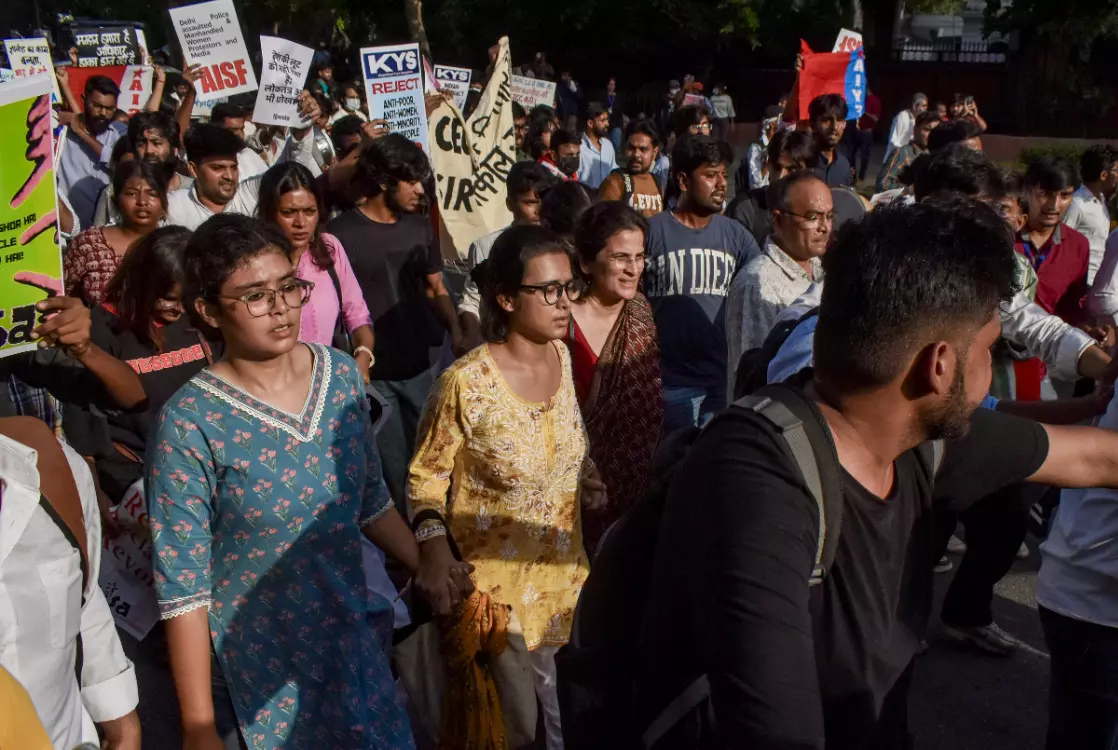
New Delhi, Oct. 12 -- Demonstrations in the national capital may lose some of their political visibility following Delhi Police's decision to remove Jantar Mantar from the list of authorised protest venues and designate three alternative locations, including two on the city's outskirts.
Under an order issued by Police Commissioner Anurag Kumar, demonstrations will now be permitted at Ramlila Maidan, Burari ground and the CBD ground in Shahdara.
The move follows recommendations by a committee constituted by the Union Home Ministry and comes amid demands by opposition parties and organisations, including the Cockroach Janta Party (CJP), for permission to hold protests at Jantar Mantar against alleged irregularities in the Special Intensive Revision (SIR) of electoral rolls.
The decision has triggered concerns over whether relocating demonstrations could affect their reach, particularly when protesters seek to draw the attention of Parliament and the central government.
Distance from power centre
Jantar Mantar's location in central Delhi has historically made it a prominent destination for political movements, allowing demonstrators to gather within close reach of Parliament and other key government institutions.
The alternative venues are considerably farther away. Ramlila Maidan is approximately 6 km from Parliament by road, while the CBD ground in Shahdara is around 14 km away. Burari ground lies roughly 23 km from the Parliament complex.
The change could alter how easily demonstrations attract the attention of policymakers, political leaders and national media. Protests in central Delhi have frequently drawn wider public attention, sometimes affecting traffic around major commercial and administrative areas.
Larger grounds, different dynamics
The newly designated locations offer substantially greater space than Jantar Mantar, which can accommodate approximately 3,000 people. Ramlila Maidan has an estimated capacity of 50,000, the CBD ground around 15,000 and Burari ground nearly 80,000.
While the larger venues can accommodate bigger gatherings, their capacity alone does not guarantee comparable public visibility. Organisers may need greater mobilisation to create a similar political impact, particularly at locations removed from the capital's administrative centre.
Jantar Mantar has hosted several prominent demonstrations, including Anna Hazare's anti-corruption movement in 2011 and protests by Tamil Nadu farmers in 2017. Its association with sustained public campaigns developed over decades.
Security versus the right to protest
Delhi Police's decision also comes against the backdrop of complaints about noise and unhygienic conditions around Jantar Mantar. The National Green Tribunal had examined concerns relating to the area in 2017.
However, critics argue that the location of a demonstration can influence its ability to communicate demands to those in power. For organisations seeking accountability from constitutional authorities, moving gatherings away from central Delhi could pose an additional challenge.
The larger question is whether the new arrangement can balance public order and residents' concerns with citizens' ability to stage visible, peaceful demonstrations in the national capital.
Published by HT Digital Content Services with permission from Millennium Post.