
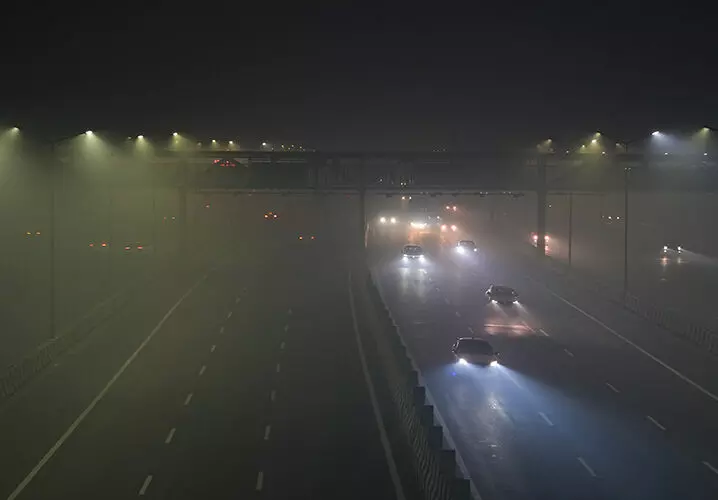
New Delhi, Nov. 10 -- With the arrival of winter, Delhi's air pollution becomes a critical concern and the centre of public debate. As temperatures fall, the city experiences a familiar combination of dense fog, calm winds and rising concentrations of particulate matter (PM). Yet, one aspect of this seasonal crisis remains overlooked: how air pollution is actually measured, reported, and communicated to the public. Public interpretation of air quality is further complicated by conflicting data across platforms. Whereas India's regulatory Air Quality Index (AQI) maxes out at a ceiling value of 500, independent global platforms routinely report figures exceeding 1,000 during severe pollution spikes.
The 500 AQI ceiling
India's National Air Quality Index operates on a scale ranging from 0 to 500, where rising numbers represent increasing levels of hazardous air quality. However, the 500 cap obscures how much worse actual pollution concentrations become when they are exceptionally high. Another important factor might be the use of data averaging periods. India's regulatory AQI relies on 24-hour average PM concentrations. Although a 24-hour average provides a useful measure of daily exposure, it conceals sharp fluctuations during acute hours, especially during night-time and early morning hours when meteorological conditions favour pollutant accumulation.
Beyond conventional monitoring
To examine Delhi's winter pollution patterns, historical observations from independent air quality repositories, including OpenAQ and the World Air Quality Index Project (AQICN), can provide an additional perspective. Continuous monitoring records from Beta Attenuation Monitors (BAM) also help capture changes in PM concentrations over time.
However, monitoring data must be carefully validated before statistical analysis. One particular challenge in Delhi is the high relative humidity experienced during winter mornings. Low-cost laser-based sensors can sometimes register water droplets in the air as PM, potentially producing inflated readings. Cross-calibration with reliable reference instruments and appropriate quality-control procedures are therefore essential to improve the accuracy of the resulting dataset. Such extended values should be understood as indicators of extreme pollution severity, rather than official Indian AQI readings or standard regulatory categories.
Indication of the winter forecast
An analysis of historical pollution patterns, combined with time-series modelling and anticipated meteorological conditions, provides a concerning outlook for Delhi during the November 2026-February 2027 winter season.
* November 2026: The projected monthly mean AQI stands at approximately 420, with daily values potentially ranging from 210 to more than 1,300 during extreme episodes.
* December 2026: The model estimates a monthly mean of around 390, with daily values ranging between 230 and 1,100 or higher. Dense radiation fog, prolonged temperature inversions and weak atmospheric circulation could contribute to sustained pollution episodes.
* January 2027: The projected monthly mean falls to approximately 355, with daily values ranging from 190 to more than 850. Temporary improvements may occur during periods of precipitation associated with Western Disturbances, although their timing and intensity will influence the overall outcome.
* February 2027: A further moderation is projected, with a monthly mean of around 260 and daily values ranging from 130 to 480. Gradually rising temperatures may weaken surface-level temperature inversions and improve atmospheric dispersion.
(These estimates represent modelled projections rather than confirmed future predictions. Actual pollution levels will depend on meteorological conditions, regional emission patterns and the effectiveness of pollution-control measures.)
Persistence of extreme pollution episodes
Delhi's winter pollution cannot be attributed to a single source. Crop residue burning, vehicular emissions, industrial activities, construction dust and other urban sources collectively contribute to the seasonal pollution burden. Meteorological conditions determine how these emissions disperse. During winter, temperature inversions can prevent warmer air from rising and mixing with the atmosphere above. This creates a relatively stable layer close to the ground, trapping pollutants within the air that people breathe. Reduced wind speeds further restrict their dispersal. The influence of La Nina-associated weather patterns on regional atmospheric conditions is also an important consideration in seasonal forecasting. However, only La Nina cannot determine the winter pollution patterns in Delhi. Local weather conditions such as wind speed, temperature inversions, and rainfall will also play an important role in determining the accumulation and dispersal of the pollutants.
The projected data also highlight an important aspect of Delhi's winter pollution: monthly averages may not adequately identify the severity of the extreme pollution episodes. Although the average values indicated consistently in poor air quality, the pollution level may rise significantly on certain days, which may reach higher levels than the monthly averages. Therefore, these extreme pollution episodes may remain unnoticed in monthly average air quality assessments. This further suggests the importance of examining daily variation in addition to the overall trend analysis.
Public health challenges
A capped index can communicate that the air is hazardous, but it cannot distinguish between different degrees of severity once the upper limit is reached. Examining underlying PM2.5 concentrations and high-frequency monitoring records can therefore provide a more complete picture of the exposure faced by Delhi's residents.
Ultimately, the winter pollution crisis requires more than seasonal advisories and emergency restrictions. Long-term improvements in regional emission management, public transport, industrial regulation, construction practices and agricultural residue management remain essential. Delhi's air pollution should not be judged only by whether its AQI reaches 500. The more important question is how far pollution concentrations rise beyond that threshold, how long such conditions persist and what they mean for public health. Understanding the numbers beyond the ceiling is an important step towards understanding the true scale of the capital's winter air crisis.
Views expressed are personal. The writer is a Research Associate at the Mobius Foundation
Published by HT Digital Content Services with permission from Millennium Post.