
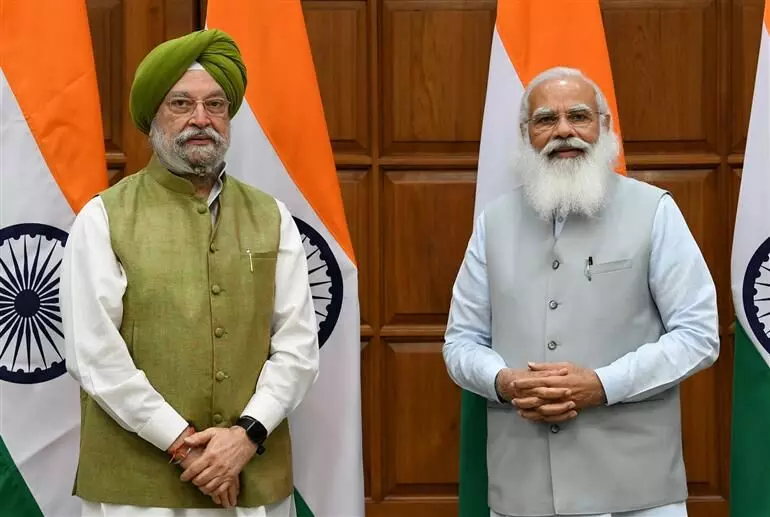
New Delhi, March 10 -- Prime Minister Narendra Modi on Tuesday held a high-level review meeting with Petroleum and Natural Gas Minister Hardeep Singh Puri and External Affairs Minister S. Jaishankar to address a potential shortage of Liquefied Petroleum Gas (LPG) following the escalating conflict involving Iran, Israel and the United States. The government has initiated contingency measures aimed at protecting domestic consumers from the fallout of the ongoing geopolitical tensions in the Middle East. The current disruption has been triggered by the closure of the Strait of Hormuz after military exchanges involving the United States and Israel, followed by retaliatory actions by Iran. The strategic waterway is critical for India's energy supplies, as nearly 62 per cent of the country's total LPG imports depend on shipments passing through this route.
Of these imports, roughly 85 to 90 per cent - largely sourced from Gulf countries such as Saudi Arabia - transit through the Strait of Hormuz, which is now blocked. While the government has begun exploring alternative supply routes and suppliers, the immediate shortfall has forced authorities to prioritise the distribution of existing stocks. India's annual LPG consumption stands at approximately 31.3 million tonnes. According to the Ministry of Petroleum and Natural Gas, LPG usage in the country is divided into two broad categories. The domestic household sector accounts for around 87 per cent of total consumption, while the remaining 13 per cent is consumed by commercial establishments such as hotels, restaurants and certain industrial units.
In an effort to shield ordinary households from the effects of the shortage, the government has decided to prioritise the supply of cooking gas for domestic users. As a result, the commercial sector - which purchases LPG cylinders at market rates - has begun experiencing a significant supply squeeze. The shortage is already being felt in major urban centres including Mumbai and Bengaluru, where hospitality businesses have reported difficulties in securing LPG cylinders. Industry bodies such as the India Hotels and Restaurant Association have raised concerns over the disruption. To manage the situation, the Petroleum Ministry has introduced several emergency steps. Oil refineries have been instructed to maximise LPG production by reducing the diversion of feedstock towards petrochemical outputs. Additionally, the LPG refill booking interval for domestic consumers has been increased from 21 days to 25 days. Officials say the measure is intended to discourage panic buying and prevent hoarding or black marketing. Beyond household supply, the government has also directed that available imported LPG be prioritised for essential institutional users such as hospitals and educational institutions.
A special committee comprising three Executive Directors from various Oil Marketing Companies (OMCs) has also been set up to assess requests from hotels, restaurants and industrial users. The panel will allocate limited supplies based on factors such as necessity, priority and available inventory. Confirming the measures, Hindustan Petroleum Corporation Limited (HPCL) said in a statement that while the geopolitical developments have affected supply chains, steps are being taken to enhance domestic production. The Petroleum Ministry also reiterated on social media that the committee of Executive Directors will take the final call on non-essential commercial allocations during the ongoing period of geopolitical disruption.
Published by HT Digital Content Services with permission from Millennium Post.