
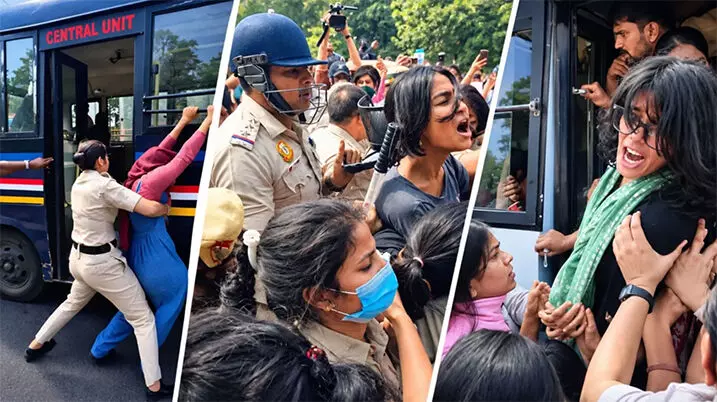
New Delhi, Oct. 13 -- The most striking feature of the Gen Z protests witnessed in Delhi over the past few months is the growing visibility of young women. They are marching shoulder to shoulder with men and, at times, assembling independently to demand their safety and dignity.
This distinct form of women's mobilisation is, as the sociologists would put it, the emergence of a distributed, experience-led form of women's political drive. Its defining feature is that young women are converting personal anxieties and shared experiences into collective political action without necessarily passing through the conventional channels of student politics.
Consider the independent demonstrations around women's safety, including the recent gathering at Delhi University's North Campus. When women have to organise their everyday lives around the possibility of harassment or violence, personal security becomes a question of citizenship.
The demand is no longer merely for the punishment of perpetrators but for the right to occupy public space. The protests following the alleged sexual assault of a minor near Aastha Kunj Park in South Delhi have questioned not only the adequacy of security arrangements but also the tendency to respond to crimes against women by restricting their movement or shifting classes online.
The memory of December 16, 2012, inevitably hangs over these demonstrations. A generation that grew up hearing that the Nirbhaya protests marked a watershed in the country's treatment of violence against women is discovering that the promise of change remains incompletely fulfilled.
The current anger derives from the contradiction between the language of women's empowerment and the everyday restrictions imposed in its name. This may also explain the apparent absence of a single commanding leader at some of these gatherings.
The absence of a visible face does not necessarily mean an absence of social organisation. College friendships, student societies, messaging groups and social media have replaced student unions in giving calls to assemble. These 'informal networks' are also coordinating logistics and articulating demands.
Leadership, in such circumstances, becomes distributed. One student may mobilise her classmates, another drafts a charter of demands and a third emerges as a persuasive speaker. None may be a full-time activist. Together, they, however, are creating a political presence that is difficult to attribute to any one organisation.
These young women are claiming ownership of a political space that established organisations may support but do not necessarily control. Establishing this would require examining who initiated the gatherings, how decisions were made and what role organised student politics played behind the scenes. The absence of a familiar leader alone cannot settle the matter.
However, what makes the mobilisation particularly interesting is its potential to transcend conventional political affiliations. A shared experience like lack of safety can provide common ground where an established political doctrine might not.
The struggle also extends beyond the state. Even at her home, the burden of preventing violence is transferred from institutions and perpetrators to its potential victims. A women-only gathering is challenging this arrangement by converting private fear into collective knowledge. Discovering that hundreds of others share the same anxieties has transformed isolation into solidarity.
This does not mean that every women-only demonstration constitutes a new women's movement. Nor should the wider Gen Z mobilisation be reduced to a single political grievance. Electoral revision, examination controversies, unemployment and women's safety are distinct issues. But they have converged around a broader dissatisfaction with institutions.
The protests also challenge the stereotype of Gen Z as politically frivolous, distracted by social media and incapable of sustained engagement. Digital fluency is not the opposite of political consciousness. The same networks used for entertainment has facilitated mobilisation, where a student who has never attended a conventional political rally develops a powerful political conviction through personal experience.
It's the absence of a conventional activist background that makes this mobilisation distinctive. A young woman need not have to read feminist theory to recognise the unequal restrictions placed on her life, nor belong to a student union to decide that those restrictions are unacceptable. This denotes a psychological metamorphosis.
If this mobilisation continues to grow, it would mark a change in the grammar of protest itself. The young women of Delhi would no longer be merely participants in somebody else's movement. They would be defining the grievance, creating the collective space and asserting the right to be heard on their own terms.
Views expressed are personal. The writer is an author and President, Centre for Reforms, Development & Justice
Published by HT Digital Content Services with permission from Millennium Post.