
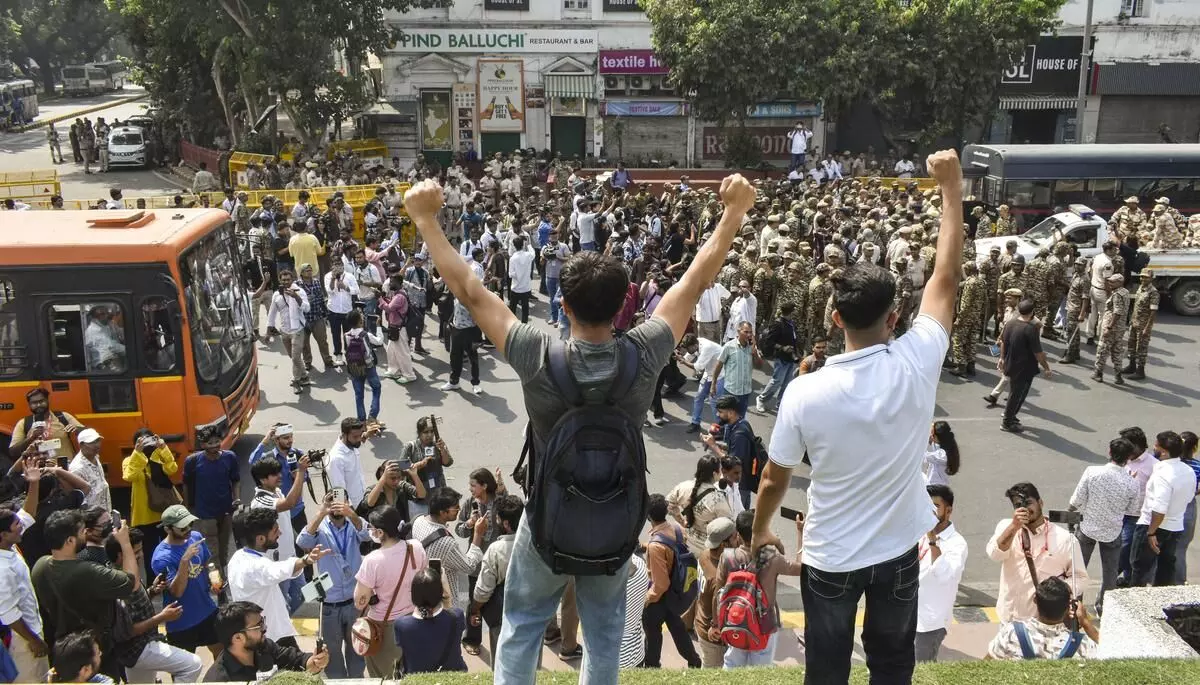
New Delhi, Oct. 10 -- With digital posters, political artwork and advice on how to protect themselves, many protesters who took part in the July demonstration returned to support those joining the Cockroach Janta Party's (CJP) latest stir in Delhi on Saturday, hoping to take part in a protest that unfolded amid heavy security and mass detentions.
Some made posters at home, while others created digital artwork focusing on illegal imprisonment and the absence of name tags on police personnel, while also preparing for scenarios such as a lathi charge.
Those who had experienced the earlier demonstration advised newcomers to carry at least two masks, swimming goggles, raincoats and clothes they would be comfortable getting wet in, anticipating possible police action via their posters
"We had participated in the July protest, so this time we wanted people joining the demonstration to be better prepared. Many of us have also been making political artwork and posters at home for people to carry during the protest," a protester said.
Hardik, who participated in the earlier demonstrations, said he had created digital political artwork ahead of Saturday's protest, focusing on issues such as alleged illegal detentions and police personnel not wearing name tags. He had also prepared for possible scenarios, including a lathi charge.
"As we fight for the freedom we once celebrated in cinema, we remember the tears our nation shed as our forefathers fought an exploitative regime. Today, we carry the torch of non-violence through the dark alleys of fascism once again," he said.
"Most of my friends are women, and given how unsafe it feels today, I will be fighting for them as well. I am sure this protest will continue for a while. I made posters advising people to carry at least two masks, swimming goggles, raincoats and clothes they would be comfortable getting wet in, keeping in mind the possibility of police action," he added.
Hardik had also participated in the protest demanding the resignation of former Union education minister Dharmendra Pradhan and the July 20 march to Parliament.
The July 20 march, called by the CJP against Pradhan over alleged NEET irregularities, saw participation by political leaders, actors and the public, even as authorities tightened security.
The agitation continued for over a month, with protesters dispersing following Pradhan's resignation.
This time, the party called for a demonstration demanding the resignation of Chief Election Commissioner Gyanesh Kumar over allegations of voter-list manipulation during the Special Intensive Revision of electoral rolls and irregularities relating to Form 6, used for voter registration.
But Saturday's planned gathering at Jantar Mantar did not take shape on a large scale. Delhi Police denied permission for the demonstration, citing inadequate notice and concerns over compliance with rules during an earlier protest.
Barricades and a heavy security deployment prevented protesters from reaching the venue, with several detained at different locations.
Around 25,000 police and paramilitary personnel were deployed across the capital, while entry and exit restrictions were imposed at 45 metro stations. Several journalists were also detained, with some alleging they were taken into custody despite displaying their press identity cards.
For protesters returning after July, even finding one another proved difficult, with updates largely circulating through social media.
"Last time, we were stationed at Jantar Mantar and then had to march. This time, there is so much confusion about when and where to come. The only updates we are getting are through tweets and posts. How do we decide when to arrive and where to go? Even if a few of us gather together, we could be detained immediately. But we will continue this fight. We will fight for our democracy," another protester said.
Praveen, another protester, said that even if they cannot gather at one place, they can still make their voices heard. "The posters, art and our presence are our way of showing what we stand for," he said.
"This time around we came prepared with goggles, masks and loose clothes. We learnt our lesson last time," he added. Indian flags and posters bearing slogans such as "Gyanu, it's done bro", "Nagrikta par hamla band karo" and "You can stop us, not democracy" and "My cat shows more accountability than this government" appeared at different locations, carrying messages that protesters had prepared long before reaching the streets.
Although Jantar Mantar remained largely inaccessible to demonstrators, the posters, artwork and advice brought by returning participants offered a glimpse of how the earlier protest had shaped preparations for the next, with those who had been there before trying to ensure that newcomers did not have to face the uncertainty alone.
Published by HT Digital Content Services with permission from Millennium Post.