
Mumbai, July 31 -- Union Minister Pralhad Venkatesh Joshi said the initiative would usher in a new era of clean energy by tapping the vast potential of India's reservoirs and water bodies.
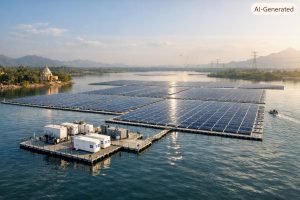
The Union Cabinet, chaired by Prime Minister Narendra Modi, has approved the Pradhan Mantri Surya Sarovar Yojana (PM-SSY), a Rs.50.7 billion scheme to develop floating solar photovoltaic (FSPV) projects integrated with energy storage systems (ESS).
The initiative targets 5,000 MW of floating solar capacity paired with co-located storage of at least two hours (10,000 MWh). Projects will be sanctioned between FY2026-27 and FY2030-31, with financial support disbursed up to FY2032-33.
Union Minister for New and Renewable Energy, Pralhad Venkatesh Joshi, said on the microblogging platform X that PM-SSY would "usher in a new era of clean energy by harnessing the untapped potential of India's reservoirs and water bodies." He added that with a target of 5,000 MW of floating solar capacity and 10,000 MWh of storage and an expected investment of Rs.285 billion, the scheme would strengthen energy security and accelerate the clean-energy transition.
A recent assessment by the National Institute of Solar Energy (NISE) estimates India's floating solar potential at over 102 GWp across reservoirs and inland water bodies, a vast untapped resource that the scheme aims to harness.
Available across all states and union territories, PM-SSY will expand India's floating solar capacity from the current 700 MW to 5,000 MW. The projects will utilise existing reservoirs and industrial ponds, avoiding competition for scarce land while improving grid reliability through integrated storage.
Under the scheme, Central Financial Assistance (CFA) of Rs.10 million per MW will be provided upon successful commissioning, along with up to Rs.5 million per project for feasibility studies covering bathymetry, hydrography, and environmental assessments.
The initiative is expected to cut carbon dioxide emissions by around 10 million tonnes annually and create up to 17,000 full-time equivalent jobs. It will also boost domestic manufacturing of floatation systems, PV modules, and energy-storage components, reinforcing India's clean-energy value chain.
Published by HT Digital Content Services with permission from Infrastructure Today.