
Mumbai, Oct. 27 -- Ahmedabad High Speed Rail model as the national template, lessons from it must be institutionalised to ensure seamless rollout of future corridors, notes Lalit Chandra Trivedi.
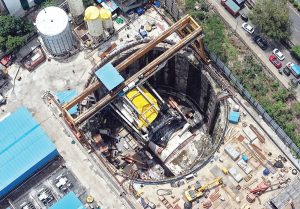
In May this year, I spent several days riding China's high-speed rail (HSR) network. Beijing to Shanghai at 350 kmph, provincial connections timed to the minute, and stations functioning seamlessly like friction-free airports. It was practically impossible not to be awed. But awe is a poor basis for policy. As India's own HSR programme approaches its first revenue service, the crucial question is not "how do we replicate China?" but "what is the Indian model of high-speed rail, and how do we get it right the first time?" That question is no longer academic. The Mumbai-Ahmedabad High Speed Rail (MAHSR) corridor-508 km, 12 stations, designed for 320 kmph operation-has moved decisively from a debated project to an imminent reality. As of mid-2026, well over 300 km of viaduct stand complete, 17 river bridges are finished, overhead electrification masts march along the mainline, and tunnel breakthroughs in Palghar district have de-risked the complex Maharashtra stretches, including the approach to India's first undersea rail tunnel beneath Thane Creek. The Ministry of Railways has confirmed that the first operational section, Surat-Bilimora, is targeted for launch in 2027, with phased commissioning thereafter. After years of scepticism, India's first bullet train looks unmistakably real. MAHSR's strategic significance It is worth pausing on what this corridor actually represents, because public debate has often reduced it to a mere prestige project. It is nothing of the sort. Mumbai-Ahmedabad is arguably the most economically dense 500-km corridor in India: two state capitals of commerce, the diamond and textile economy of Surat, the petrochemical belt of Bharuch-Vadodara, and a string of fast-urbanising towns. A two-hour surface connection between Mumbai and Ahmedabad does more than compete with airlines; it restructures the economic geography of western India. Today, peripheral towns like Boisar, Vapi, and Bilimora will become commutable satellites of Mumbai and Surat. This is the real return on HSR investment; a return that conventional financial appraisals systematically undercount. Equally vital is what the project has done for Indian construction capability. Full-span launching of 40-metre girders at industrial tempo, undersea tunnelling, ballastless track laying on the Japanese-slab system, and the erection of dedicated HSR overhead equipment are capabilities that did not exist in India in 2017. They exist now, embedded within Indian contractors, engineers, and supply chains. Future corridors will be built faster and cheaper because the Mumbai-Ahmedabad corridor was built first. That learning-curve dividend is a permanent national asset.
China's lessons and limits The China study tour reinforced three key lessons and one critical caution. The first is standardisation. China builds essentially one railway, many times over: standard viaduct spans, station templates, trainset families, and maintenance regimes. Costs fell, and delivery accelerated because every subsequent corridor was a repetition, not a reinvention. India must resist treating each future corridor as a bespoke engineering statement. The MAHSR designs-civil, track, power supply, and signalling-should become the refined, non-negotiable national template. The second ponderable is the network effect, as HSR is a network business. A single line, however efficient, only captures city-pair traffic. The economics transform when corridors interconnect, allowing a passenger in Lucknow to reach Ahmedabad with one seamless change. China's ridership exploded not when individual lines opened, but when a grid formed. India's corridor planning must be sequenced with network effects in mind, rather than as disconnected political announcements. Then comes the institutional focus. China Railway operates HSR through dedicated verticals with clear accountability for cost, schedule, and safety. The National High Speed Rail Corp. Ltd (NHSRCL), the implementing agency, has played this role admirably for MAHSR. India must now decide if the entity evolves into the national HSR authority-an owner of standards, repository of learning, and eventual operator and concessionaire-or if each new corridor spawns a new entity. My strong view is the former. Finally, the Chinese HSR model is also a cautionary tale, as it rests on financial foundations India cannot and should not copy. The Chinese network was financed by extraordinary state-directed credit, and a significant share of its secondary lines will never recover their capital. China could absorb this; India, with a tighter fiscal envelope and a consolidating banking system, cannot. India must exercise strict discipline in corridor selection; building where demand density is proven, not where the map looks pleasing. Mumbai-Ahmedabad passes this test emphatically. So, on traffic density evidence, do corridors under detailed project report (DPR) preparation, such as Delhi-Amritsar, Delhi-Ahmedabad, Mumbai-Pune-Hyderabad, Chennai-Bengaluru-Mysuru, and Varanasi-Howrah. However, sequencing must rigorously follow economics, not sentiment.
India's emerging model What is emerging is a distinctively Indian layered model of speed, which deserves more credit than it receives. The HSR will operate at 320 kmph on dedicated, fenced, grade-separated corridors. This begins with MAHSR using Japanese Shinkansen technology, whose six-decade record of zero passenger fatalities remains the gold standard that India was right to choose. Meanwhile, the Vande Bharat trainsets have progressively raised speeds on upgraded conventional corridors. With sleeper variants extending to overnight travel and 180 kmph trials already demonstrated, this tier builds ridership habits, revenue, and manufacturing scale on infrastructure India already owns. The development of indigenous high-speed trainsets-with BEML and Integral Coach Factory (ICF) working toward 280 kmph-class vehicles-signals that India does not intend to remain a technology importer. Here, my years at ICF taught me both optimism and realism: Indian rolling-stock engineering is capable of world-class outcomes, but high-speed traction, bogie dynamics, aerodynamics, and crashworthiness at 300-plus kmph are unforgiving disciplines. Technology partnerships, deep localisation of the supply chain, and patient validation must go hand-in-hand. The success of Make in India should be measured not by the nameplate on the first trainset, but by the depth of the component ecosystem-traction converters, gearboxes, brake systems, fasteners, and slab track-that exists domestically a decade from now.
Project governance template As India adopts the MAHSR model as the national template for upcoming HSR networks, we must deliberately institutionalise the harsh lessons learned from its initial delays. The years lost to fragmented state-level approvals, prolonged legal battles over single land parcels, and delayed utility shifting exposed a fundamental disconnect: we attempted 320 kmph engineering with legacy, slow-moving administrative governance. To prevent these bottlenecks in subsequent corridors, the institutional blueprint must be rewritten. Civil construction contracts should not be awarded until at least 80-90 per cent of land acquisition is legally finalised and statutory clearances are secured. By transforming MAHSR's hard-won experiences into a standardised playbook for inter-agency coordination, fast-tracked dispute resolution, and upfront financial structuring, India can eliminate execution uncertainty and build future networks at an industrial tempo.
Towards a national programme The recent announcement of seven additional HSR corridors marks a decisive shift in India's approach, from delivering a single flagship project to creating a national HSR network. The challenge now is not conceptualisation but disciplined execution. Rather than pursuing all corridors simultaneously, India should adopt a phased programme based on traffic potential, project readiness and financing capacity. A dedicated National HSR Programme Management Office should standardise engineering specifications, procurement documents, contract conditions, signalling architecture, rolling stock, maintenance philosophy and digital project-monitoring systems across all corridors. Land acquisition, statutory clearances and utility shifting should reach predefined milestones before major civil contracts are awarded. Domestic manufacturing capacity for slab track, signalling, traction equipment, rolling stock and specialised construction machinery should be expanded in parallel so that each successive corridor achieves lower costs and faster delivery through learning-curve benefits. A rolling pipeline of projects-not isolated announcements-will provide long-term visibility to contractors, consultants and manufacturers, encouraging investment in specialised capabilities. If executed with this programme-management discipline, the seven new corridors can become the foundation of a self-sustaining Indian HSR ecosystem rather than a series of standalone infrastructure projects.
Critical challenges ahead Five critical issues will determine whether India's HSR story compounds or stalls. For starters, the new operational rulebook must recognise that conventional frameworks-such as the Indian Railway Conference Association (IRCA) books, the General & Subsidiary Rules (G&SR), and the Schedule of Dimensions (SOD) of Indian Railways-will be largely irrelevant to our HSR model. Furthermore, because the signalling systems and rolling stock are fundamentally different-especially as India actively manufactures its own B28 and B35 train sets-the resultant network will be a unique product with its own distinct technological ecosystem. India cannot rely on legacy systems; it must author an entirely fresh, bespoke framework of rules, safety codes, and operational manuals tailored specifically to this native ecosystem. The MAHSR's cost, now approaching Rs.2 trillion, has grown with delays and scope realities. The JICA yen-loan structure-long tenor, concessional rate-has been generous, but a national programme cannot rely solely on sovereign concessional debt. Future corridors require blended structures: multilateral debt, budgetary support, land value capture around stations, and private participation in stations, rolling stock, and operations. Revenue assumptions must be conservative, and non-fare revenue must be engineered into station design from day one, not retrofitted. On the project's completion, addressing the fare and ridership issue will be critical to ensuring its commercial success. HSR fails when priced as a luxury and succeeds when priced as mass mobility. The fare band should sit meaningfully below airfares and close enough to AC rail fares that time savings decide the choice. Frequency matters as much as fare; the Shinkansen's power lies in turn-up-and-go service, and MAHSR must open with a timetable dense enough to make advance planning unnecessary. Furthermore, feeder connectivity-metro, suburban rail, and organised road transport-must be treated as an integral part of the project, not the host city's problem. While the phased opening of Surat-Bilimora is operationally sensible, the marketing challenge of a partial service must not be underestimated; early impressions harden into reputation. Ultimately, HSR is a maintenance business attired as a construction project. Millimetre-level track geometry, disciplined inspection regimes, and a trained cadre-currently being developed at the Vadodara HSR training institute with Japanese collaboration-will matter more to the system's reputation than any inauguration. This maintenance philosophy must be institutionalised before the first passenger boards. The fifth, and the last point, is about regulatory clarity. India needs a settled framework for HSR safety certification independent of the operator, alongside clear rules for how future corridors will be structured-whether in public, public-private partnership (PPP), or hybrid modes. Announcing corridors is easy; establishing the institutional architecture to deliver them at a predictable cost is the harder, more valuable act.
Beyond the awe India won't build HSR the way China did, nor must it ever try that. China built in an era of unconstrained credit and centralised land command. India is building under democratic scrutiny, fiscal discipline, and judicial oversight of land acquisition. That makes India's programme slower to start, but potentially sounder in the finish: every corridor that survives the country's rigorous appraisal gauntlet possesses genuine economics behind it. When the first B28-series trainset accelerates out of Surat in 2027, it will carry more than passengers. It will carry proof that India can execute the most demanding railway engineering on earth, providing the template for the network to come. The task of the next decade is to convert one line into a system, which is standardised, indigenised, soundly financed, and maintained to an uncompromising standard. Awe got us interested in high-speed rail. Discipline will make it ours.
About the author Lalit Chandra Trivedi, CEO, LCT Engineers and former General Manager of Indian Railways, brings over 38 years of expertise across rolling stock, signalling, freight infrastructure, and urban rail. The views expressed here are his own.
Published by HT Digital Content Services with permission from Infrastructure Today.