
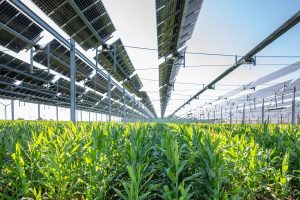
Mumbai, Oct. 22 -- Ministers from multiple states outline plans to accelerate agrivoltaic deployment, enhance farm incomes and attract investment into farm-solar infrastructure at a global meet.
Energy and agriculture ministers from multiple states reaffirmed their commitment to advancing agrivoltaics through policy support, infrastructure development and farmer-centric implementation frameworks at the AgriVoltaics World Conference 2026 on Thursday. During the ministerial track co-organised by the International Institute for Sustainable Development (IISD) and the Council on Energy, Environment and Water (CEEW), ministers from Odisha, Madhya Pradesh, Uttar Pradesh, Rajasthan and Bihar outlined strategies to scale agrivoltaic deployment, enhance farm incomes and attract investment into dual-use land and solar infrastructure.
Arvind Kumar Sharma, Minister of Energy, Uttar Pradesh, highlighted the state's extensive agricultural base, diverse cropping patterns and expanding renewable energy infrastructure as key strengths for agrivoltaic deployment. He said generating solar power alongside agricultural activity could optimise land use while creating an additional income stream for farmers.
Sharma also pointed to Uttar Pradesh's investments in rooftop solar and grid infrastructure, noting that Green Energy Corridor-III would strengthen renewable power evacuation. Emphasising the need for financing models suited to small and marginal farmers, who account for nearly 80 per cent of agricultural holdings in the state, he invited investors to participate in the emerging opportunity.
"The potential for agrivoltaics is enormous. Those who wish to be associated with agrivoltaics need to look towards Uttar Pradesh," he said, while assuring industry participants of support for grid connectivity and power evacuation.
Surya Pratap Shahi, Minister of Agriculture, Uttar Pradesh, highlighted plans to solarise all 1.6 million agricultural tubewells whose electricity bills have been waived, supported by dedicated grid infrastructure. He stressed the importance of protecting farmers' land ownership rights and called for structured training programmes on crop selection and agrivoltaic practices through Krishi Vigyan Kendras, agricultural universities and technical institutions.
"The agriculture of Uttar Pradesh and its farmers are, in a way, the lifeblood of our economic system," he said.
Rakesh Shukla, Minister of New and Renewable Energy, Madhya Pradesh, highlighted the state's progress in agrivoltaics, solar energy and battery storage under its farmer welfare agenda. He said cultivation beneath solar panels had already commenced at select locations, while the tendering process for battery storage projects had been completed.
"In the agricultural sector, we have some plants where farming takes place beneath solar panels. Such projects have begun at a few locations in Madhya Pradesh, and we are continuously progressing in this direction, including in battery storage, for which we have also completed the tendering process," he said.
Policy and Investment Push
Shailesh Kumar Mandal, Minister of Energy, Bihar, outlined efforts to strengthen agricultural electricity infrastructure through feeder separation and solarisation. He said the state had advanced work on about 2,700 agricultural feeders and received government approval for financial support towards their solarisation.
Vijay Kumar Sinha, Minister of Agriculture, Bihar, described agrivoltaics as an opportunity to increase farm incomes, encourage crop diversification and create employment in rural areas. He emphasised the need for stronger collaboration between agricultural institutions, financial organisations and energy companies to expand research, awareness and farmer training.
Kanak Vardhan Singh Deo, Deputy Chief Minister of Odisha, announced that the state is finalising its dedicated Agrivoltaics Policy 2026 with a target of developing 1 GW of agrivoltaic capacity by 2030. The proposed policy will require at least 90 per cent of project sites to remain cultivable while safeguarding farmer consent and crop insurance provisions. Farmers will be allowed to either own projects or lease their land while continuing agricultural activity.
To attract investment, Odisha plans to offer 25-year power purchase agreements through Grid Corp. of Odisha Ltd (GRIDCO), along with grid connectivity support and investment incentives. "It gives investors certainty: 25 years of PPA with GRIDCO, an offtake guarantee, grid connectivity and the freedom of open access and competitive use," Singh Deo said.
Conference discussions also focused on innovative land-use models, state-level incentives and adaptations of the PM-KUSUM scheme to local agricultural conditions. Participants highlighted the growing role of state governments in creating policy frameworks capable of attracting agrivoltaic investment while balancing energy generation and agricultural productivity.
Published by HT Digital Content Services with permission from Infrastructure Today.