
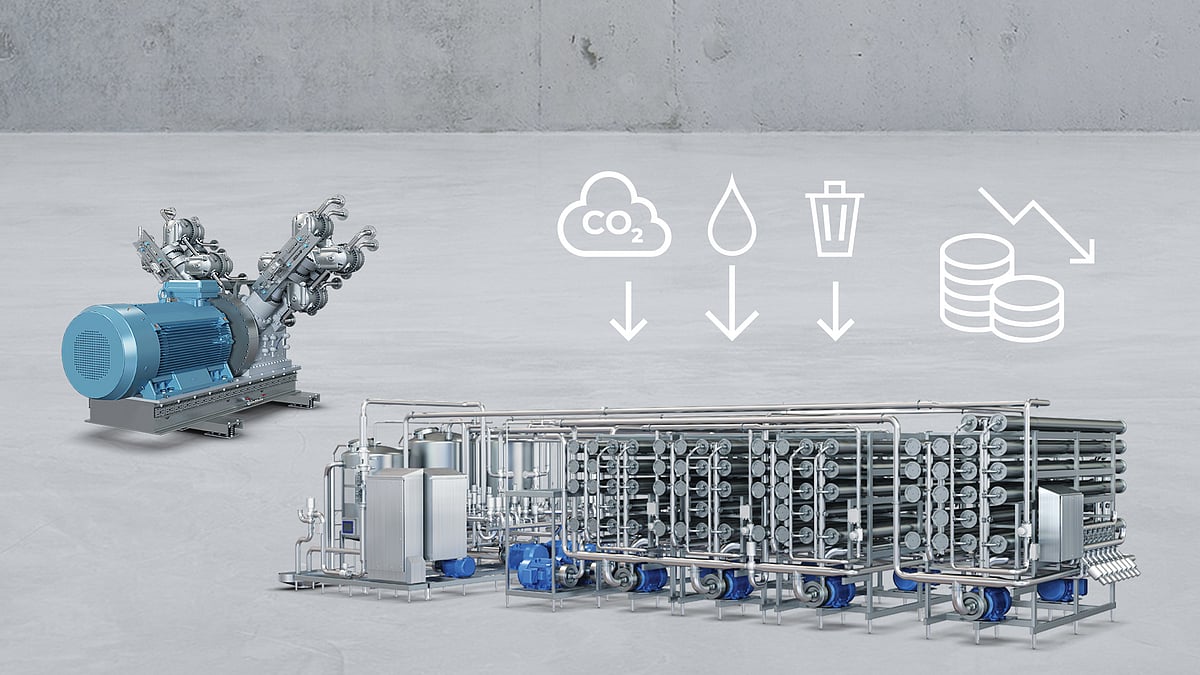
India, April 7 -- Modernizing existing dairy processing equipment can reduce greenhouse gas emissions by 40-49%[1], depending on the type of line, according to a new study by Tetra Pak. Importantly, these reductions dont necessarily require a full-line overhaul and use solutions that are currently on the market. The study also examined how improving existing equipment lines can lead to substantial cuts in emissions, product losses, and operating costs.
The new Dairy Processing Impact Assessment, independently reviewed by the Carbon Trust, uses a methodology aligned with leading international avoided emissions frameworks.[2] It quantifies the gains available from upgrading existing liquid dairy processing lines.[3] The study compares 2019 best-practice lines with potential emissions savings based on a modelled global roll-out of upgraded lines in 2025.
The global dairy sector plays a critical role in global food systems through the food and beverages it provides and the livelihoods it supports worldwide. At the same time, it is a significant user of water and energy and was responsible for 2.7% of global greenhouse gas (GHG) emissions in 2023.[4] Yet this context also opens the door to a significant opportunity. By optimising existing processing lines with solutions already available on the market, producers can enhance efficiency, reduce costs, and strengthen environmental performance without waiting for new technologies or undertaking full line replacements. These proven improvements offer a practical, immediate pathway to more resilient, resourceefficient dairy operations.
The study shows that modernising existing equipment delivers substantial efficiency gains, with average reductions of 47% in greenhouse gas emissions, 45% in water use, and 57% in product losses .[5] If these modernisations were implemented across global dairy production, this could lead to potential global carbon savings of up to 12.7 MtCOe or taking three million cars off the road.[6] Implementing water saving and recovery solutions, such as advanced filtration and cleaning in place (CIP) systems, could reduce water use in dairy production lines by up to 455 million m a year globally.
Rodrigo Godoi, vice president, Processing Portfolio Management at Tetra Pak, comments, For many dairy producers, improving efficiency while managing costs is a daily challenge. Our study shows that practical improvements to existing lines can reduce energy, water, and product loss, helping customers strengthen performance and lower total cost of ownership without major disruption.
And with supportive policy frameworks and access to targeted financial incentives, these improvements can be scaled even further, helping producers overcome upfront investment barriers and accelerating progress across the dairy sector.
The assessment findings underline the contribution that improvements to existing processing lines can make to more stable and resilient food systems. These reductions can be supported by Tetra Pak through a suite of marketavailable upgrades to existing lines, including:
Electrically powered heat pumps, replacing or reducing the use of fossil fuel-based energy in boilers and chillers, with the goal of lowering fuel consumption and reducing heatrelated emissions. [7]
Integrated process efficiency, enabled by OneStep Technology for UHT milk and yoghurt, combining multiple process steps into a single, more efficient concept, delivering electricity and steam savings.[8]
Filtration and recovery solutions, including membrane filtration, cleaning in place (CIP) recovery, and water filtering stations that recover product loss and water from process and cleaning streams.[9]
Veronika Thieme, associate director Europe at the Carbon Trust, comments, Our food systems offer significant decarbonization opportunities. Assessing avoided emissions is a powerful way to understand the carbon savings these solutions can deliver. By quantifying the avoided emissions from new solutions that can help the agricultural industry cut emissions, we create the evidence base needed to scale them.
Published by HT Digital Content Services with permission from FoodTechBiz.