
India, April 30 -- One spice manufacturer spent three months troubleshooting a batch consistency problem. Every masala blend passed sieve analysis. Every ingredient was within specification. The issue turned out to be the blender not a faulty machine, but the wrong machine for a formulation that included a hygroscopic binding agent. Switching to a paddle blender resolved the problem in the first trial run. Three months of rework, three months of elevated customer complaint rates, three months of wasted product none of it necessary if the blender selection had matched the formulation from the start.
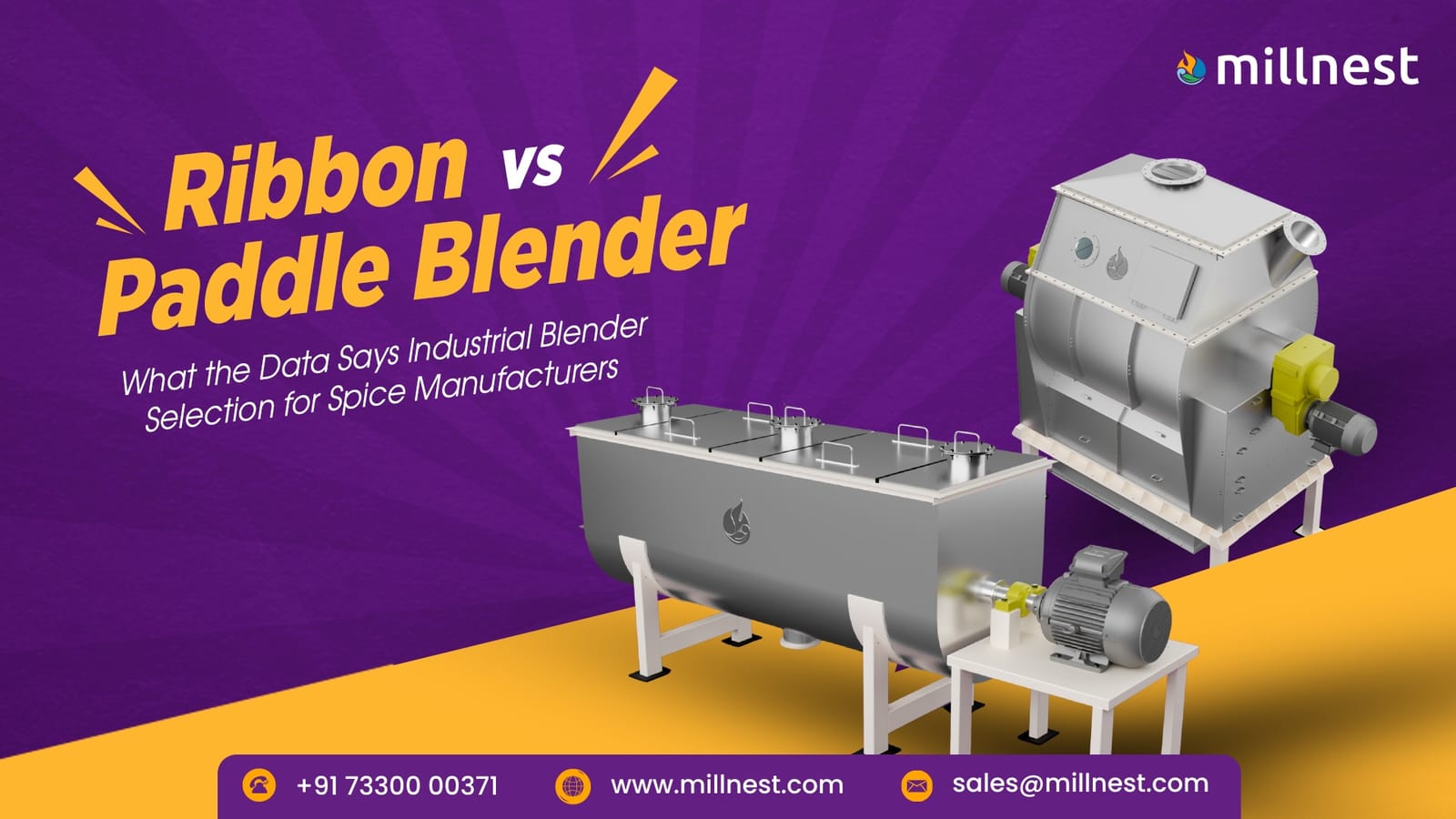
The ribbon blender and the paddle blender are the two dominant industrial blending machines in spice and food processing. Both are food-grade. Both handle dry powders. Both are available in capacities from 50 litres to several thousand litres. On paper, they look interchangeable. In practice, they are not and the difference between them shows up in your batch uniformity data, your cleaning cycle log, and ultimately your customer rejection rate.
This article gives you the data to make that call correctly. We cover how each machine works, where the performance differences actually show up in measurable terms, and an application matrix that maps specific spice and masala product types to the blender that handles them better.
What is a ribbon blender?
A ribbon blender consists of a U-shaped horizontal trough containing a central shaft fitted with a double-helix ribbon assembly. The outer ribbon moves material inward along the trough; the inner ribbon simultaneously moves material outward. This counter-flow action creates a continuous, aggressive mixing pattern that achieves homogeneity quickly across large batch volumes.
The ribbon blender is the most common masala mixing machine in commercial spice processing for a straightforward reason: it handles free-flowing dry powders exceptionally well, moves large volumes efficiently, and its operating principles are well understood at every level of a production team. For commodity masala blends mixed dry powders at consistent particle sizes, no sticky or fragile components it delivers repeatable, high-throughput results with a predictable maintenance profile.
Counter-flow dual-helix aggressive, high-volume
Mixing action: outer + inner ribbon counter-flow
Best for: free-flowing dry powders, multi-component blends
Batch time: typically 1020 min for dry powders
Fill level: 6075% of vessel volume for optimal mixing
Cleaning: moderate ribbon geometry is accessible but thorough
Liquid additions: possible with spray nozzle option
Capital cost: lower for equivalent volume
Angled lift-and-fold gentle, precision mixing
Mixing action: angled paddles lift, fold, and tumble
Best for: sticky, fragile, hygroscopic, semi-solid ingredients
Batch time: 1525 min (longer for challenging formulations)
Fill level: 4070% of vessel volume
Cleaning: faster better internal access, fewer dead zones
Liquid additions: handles mid-blend liquid addition effectively
Capital cost: moderate premium at equivalent volume
What is a paddle blender?
A paddle blender uses a series of strategically angled paddles mounted on a horizontal shaft inside a W-shaped or U-shaped trough. Rather than the ribbon's aggressive counter-flow, the paddles lift material, fold it back through the mixing zone, and allow it to tumble gently a low-shear action that maintains ingredient integrity while still achieving homogeneity.
The paddle blender earns its place in spice processing when the formulation includes ingredients that the ribbon blender damages or segregates. Sticky components, hygroscopic powders, semi-solid masala bases, fragile encapsulated flavour granules, sugar-coated seasoning particles all of these behave better under a paddle blender's gentler action. The angled paddle geometry also eliminates the dead zones that can form at the corners and end walls of a ribbon blender when loading geometry is not carefully managed.
The benchmark data: where the differences show up
Abstract comparisons between blending mechanisms are less useful than performance data. Here are four benchmarks that procurement heads and plant managers should evaluate when making an industrial blender selection for spice applications.
Batch uniformity
For standard dry powder blends free-flowing mixed masala powders at consistent particle sizes both machines achieve acceptable RSD (relative standard deviation) values. The ribbon blender edges slightly ahead for pure dry powder applications because its aggressive counter-flow produces thorough mixing faster. The gap is small enough that for most commodity masala applications, either machine passes specification.
The significant divergence appears with sticky or hygroscopic formulations. When ingredients like amchur powder, dried mango-based acidulants, certain salt types, or any semi-hygroscopic binding component are in the blend, the ribbon blender's counter-flow action can create localised adhesion zones areas where sticky material accumulates on the ribbon surface and the trough wall rather than continuing to mix. RSD values in these blends can climb to 46%, putting batches outside specification. The paddle blender's gentler tumbling action keeps material moving without the same adhesion risk, maintaining RSD values in the 22.5% range for the same formulation.
Shear sensitivity and ingredient integrity
Shear is the force that tears or deforms particles during mixing. For most dry spice powders, shear from a ribbon blender is not a problem. The issue arises with specific ingredient types that appear in premium and speciality masala applications: encapsulated flavour compounds, coated seasoning particles, freeze-dried vegetable pieces, and certain nutraceutical ingredients are all sensitive to the shear forces generated by the ribbon's inner and outer helix running in counter-flow.
As a practical threshold: if any ingredient in your formulation has a coating or encapsulation layer thinner than approximately 50 microns, or if any particulate ingredient has a target visual integrity specification (visible chilli flakes, dried herb pieces, whole spice fragments), the paddle blender is the safer choice. The ribbon blender will fracture coatings and reduce fragile particles to fines at a measurably higher rate adding to your out-of-spec loss and potentially affecting the organoleptic properties of the final product.
The ribbon blender uses less energy per tonne of blended product for standard dry applications approximately 3.2 kWh/tonne compared to the paddle blender's 4.1 kWh/tonne under comparable conditions. This difference reflects the ribbon's more efficient mechanical action for free-flowing materials: it achieves homogeneity in fewer minutes per batch, which means the motor runs for a shorter total time per tonne produced.
This advantage narrows when the ribbon blender is applied to formulations it is not suited for. A ribbon blender running a sticky masala blend at suboptimal uniformity requires extended mixing time to reach specification or never reaches it, resulting in rework. The apparent energy saving disappears when you account for the additional motor run time, the rework energy, and the associated labour cost. The energy comparison is only meaningful when both machines are assessed on blends they are matched to handle.
Cleaning cycle time is the metric that most frequently surprises plant managers during the first year of operation. The ribbon blender's inner and outer helix assembly creates more surface area and more geometry complexity than the paddle configuration. In a multi-SKU production environment particularly plants producing five or more masala variants per shift the cumulative cleaning time across a week's operation is a significant operational cost that rarely appears in the original equipment comparison.
Benchmarks from food processing plants indicate an average cleaning cycle of 4560 minutes for a ribbon blender following a sticky or oily masala blend, compared to 3040 minutes for a comparable paddle blender. Over a 5-day week with two cleaning cycles per day, that gap represents 1.53.5 additional hours per week spent on cleaning time that is unavailable for production.
Application matrix: product type recommended blender
The table below maps common spice processing and masala product categories to the recommended blender type, with the primary reason for the recommendation. Use this as an initial filter your specific formulation, batch volume, and production frequency may shift the answer.
The application matrix is a starting point, not a final answer. The ingredient that changes everything is usually the one that is not in the name of the product a binder, a flow agent, a coating and it is that ingredient's behaviour under shear that determines which blender you actually need.
The cost of the wrong selection
Industrial blender selection errors are not always visible on day one. A ribbon blender running a mildly hygroscopic blend may produce acceptable batches initially particularly if the ambient humidity is low. The problem emerges gradually: cleaning cycles lengthen as adhesion builds up on the ribbon and trough surfaces, RSD values creep upward as the batch mixing pattern becomes less consistent, and eventually a buyer flags a quality issue.
Rework cost
Batches running outside RSD specification require re-blending adding motor run time, labour, and delay into the production schedule. At 35 batches per week, this compounds quickly.
Buyer rejection
Uniformity failures in masala products can reach buyers as inconsistent flavour intensity across packs. Once a buyer raises this, regaining confidence requires consistent corrective evidence over multiple shipments.
Extended cleaning
A mismatched blender running sticky formulations accumulates surface buildup faster than expected. Additional cleaning time per cycle reduces daily production capacity and increases CIP chemical consumption.
Accelerated wear
Running a ribbon blender against its design limits with sticky, abrasive, or semi-solid ingredients accelerates ribbon and shaft wear. Replacement cycles shorten and downtime for repair increases.
The right industrial blender selection is not the one with the lower invoice. It is the one whose performance profile matches what your specific product formulations actually require from the blending step.
What to do if your plant runs both product types
Many spice manufacturers run both free-flowing commodity blends and formulation-sensitive premium blends. The temptation is to find a single machine that handles both adequately. In most cases, adequately is not the right standard and a two-blender configuration, where each machine is correctly matched to its product category, is a better investment than one machine running at suboptimal performance across all product types.
For plants where capital budget constrains this approach, the sequencing question becomes important: which machine do you buy first? If your highest-volume product is a free-flowing commodity masala, the ribbon blender is the right primary purchase it handles the volume work efficiently, and the paddle blender follows when premium or formulation-sensitive SKUs reach sufficient scale to justify the investment. If your margin product is a premium masala with shear-sensitive or sticky components, buy the paddle blender first and manage the commodity range within its capability until volume justifies the ribbon.
Ready to choose the right equipment for your process?
Visit MillNest to explore our range of food-grade processing solutions designed for performance and consistency. If youre unsure which equipment best fits your application, our team is here to help. Get in touch with us for practical guidance and recommendations tailored to your production needs.
Published by HT Digital Content Services with permission from FoodTechBiz.