
India, Nov. 18 -- As the food and beverage industry navigates increasing production complexity, rising cost pressures and evolving sustainability requirements, technology is playing a pivotal role in shaping the future of food manufacturing. From intelligent automation and artificial intelligence (AI) to resource-efficient processing and integrated production lines, manufacturers are increasingly looking for solutions that deliver measurable operational benefits while maintaining product quality, safety and efficiency.
Scheduled to take place from 23 to 26 February 2027 in Cologne, Germany, Anuga FoodTec 2027 aims to bring these technological developments into focus, providing a platform for the global food and beverage industry to explore emerging technologies, evaluate integrated solutions and understand how innovations can be applied to real-world production challenges. With its new identity and the guiding theme, Navigate Complexity. Smart. Safe. Sustainable., the event seeks to help industry professionals navigate the changing demands of food manufacturing.
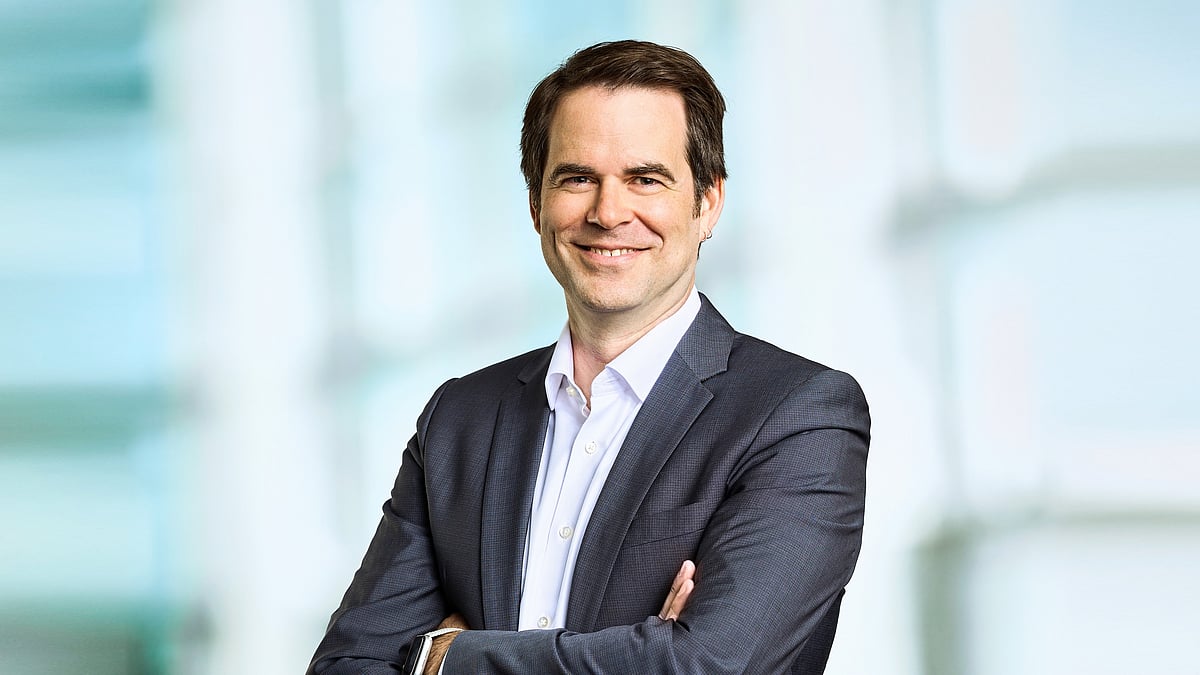
In this exclusive interview with FoodTechBiz, Roland Thiemann, Director, Anuga FoodTec, discusses the changing priorities of food manufacturers, the growing importance of connected production systems, the practical applications of AI and automation, and how sustainability can be integrated into industrial processes. He also shares what visitors can expect from the 2027 edition and why looking at the entire production line is becoming increasingly important for investment decisions.
FTB - Since taking on this role, what has surprised you most about how the food and beverage industry is changing?
Roland Thiemann: What stands out most to me is how closely interconnected the tasks in production have become. Production lines have to respond to new requirements without losing process stability. At the same time, there is growing pressure to use resources more efficiently. These challenges cannot be solved independently of each other.
This also changes how we look at innovation. A new technology doesnt just have to convince on its own merits. It has to fit into operations and be economically viable. This connection between technical performance and industrial feasibility is moving more and more into focus. For Anuga FoodTec, that means we must not only show developments, but also make their context understandable.
FTB - Anuga FoodTec has a new identity. Whats the bigger idea behind this change, and what can visitors expect to see differently?
Roland Thiemann: Our aim is to make Anuga FoodTec visible as the platform for the technological transformation of the food and beverage industry. Anyone coming to Cologne should not just get a market overview. The goal is to be able to assess solutions for their own production and prepare the next steps.
The theme Navigate Complexity. Smart. Safe. Sustainable. sums up this aim. We show how complex production requirements can be mastered technically.
Trade visitors will experience this in practice in the new Community Hubs SMART and SUSTAINABLE. There, it doesnt stop at a presentation. Visitors own production questions can become the starting point for a discussion. The SMART Hub is about intelligent production systems, while the SUSTAINABLE Hub goes deeper into the technical implementation of resource efficient production. In this way, we complement what can be seen in the exhibition halls with a direct professional exchange.
FTB - What are the biggest challenges food manufacturers are dealing with today, and where can technology make a real difference?
Roland Thiemann: Companies have to invest, while cost pressure grows alongside higher regulatory requirements. New product concepts are expected to reach production faster, yet the lines must continue to run reliably. That is a demanding starting point.
Technology can help when it addresses a concrete operational problem. Connected process controls, for example, make it visible where deviations occur. On that basis, processes can be optimized in a more targeted way. Another approach is better use of energy, for instance through heat recovery.
The decisive question remains: what actually improves in operations? A solution is not worthwhile simply because it is new. It has to support the specific production task and be technically and economically viable.
FTB - Everyone is talking about AI and automation. Where are you seeing them deliver real results on the factory floor?
Roland Thiemann: The benefit becomes very noticeable in quality control. AI supported statistical process control can help detect deviations early and make production data usable for control. Predictive maintenance builds on the same idea: changes in equipment behavior are analyzed so that maintenance can be planned better and downtime reduced.
Automation also takes over clearly defined production tasks. Among the winners of the International FoodTec Award 2027, for example, is the Skewer System 2040 from MIVEG GmbH for automated skewer production. That is a concrete application, not an abstract promise of the future.
With AI, however, one requirement remains crucial: the data must be reliable. This calls for suitable interfaces and the process knowledge of the experts. AI does not replace that knowledge. It helps to connect it with the information from ongoing production. AI and connectivity open up new possibilities for production, but they also raise the requirements for cyber security.
FTB - How can manufacturers make their production and packaging more sustainable without compromising product quality or safety?
Roland Thiemann: By looking at sustainability within the specific process. Heat recovery can make existing energy usable again. Reusing water across successive process steps can also reduce fresh water demand. Such approaches must, however, be aligned with the requirements for hygiene and process safety. Lower consumption alone is not a sufficient yardstick.
The same applies to packaging. Recyclability is important, but a package must still protect the food. Its effect on shelf life is therefore a direct part of the assessment. If food losses are avoided, that is also a contribution to sustainability.
So the packaged product and its production process have to be considered together. This is exactly the connection Anuga FoodTec takes up. In the SUSTAINABLE Community Hub, technical approaches that combine resource efficiency with the demands of industrial production will be discussed.
FTB- Why should manufacturers look at the entire production line rather than investing in processing or packaging equipment separately?
Roland Thiemann: Because the performance of a single machine says nothing yet about how well it works within the entire line. What matters are the interfaces to the upstream and downstream processes. This applies to material flow as much as to digital connectivity.
Let me pick up the thought on packaging once more: its suitability cannot be judged by the material alone. It must also fit the filling process and the requirements of the product. Anyone who considers these connections only after an investment has left out an essential part of the assessment.
At Anuga FoodTec, connected process sections can be compared directly. Trade visitors can talk with suppliers about line integration and clarify open questions on scalability. The point is not to replace an entire line as a matter of principle. Even a single investment should be assessed in the context of the existing production system.
FTB - Looking ahead to 2027, what new technologies or trends are you most excited to see at Anuga FoodTec?
Roland Thiemann: I am particularly interested in developments that solve a concrete production task in a new way. The International FoodTec Award 2027 already provides great examples. A total of 21 innovation projects were honored, including five with Gold.
One of them is AddCool from GEA Process Engineering and Arla Foods Amba Akafa. The high temperature heat pump was integrated into an industrial spray dryer at a dairy. It shows clearly how a technical development directly addresses an existing production process.
The 3D MassFormer from Revo Foods opens up a very different field. It uses extrusion to create new food textures. Such developments show that innovation can change both the process and the product itself.
I find this range exciting. It gives trade visitors the chance to look beyond familiar solutions and to examine new approaches for their relevance to their own operations.
FTB - For someone planning to attend Anuga FoodTec 2027, what would you say are the key reasons to visit, and how can they make the most of their time at the show?
Roland Thiemann: The decisive advantage is the direct comparison. From February 23 to 26, 2027, trade visitors in Cologne can see machines in live operation and discuss technical requirements directly with the suppliers. They will not only see solutions from their own production area. A look into other branches of the food and beverage industry can also open up new approaches.
My advice would therefore be: bring a concrete production question with you. Select suitable companies in advance and plan in additional expert sessions. But also leave time for an approach you didnt have on your radar yet.
The Innovation Stage helps with professional context. In the Community Hubs, questions can then be explored in more depth in exchange with experts. And the Guided Tours lead to selected applications in the exhibition halls. This turns a trade fair visit into more than a series of individual appointments: the impressions can be transferred to your own investment planning.
From innovation to industrial transformation
As food manufacturing becomes increasingly interconnected, the ability to evaluate technologies beyond individual machines will be critical to making informed investment decisions. From AI-enabled quality control and predictive maintenance to energy recovery, sustainable packaging and integrated production systems, the focus is shifting towards solutions that deliver tangible benefits across the manufacturing process.
With its renewed identity, dedicated SMART and SUSTAINABLE Community Hubs, Innovation Stage and Guided Tours, Anuga FoodTec 2027 aims to provide industry professionals with opportunities to explore these developments and engage directly with technology providers and experts.
As Roland Thiemann emphasises, the real value of innovation lies not simply in introducing new technologies, but in understanding how they fit into existing operations and address specific production challenges. For manufacturers looking to improve efficiency, strengthen sustainability and prepare their facilities for future demands, Anuga FoodTec 2027 will offer an opportunity to assess these possibilities first-hand.
For more information, please visit - International trade fair for food technology | Anuga FoodTec
Published by HT Digital Content Services with permission from FoodTechBiz.