
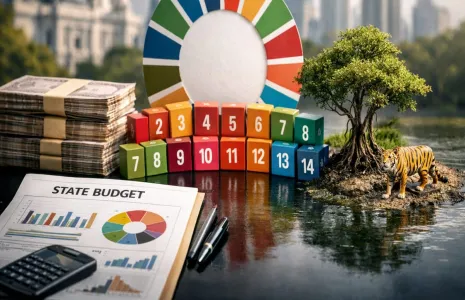
Mumbai, June 30 -- West Bengal has linked nearly Rs 3.01 trillion (tn) to the United Nations sustainable development goals, equal to about 69 per cent of a state budget of Rs 4.38 tn. The budget document presents the exercise as the state's first effort to align fiscal commitments with the UN 2030 Agenda and to embed the goals into governance. Environmental sustainability is highlighted with emphasis on the Sundarbans and ecosystem restoration.
Highest allocation is linked to SDG 10 on reducing inequalities, at about Rs 530 billion (bn). Other major allocations address poverty, economic growth and education, at about Rs 314.08 bn, Rs 285.49 bn and Rs 283.5 bn respectively. A finance department official said the SDG budget work began under the previous administration and was completed with support from the new finance minister.
Budget documents indicate a shift in Sundarbans policy towards waterways and pontoon based jetties rather than bridge led connectivity, with an allocation of Rs 1 bn for related infrastructure. Promotion of solar operated boats is planned and initial work on the Gangasagar bridge has been cleared. Two delta projects are listed for multilateral funding at estimated costs of Rs 13.53 bn and Rs 41 bn.
Climate finance proposals include a West Bengal Climate Resilient Fund and a West Bengal Climate Finance Facility, with a proposed Rs 2 bn allocation to mobilise finance and support projects. The budget links carbon credit mechanisms to potential revenue for the State Action Plan on Climate Change. Analysts welcomed the climate focus while urging robust governance for delivery.
Energy plans aim to meet demand, currently 13 gigawatts (GW) and projected to reach 16 GW in two years and 27 GW by 2035, through new thermal capacity and a floating solar project at Bakreshwar Dam estimated at Rs 20 bn. The plan targets 200,000 rooftop solar installations and notes gaps in environment allocations.
Published by HT Digital Content Services with permission from Construction World.