
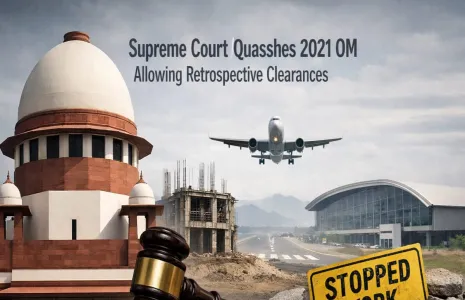
Mumbai, Aug. 3 -- The Supreme Court quashed the 2021 Office Memorandum allowing retrospective environmental clearances for projects commenced without approval. A bench of Chief Justice Surya Kant and Justices Joymalya Bagchi and Vipul M Pancholi delivered a unanimous verdict applying prospectively to protect projects that had already received retrospective clearances from demolition and punitive measures. The court cited examples such as an AIIMS in Odisha, a greenfield airport in Vijayanagar in Karnataka and several common effluent treatment plants central to pollution control.
The court held that post-facto clearances cannot be granted by an administrative office memorandum and must be issued through valid statutory notifications under Section three of the Environment (Protection) Act, 1986. The bench found that the 2021 memorandum established a perpetual amnesty regime, altered the nature of enquiry and the criteria under the 2006 notification, and effectively supplanted dedicated legislation by administrative instruction which was impermissible in law. It concluded the memorandum failed tests of proportionality and reasonableness and violated Article 14 and Article 21 of the Constitution.
The quashing of the memorandum was declared to have prospective effect and the court directed that no further applications under the 2017 notification and the 2021 memorandum should be entertained. The Central government was restrained from issuing future administrative orders to grant post-facto clearances except by way of a valid notification under Section three of the Environment (Protection) Act. The bench clarified that its directions would not fetter the court's power under Article 142 to pass orders necessary to do complete justice in appropriate cases.
The matter had drawn fresh hearings after a sequence of earlier rulings, including a 2025 decision that barred retrospective clearances and a subsequent majority order later in 2025 that permitted them on payment of heavy penalties. The earlier majority had observed that otherwise thousands of crore rupees and vital projects funded at nearly Rs 200 bn from the public exchequer would be lost, prompting a rehearing and the present judgment.
Published by HT Digital Content Services with permission from Construction World.