
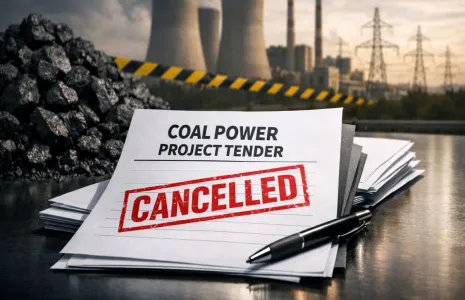
Mumbai, June 29 -- The Rajasthan government has withdrawn a tender for long-term power procurement from a proposed 3,200 Megawatt (MW) coal-based power plant after an order issued on June 11 by Rajasthan Urja Vikas and IT Services Ltd (RUVITL). The tender had been floated under the Design, Build, Finance, Own and Operate (DBFOO) model and was intended to meet the state's future electricity requirements. Officials said the action was aimed at avoiding costs associated with surplus generation capacity. The government said it was mindful of the risks of locking in long-term fossil fuel assets.
Capacity concerns had been raised by experts and consumer groups, who questioned the need for additional thermal capacity. The Central Electricity Authority's Resource Adequacy Plan indicated that Rajasthan's projected power demand could be met without adding another 3,200 MW coal-fired plant during the planning period. The Rajasthan Electricity Regulatory Commission had asked RUVITL to justify the requirement for the proposed capacity addition and imposed conditions on the project. The regulator's conditions sought clearer demand forecasts and procurement rationale.
The tender was originally issued in December 2024 and had undergone multiple extensions before being scrapped. Industry observers said the withdrawal reflected growing confidence in Rajasthan's expanding renewable energy capacity and in the increasing deployment of battery energy storage systems (BESS). They added that improved access to interstate power supplies was also a factor reducing the need for new coal-based generation. Analysts said the change would accelerate investment in grid flexibility.
The decision is likely to influence future procurement strategies as regulators and policymakers reassess capacity planning and system flexibility. Stakeholders will monitor grid reliability and storage integration while balancing affordability and energy security. RUVITL and state authorities are expected to focus on flexible contracting, integration of renewables and storage assets, and measures to ensure adequate supply during peak demand periods.
Published by HT Digital Content Services with permission from Construction World.